
Adam Cardone / Queens, NY
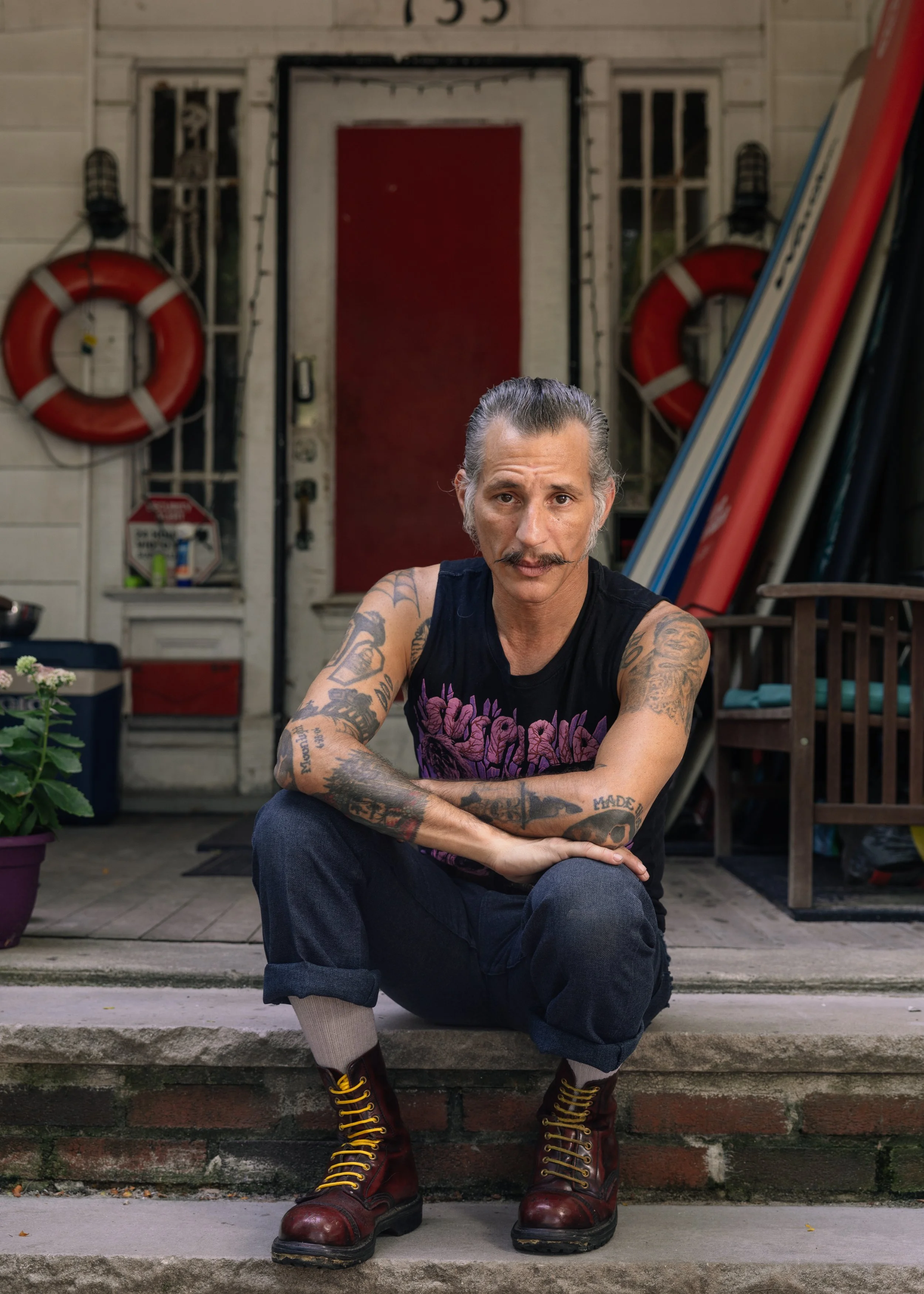
My surroundings were filled with things like Santa Claus is real, the Tooth Fairy is real, Jesus is real, Mary is real. These were all real. They were all in the same pool. I began noticing things in church. My naturally curious brain was starting to question things. What was this story? What do you mean he came back from the dead? Noah’s Ark? Really? My bullshit radar was already going off.
As I got older, I began looking into occult movements. They were there as an alternative. But as soon as I started looking at occult material, I noticed it was the same as the Christian stuff. It was exactly the same value system wearing a different costume.
That’s when everything started coming together. I realized I didn’t believe in God or deities. I was definitely wired that way, and I noticed that everybody else seemed to believe in them.
So then I bought The Satanic Bible.
I read it pretty quickly, and it wasn’t a spiritual awakening. It was something very specific, and you’ll hear the same thing from other people, not just me.
The guy who wrote The Satanic Bible said the book was simply describing a certain kind of person. You might be one of those people. I definitely was one of them.
Not only that, but everything in the book was something I was already doing. It wasn’t that I read it and thought, “Oh, I want to do that.” It was more like, “I’m already doing this, and he’s just organized it a little.”
Then came the big realization. I started noticing similarities between the book, the magic trick books I’d been reading, the psychology I’d been studying, and my interest in theater. Everything started coming together.
I won’t call it a conversion. I won’t call it an awakening, either, because I was already awake. I had just failed to notice a few details that made everything fit together.
Discovering The Satanic Bible was like discovering a work of art. I don’t mean just the writing, but the book itself. The author deliberately used certain things to make people angry. He knew what he was doing.
The book opened me up to his sources and how he had arrived at those ideas. That’s the real gem.
-
So, what’s the question? The faith question?
Yes.
I would say my version of a conversion didn’t happen as a faith flip. It was more about growing up Italian Catholic.
My surroundings were filled with things like Santa Claus is real, the Tooth Fairy is real, Jesus is real, Mary is real. These were all real. They were all in the same pool.
Then, as I got older, the Tooth Fairy disappeared. Santa Claus disappeared. Jesus didn’t disappear.
Up until I was maybe seven or eight years old, I started noticing something else. I began reading magic trick books, specifically one called Spooky Tricks. I mention this because it’s a very specific book. The magic tricks involved a little ghost or a haunted house as the agency behind the trick. It wasn’t just magic tricks. They were spooky tricks.
I started reading that book, and at the same time, I began noticing things in church. My naturally curious brain was starting to question things. What was this story? What do you mean he came back from the dead? Noah’s Ark? Really?
I watched grown adults accept these stories without questioning them or even saying, “It’s just a story.” No, they were saying it was real.
My bullshit radar was already going off.
At the same time, I was learning magic tricks and studying human psychology. I also wasn’t doing well in certain subjects at school. I was put into special education because I had a math learning disability. I actually rode, the politically incorrect “retard bus”. Because I rode the retard bus I had to get out in front of all the kids and walk into school.
All of this was going on, and I started noticing that I was having an inner dialogue. I was talking to myself. I was thinking. I didn’t have anybody to talk to about what I was thinking.
You’re watching your whole family go through the motions of these fantasy things, and you don’t have anybody to ask about them. I knew I wasn’t going to get an answer. I remember asking questions in Sunday school and being told not to ask that.
As all of this developed, my brain was expanding. I was talking to myself, and I realized that God was me. God was my subconscious. It was my inner dialogue. I could project it outward if I wanted to, but I didn’t have to. I could accept that these were simply my inner thoughts and the things I naturally wanted to do.
I was starting to piece it all together.
As I got older, I began looking into occult movements. They were there as an alternative. But as soon as I started looking at occult material, I noticed it was the same as the Christian stuff. It was exactly the same value system wearing a different costume.
That’ when everything started coming together. I realized I didn’t believe in God or deities. I was definitely wired that way, and I noticed that everybody else seemed to believe in them.
My first intuition was that I couldn’t say anything.
It was the early to mid 1980s, during the Satanic Panic. If you mentioned anything that people found off-putting, it could become a big deal. So I kept my mouth shut.
I didn’t really have anybody to talk to, but I had books to read. Then I discovered punk rock and heavy metal, and suddenly I had weirdo friends.
I attribute listening to certain kinds of music to opening me up to the one or two percent of people who aren’t part of mainstream society. I started finding others. I didn’t agree with all of them, but I knew I wasn’t alone. I had people I could talk to without anyone getting upset.
Through that, I discovered that I was an atheist and that punk rock was my literal biorhythm.
As I studied occult literature, religious literature, and theology, I slowly concluded that the occult movement was a bunch of jerks. The Wiccan movement, all of it. I still have some of the books I bought when I was young because you couldn’t find everything in the library. You had to buy them, so I’d save up and purchase one.
Then I’d read it and think, “This is trash.”
There were two books in the library or bookstore that particularly interested me: the Necronomicon and The Satanic Bible.
The Necronomicon claimed on the back that it was a dangerous, black, evil book. The Satanic Bible already had a legendary status. I was a little afraid of both at first. I didn’t know what they were about.
So I bought the Necronomicon first at a B. Dalton bookstore. My friend’s mother worked there, although I made sure she wasn’t there when I bought it.
This is actually a new detail. I’ve told this story before, but I don’t know if I’ve mentioned that part.
I took the book home and opened it. It was bullshit. It was garbage. It turned out to be a hoax. It wasn’t real. Two guys who owned a bookstore in New York had put it together using old legends and other material.
So then I bought The Satanic Bible.
I read it pretty quickly, and it wasn’t a spiritual awakening. It was something very specific, and you’ll hear the same thing from other people, not just me.
The guy who wrote The Satanic Bible said the book was simply describing a certain kind of person. You might be one of those people.
I definitely was one of them.
Not only that, but everything in the book was something I was already doing. It wasn’t that I read it and thought, “Oh, I want to do that.” It was more like, “I’m already doing this, and he’s just organized it a little.”
I thought, “Wow, I could have written this book.”
Later, he said he wrote The Satanic Bible because if he hadn’t, somebody else probably would have, and they wouldn’t have done as good a job.
I felt the same way about it. I thought it was brilliant. I understood what was going on.
Then came the big realization. I started noticing similarities between the book, the magic trick books I’d been reading, the psychology I’d been studying, and my interest in theater. Everything started coming together.
I won’t call it a conversion. I won’t call it an awakening, either, because I was already awake. I had just failed to notice a few details that made everything fit together.
Discovering The Satanic Bible was like discovering a work of art. I don’t mean just the writing, but the book itself. The author deliberately used certain things to make people angry. He knew what he was doing.
The book opened me up to his sources and how he had arrived at those ideas. That’s the real gem.
Take the Dungeons & Dragons books. There’s an appendix, which I think is Appendix A or Appendix B. I always mix them up because I’m a little dyslexic. It talks about what inspired the guy who created Dungeons & Dragons. People have gone down all sorts of rabbit holes because of that little section. Some people say it’s the best part of the whole thing.
To me, The Satanic Bible did the same thing. It made me ask, “Where did he get all this stuff?”
Of course, there was philosophy, Friedrich Nietzsche, the circus, carnivals, magic shows, Freud. He was a Renaissance man. We don’t deify him. Well, we do deify him for fun, but he was just someone who understood things. He showed that when you put all these elements together, something magical happens.
So that’s my conversion story, even though it wasn’t really a conversion. It was more like realizing, “Wow, I’m not alone.”
It energized me. It gave me an internal flame. You’ll meet people who identify with this stuff and say that nobody knows about it except them. There’s something powerful about that. The secrecy itself gives them a kind of charge.
I’ve met people at some of our large gatherings who have lived very anonymous Satanic lives. Nobody knows. They’re not out there promoting it. They could lose their jobs or their families.
There’s another group that goes around claiming the temple. For them to exist, people have to know what they are. For us to exist, people don’t need to know. See the difference? It’s clear.
For me, if I’m telling somebody about it, there’s usually a reason. I’m using it as a tool. It can be a tool.
You said you’re still culturally Catholic and you like Christmas.
Yeah, because to me, it’s an aesthetic. It’s family. It’s a vibe.
There’s mythology, food, outfits. It’s embedded in American and Western culture. Italians have their own Christmas traditions, too. Scandinavian Christmases look amazing.
It’s the sights, the sounds, the smells. It’s the glue that holds society together.
That’s why I understand the purpose of religion. It was a shared mythology with a value system that everybody could talk about.
Now there is no common mythology except fucking politics. And politics has its outfits, haircuts, and styles. It’s the whole thing.
Here’s something crazy. When I was a little kid, someone told me that if you were in Ireland, people could tell whether you were Catholic or Protestant by how you walked.
I remember thinking, “That’s bullshit.”
Guess what? You can tell whether somebody is a Republican or a Democrat by what they’re wearing or how they walk.
Now I understand it, and that’s not good. It’s weird.
Here’s another thing I really hate. When I was a little kid, we’d eat lunch and talk about what we’d watched on television. We’d talk about cartoons, but the difference was that we watched our grandparents’ movies and our parents’ television shows. All the reruns were on TV, and we all saw them.
We watched Abbott and Costello and the Three Stooges. Those were our grandparents’ favorites, but we knew them, too.
Some of the values in those old shows were different from ours. But we all watched them together.
Now, little kids don’t spend as much time with old people. They don’t understand why Grandpa is old and racist.
If you spend time with him, you’ll hear his version of things. You don’t have to agree with him, but you’ll see that he comes from a different world. He had to learn things, and our values are different now. That doesn’t mean you have to hate him.
I don’t hate my old racist grandpa.
My grandparents were definitely like that. If you interviewed them today, you’d think, “Whoa.”
Where did you grow up?
Central Pennsylvania.
A very Italian, German, coal-mining, railroading place.
How long did it take you to find your community and your way to the Church of Satan?
That’s a good question.
From the moment I read that book, I considered myself a Satanist. I thought, “You know what? I’m a motherfucking Satanist.”
I owned the title privately. A few people knew, but I didn’t spread it around.
When I was in college, I let it slip a little, but I still kept it on a need-to-know basis. My friends knew.
Then I moved to New York, and over the years I’d met a few actual members.
For years, membership cost $100. It was $100 for many, many years. I thought, “One day, I’m going to join that.”
It made absolute sense to me.
I didn’t see it as joining an organization so much as making a donation and saying thank you. I realized the group existed to fly the flag for what we are. They represented the truth of the matter.
I knew that one day I’d join, get the red card, and think, “Cool, I gave them $100.” It was like buying a few coffees at Starbucks.
But I never had a reason to do it immediately.
Then I met a guy at a monster convention named Joe Netherworld. You’ll hear his name come up elsewhere.
I was at the convention to buy a Vincent Price resin kit from Joe. He was a member, and he was friends with the high priest. I don’t know if he was a reverend yet, but he was definitely involved.
Was this in New York?
It was at a monster convention in New Jersey called Chiller Theatre.
From that moment on, we became good friends. He’d come see my band, and he did photo shoots. He was an artist and a good friend.
He’d always ask, “Are you a member?”
I’d say no, and he’d say, “You should join. Come on.”
I’d tell him, “Yeah, you’re right. I should eventually.”
And eventually I did.
Then I met the high priest, and we became friends immediately. We got along right away and had so much in common.
I started meeting other people, including the New York people. I’ve met people all over the world. We’re not all friends, but some of us are good friends, and some are very close.
The cool thing is that my value system can be very different from that of people in other groups. When you’re around a group where you can just start talking and people understand what you’re saying, it’s kind of cool.
It’s a rare scene. We don’t always hang out together. Usually, it’s in small groups or one-on-one. Occasionally, once every decade or so, we have a large-scale gathering.
You said something on the phone that I thought was really interesting. You were asking me about this project, and I used the term “spiritual” or “religious.” I never know which word to use, so I let people choose. You quickly corrected me and said Satanism isn’t spiritual.
Yes.
So it is real, but it is a religion.
What’s the difference?
Great. This is good.
To me, spirituality and religion aren’t just different. They’re actually different sections of your mind.
I’d put spirituality in the category of being hardwired to see the universe with a sense of awe and to project something beyond yourself.
People say it’s related to the spatial-awareness part of your brain. It’s the feeling of connectedness to the universe. When you look up at the sky, you might have this strange feeling of oneness, as though you’re connected to everything.
I’d put that under spirituality.
Religion, on the other hand, is the tribal part. It’s the group, the rules, the organization.
That’s where you get problems with racism, tribalism, and partisanship. Everything starts dividing into groups. It’s part of how we survive, but it also causes trouble.
I think these are different areas of our minds.
For me, I can subscribe to certain religious practices for my own well being. I like organizing certain things because I can see the results.
But I don’t need to believe in a deity to achieve those results. In fact, I can pretend to believe in a deity and still achieve them without actually believing.
To me, that’s religion rather than spirituality.
Someone might ask what I think about the supernatural, because that’s usually the follow-up question.
I do believe there’s something going on here that we don’t quite understand. How could I not?
But that doesn’t mean it’s spiritual. It means it’s natural, even if we don’t know what it is.
There are lots of things we don’t understand. That’s what everything is, really.
I use the term “super space natural.” It’s something LaVey pointed out. It’s a hyper-version of the natural world that we simply don’t understand yet.
Quantum physics shows us that different scales operate according to different rules. We’re playing by certain rules here, but when you pull the camera back, there are different rules at work. I don’t know what they are.
You can call it whatever you want, but I’m not going to call it spiritual. I’d rather not.
I think we’re hardwired for two things. One is that feeling of oneness. The other is archetypes.
We’re hardwired to want an architect, a hero, a lawbringer. And here’s the big one: we’re hardwired to want a devil character.
To me, the devil is the most important one.
God, the hero, and the lawbringer don’t necessarily give you context. The devil gives you context immediately, without even trying. He gives you someone who’s against you and someone you can be against.
You think, “I’m going to fight him.”
Without the devil, some people would kill themselves. Without Trump, there’s an entire group of people and news organizations that would go out of business because they wake up every morning and write about how much they hate Trump.
You can hate the guy. I understand why. There’s plenty of reason to.
But if your whole day revolves around him, that’s a little weird. You could say the same thing about anything you dislike. Without one target, another one appears.
It’s what gets you out of bed in the morning.
I’m not saying that’s good or bad. I’m saying it is what it is, and I can see it very clearly.
I believe Carl Jung was interested in the idea that archetypes are embedded in our minds. I believe that’s true, but I look at it a little differently. I don’t accept everything as a blanket statement. I pull it apart, examine it, and pick and choose.
To me, that’s not spirituality.
That doesn’t mean I can’t look at a sunset and get goosebumps or cry.
Religious people might say, “It’s so sad that you don’t have that.”
But I still get choked up over a sunset. I just don’t think there’s a guy with a beard in the sky making it happen.
I can accept the mystery.
That’s also how I see my work as a magician. I’m creating wonder, but I’m also creating the desire not to give a fuck about how it works.
I’m doing two things. I’m making you say, “Wow,” without making you think, “I need to get my phone out and figure out how that worked.”
Instead, you say, “Wow, that was great. I don’t know how that worked. It blew my eyes off.”
Then you go about your day carrying that feeling in your heart.
That’s how I see it.
I’m inquisitive, but I also accept that I’m a little bug on a giant planet. I’m obviously limited in what I can understand.
When I was young, I had a brief phase that Satanists call “insanism,” when people first realize they’re Satanists and feel liberated. They want to show everybody and prove that everyone else is wrong.
It’s like, “No, bro, stop. You’re missing the point.”
You’re not going to prove anything, and there’s no need to show off like that. The zeal can make you drunk for a while, but you need to calm down. You’re not convincing anybody. You’re actually going to drive them closer to God.
I realized that pretty early. I’m not a martyr for this.
Sometimes I feel a little sad about it because I understand how appealing that phase can be. It looks fun for a minute, but it can cause trouble.
Does that make sense?
Yeah, it does.
To me, being religious doesn’t have to mean being spiritual. That’s one of the unique characteristics of what we do here.
Why Have a Religion? I’m trying to ask why have a religion instead of having no religion?
For me, I think we’re hardwired to want to ritualize things. When rituals are organized, they work. It’s a formula, almost like a magic power.
Magic breaks down into a few categories. There’s external magic and internal magic.
Internal magic is when you draw a symbol on a piece of paper, say a chant, or sing a song. You’re doing something to your subconscious. It gives the artist, or the occultist, an opportunity to make a change.
I realized I was doing this even as a little kid, before I discovered any of this material. I had my own strange rituals because I knew they worked in some way.
Here’s one example: writing shit on the wall.
A lot of people do things like this. They write down something they want to achieve. By writing it down, you’re declaring that you really want to do it. Then you look at it and remind yourself.
To me, that’s one of the biggest things. Rituals work.
I think our ancestors figured that out.
The big issue with religion is the dogma. Most of my dogma was already there when I was born. These are my hardwires: the things I think are good and bad, according to my own sense of right and wrong.
I know what those values are, and they’re very specific.
For example, I have views on retribution and turning the other cheek. I think about why cavemen chopped people’s hands off and what that meant.
I agree with some of those ideas. They come from visceral, core values that I think we’re born with. Other people have them, too, but they won’t admit it because they’ve been conditioned not to think that way.
I think these were hardwired ways for us to survive.
When you catch the bad guy, chop off his hands, and put his head on a stick in front of the village, it’s not really for him. It’s for everyone else.
I understand what that means and why it happened.
As a kid, I was told that this kind of thinking was wrong. But then I’d see the same people watching movies, agreeing with the violence, and yelling at the television that somebody should have his head cut off.
I’d think, “Wait, they just told me that was wrong.”
So I started figuring out which values made sense to me.
That’s why, when you look at our list of bylaws for Satanism, they’re all natural things that we can feel and understand. Some things can be justified, and some things are bad. Some things help, and others don’t.
My versions of dogma are the ones that make sense to me.
Don’t shit where you eat. That’s probably the biggest one.
People shit where they eat all the time. I don’t do that. I also don’t shit where other people eat if I value them.
And if someone shits where I’m eating, I make sure they know it wasn’t good. I don’t hide. I step up and say, “Hey, you’re shitting in my food now.”
I don’t think there’s anything wrong with that. As a kid, I was told that a lot of these ways of thinking were wrong, but that never made sense to me.
So I think religion can be useful. If somebody wants to make up their own religion, go for it. Do it.
That’s what I was doing as a little kid.
It just so happens that this one is kind of fun.
How did your friends and family from childhood react?
Most of them never knew. I didn’t talk about it.
The family members who do know don’t get all the details. They’re not particularly curious.
But they know me well enough that I think they trust my judgment. They might not agree with me. They might wonder what it is, but they know I’m not drinking the Kool-Aid, shooting heroin, or plotting to blow something up.
They can see that I’ve got something going on and that I’m not harming myself.
I don’t bring it up unless someone asks me about it.
When people do ask, I have a short answer or a long answer, depending on my mood and the situation. It can get annoying explaining it.
But if somebody is genuinely curious, I’d like to satisfy their curiosity because I’m curious, too.