
Celine Ibrahim, PhD / Brookline, NH
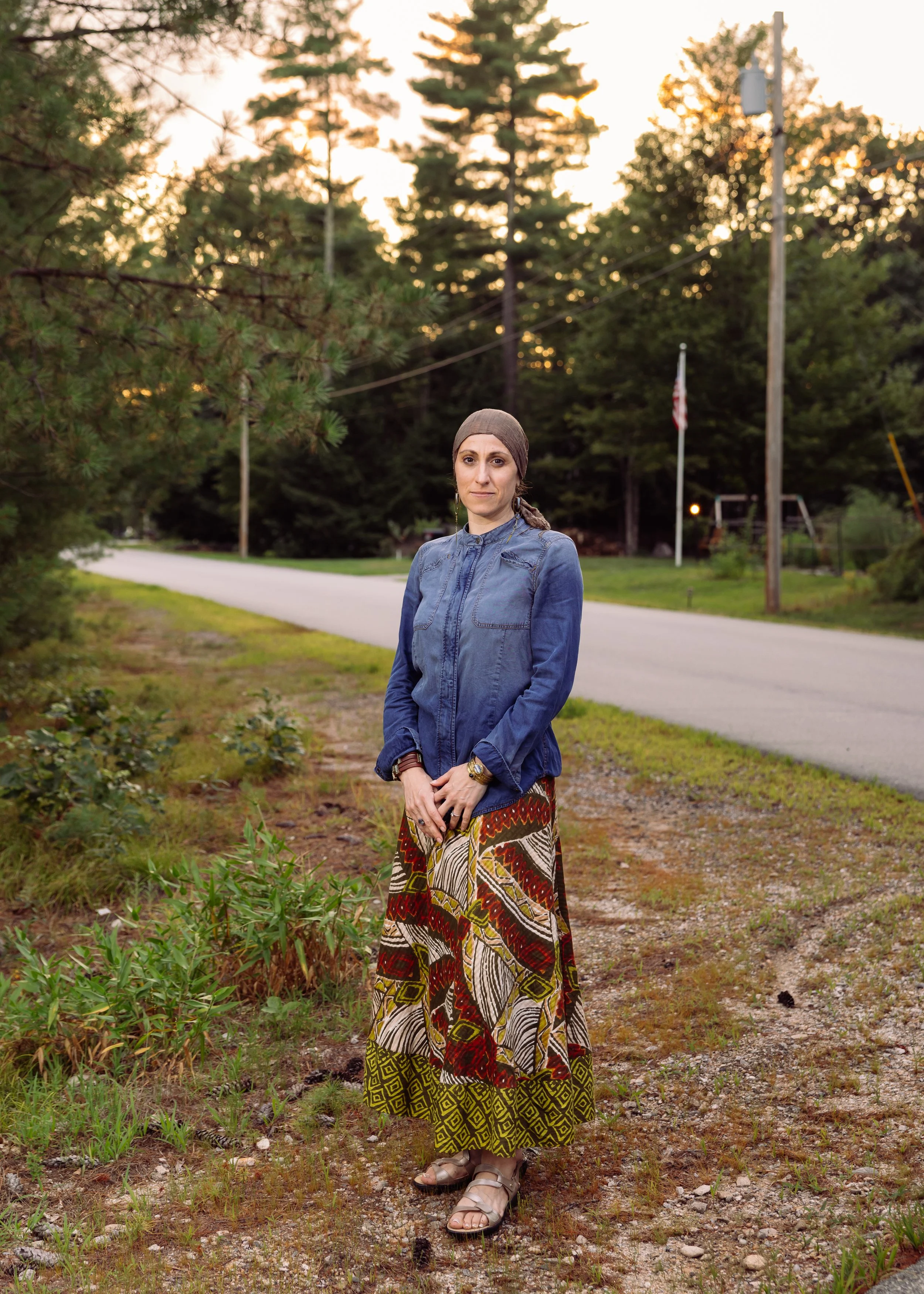
“Islam was the most personally inspiring religious and philosophical framework that I had encountered in all of my journeyings; the more I studied the Qur’anic revelations, the more the Qur’an would reveal itself. The religion was alive in people’s beings, and it made me alive too. Islam was an ocean, and I was thoroughly enjoying the plunge into learning.”
*Excerpt from “One Nation, Indivisible: Seeking Liberty and Justice from the Pulpit to the Streets” Celene Ibrahim (author/editor)
I was taking classes on Islam at the University of Cairo. I got to visit mosques and I was reading classical spiritual manuals from the 12th and late 11th century in translation, because I wasn't good at Arabic yet. I was like, oh this is really simple and beautiful, and at the same time it demands a lot from you as a person. It's not an easy tradition where you can just like get off the hook. You have to fast on Ramadan and you have to have your life structured. I like that. It was a challenge and it made sense. I liked things about Christianity, I liked ethics of Christianity but I didn't like the theology. Islam still has theology, but the central principles are really simple and intuitive for me. The divine is like a unified…. created in time itself so stands outside of time.
-
Were you religious growing up? Your parents?
They were. One was Catholic but not particularly religious and the other Protestant but moved more Evangelical when I got older.
I thought evangelical Christians were kind and well-meaning, but their theology wasn’t what I wanted to build my own life around.
Islam still had theology, of course, but its central principles felt simple and intuitive to me. The idea that the divine is unified, and that God created time itself and therefore exists outside of time, made sense to me.
I wrote a book on Islam and monotheism for Cambridge University Press. It’s a textbook, the kind of book people use in college courses. It’s fairly short because it’s intended as an introduction, something you might cover in the first week or so of a twelve week course.
What was the conversion process like?
For me, it was a matter of personal conviction. It simply made sense.
After I’d made that decision internally, I met Ahmed. We met at the end of March while I was studying abroad. I’d arrived in January, and we got married on June 1.
How old were you?
I was about 22. Because I’d taken an extra year to attend an international school and had done a gap year, I was two years older than a typical sophomore. I was almost at the age when I would have been finishing my senior year.
What was the conversion itself like? Was it emotional as well as intellectual?
It was both. The intellectual aspect had always been important to me because I was studying religion at university. I was connecting the spiritual side with the intellectual side.
The conversion itself wasn’t particularly ceremonial. It was simple. You declare your belief, and it has to be your own choice. You can’t convert because someone tells you to, because you’re pressured into it, or because you’re forced. If it isn’t sincere and intentional, it isn’t valid.
We hadn’t made an appointment. We simply walked in, and whoever was there spoke with us. I remember that some of the declarations were in Arabic, and they were translated for me.
How did you go from there to becoming a scholar and a chaplain?
I actually looked at my college transcript the other day because I was talking with someone about course selection. I wanted to see exactly what I’d studied, since my memory was a little fuzzy.
I was already taking courses in Middle Eastern studies, so switching my focus wasn’t a huge change. I was studying Portuguese, and then I switched to Arabic. I’d always been interested in humanistic studies.
I really focused on learning Arabic because it takes a long time. I also took courses in early Islamic history.
At one point, I thought I might study international relations, but then I discovered a program at Harvard Divinity School focused on community leadership.
The program had different tracks, and I didn’t realize they’d recently revamped it. It had originally been designed to train Christian ministers, but they had broadened it to appeal to a wider audience. I thought it was an established program for people from different religious backgrounds, but when I arrived, I was the only Muslim in the program.
I had to work with the faculty to figure out what my training should look like, given that I wasn’t going to become a priest, pastor, or minister. That took three years.
I became interested in women’s and gender studies because one of the professors was a leading scholar in that field, particularly in relation to Islam. She was one of the main people writing about women and gender in Islam from the 1990s through the early 2000s.
I took many classes with her, as well as courses in Islamic law. Eventually, I found my way into chaplaincy, and then I went on to do a PhD, with more work in Qur’anic studies and Arabic.
Is it unusual to be a Muslim woman working as a chaplain?
It was less unusual in the sense that the field itself was just beginning to develop in the United States. Institutions were starting to hire Muslim chaplains, initially in places such as the military and prisons. They were already employing Christian chaplains, and when they had Muslim personnel who needed support, they realized they needed Muslim chaplains as well.
I helped develop the field of educational chaplaincy.
Different types of chaplaincy are very different from one another. I could provide spiritual care in a prison, for example, but understanding the institution itself is another matter. The same is true of the different branches of the armed services, each of which has its own chaplaincy structure and training.
I have friends who were among the first women in their respective roles. One of my friends was the first female chaplain in the Army. We were all pioneers in a field that was still taking shape.
There are only certain institutions that can afford full-time chaplains, and many of those positions are connected to the military. Some universities also have full-time chaplains.
By that point, I was increasingly interested in the academic side of my work, so educational chaplaincy was a good fit. It allowed me to provide spiritual care while remaining within the intellectual environment of academia.
Your book has also been doing well.
Thankfully, yes. It’s being taught in universities in many places, which is really gratifying. It’s wonderful to write something and then occasionally be somewhere completely unexpected and have someone come up to me and say, “Are you [the author of that book]? I read your book!”
You deserve that recognition.
My family was incredibly supportive while I was writing my dissertation. Ahmed put a whiteboard up and wrote notes for me, reminding me to focus. He’d ask how many words I’d written and keep track of my progress. He also cooked for me and brought me food while I was writing.
He still reads some of my work to make sure it’s accessible. Sometimes I get too dense or academic, and he helps me explain things in a way that a general reader can understand.
Before you knew much about Islam, what was your perception of it growing up?
I didn’t even know Muslims existed. I don’t remember learning anything about Islam in primary school or through tenth or eleventh grade. I was a good student, so if we’d studied it, I think I would have remembered.
I don’t think that’s necessarily unique to my school or region. Religion isn’t taught very much in American schools, and I don’t remember learning anything about Islam in history class, either.
But I was interested in religion. I think that came from a natural sense of spirituality.
I also went to a Catholic school because it offered a better education than the public school. We had mandatory Mass, and I started attending CCD classes, which are part of the formal religious education Catholics receive before confirmation.
My parents hadn’t raised me as a Catholic in the formal sense, so I had to go through the process myself. I found it interesting. Eventually, I became an altar girl, which allowed me to participate in Mass, and I really liked that.
One of the churches I attended had a priest who was deeply interested in liberation theology. He introduced me to a more socially engaged form of Christianity that wasn’t so parochial.
He travelled to Central America on missions and was very critical of US foreign policy and the role of the Catholic Church. In some places, the Church had opposed oppressive regimes and challenged US involvement, while in others it had played a very different role.
I would talk to him about these things when I was 13, 14, or 15. That was an important introduction to the political dimensions of religion.
He was probably in his seventies at the time and had been born in the 1920s. He’d fought in World War II and had a great deal of life experience. Looking back, I think he may also have been lonely and enjoyed having someone to talk to intellectually in the middle of Pennsylvania.
He had high hopes for me in terms of the Catholic Church, even after I converted to Islam. He met Rahma when she was a baby.
I went from having him as a mentor to having Lawrence Thorpe, a Buddhist, as another mentor. Both were intellectually and politically engaged, and both were deeply involved in social justice work.
That was the kind of religion I was exposed to: engaged, intellectual, and concerned with justice.
The priest also spoke in tongues, which is unusual in Catholic settings. I used to attend services with him when I was 13, 14, or 15, along with a group of older Catholic women. He would take the consecrated hosts out, pray over people, and sometimes begin speaking in tongues.
Was that part of the charismatic Catholic movement?
Yes, something along those lines. He was a bit of a renegade.
His Catholicism was deeply influenced by his time in Central America. I wish I knew more now about his training and background, because I’d probably understand his perspective better as an adult. But his criticism of US government policies in Central America was very formative for me. It was probably the beginning of my left-wing political education.
It sounds as though your family was fairly open-minded. How did they react to your conversion?
My mother is very evangelical in her beliefs. She’s very focused on Jesus and the idea that belief in Jesus is essential to salvation.
I remember Rahma having a conversation with her when Rahma was about five or six. She was asking my mother how Jesus could be both a person and God at the same time.
Who won the argument?
I don’t remember who won, but my mother probably still prays that I’ll convert back to Christianity. We don’t talk about it very much. She occasionally asks me questions about Islam, but she has also absorbed a lot of anti-Muslim sentiment.
Where do you think that comes from?
Mostly from the politics of her online circles and the people around her in Pennsylvania. They tend to have relatively homogeneous life experiences and are very politically involved through their church. They’re deeply immersed in conservative politics and the culture-war debates.My father is Catholic, but he isn’t particularly involved in religion.
Has your conversion affected your relationship with your parents?
I think they’re happy that I’ve been successful professionally. My father doesn’t seem particularly concerned about my religious identity, although I imagine he has his own thoughts about salvation.
My mother is proud that I’m a successful academic, but I think she would rather I were a Christian writing books about the Bible.
Do you think her reaction would have been different if you’d converted to another religion?
The political dimension certainly would have been different. She wouldn’t have been conditioned to feel the same kind of animosity toward that religion.
But I think she’s very focused on the idea that Jesus saves. For her, there’s really only one path.
My next question is a little different, since you’re a scholar of religion. How has your own faith influenced your understanding of other religions?
I write quite a bit about inter-religious studies. Because I had a fairly thorough education in different religious traditions, I naturally tend to think comparatively about religion.
I’ve published a lot on that subject. I should send you one of my articles, which recently appeared in a book. It examines the names of God in the Islamic tradition: the Compassionate, the Giver of Life, the Bringer of Death, and so on. I then look at different religious traditions, including Indigenous traditions, Sikhism, Jainism, and other major religions.
I compare the names and attributes of the divine in Islam with those that resonate with the worldviews of other traditions.
I’m constantly writing about inter-religious topics and participating in panels, collaborations, educational programs, and events that bring different religious communities into conversation.
Islam has faced a great deal of prejudice in the United States over the past twenty years. Have you experienced misconceptions or prejudice yourself?
I encounter those issues professionally all the time. I get a lot of questions because I work in women’s and gender studies, and many Western criticisms of Islam focus on gender.
Do you think that would be different if you were a man?
My male colleagues encounter many of the same questions. But I think I’m well positioned to address them because I can speak both from my own experience and from my scholarly expertise.
I’m not an apologist for Islam. I also do feminist work, so I examine these issues through a feminist lens.
I’m working on all kinds of questions where I think cultural influences have shaped religious practices in ways that make them more chauvinistic or patriarchal than they need to be.
There are particular issues where that happens, but it isn’t unique to Islam. I have colleagues who work on Christian feminist studies, too. These are human issues, not problems specific to one religion.
Sometimes I have to challenge biases and misunderstandings among non-Muslims who are looking at Islam. At the same time, I work within Muslim communities to help people understand women's rights and other questions.
So I’m doing both kinds of work: engaging with non-Muslims and addressing issues within Muslim communities.
As a convert, your religious identity and convictions are fully your own. But do you ever feel like an outsider in the community you’ve adopted?
Thankfully, people generally show me a certain level of respect because I’m a teacher and a scholar. My academic qualifications and professional work help establish my place in the community.
Every now and then, though, being a non-native Arabic speaker can be a disadvantage. I haven’t memorized the entire Qur’an, for example, and I sometimes find myself engaging intellectually with people who have memorized enormous amounts of religious text from a very young age.
By the time some of them are 15 or 16, they already know many passages by heart. I may know the text intellectually, but I might not be able to quote it from memory on the spot.
That’s a disadvantage in some settings. When I’m writing, however, I can look things up, so it’s not an issue.
What does your daily religious practice look like? Do you have a congregation or a regular community?
We live quite far out here, and my approach to Islam is relatively intellectual.
I recently went to a conference at Duke, and I remember thinking, “This is my crowd.” We were discussing fine points of Islamic theology, medieval thinkers, and the application of their ideas to contemporary questions.
There can be a disconnect when I’m around Muslims who aren’t as professionally or academically focused on religion. My community tends to be other professional Muslims.
There’s also a different value placed on what I do because I haven’t gone through a full traditional religious education. I’m bringing a critical academic perspective to Islam rather than approaching it entirely from within one tradition.
Many Muslims have a particular cultural understanding of Islam. Because I’ve studied it academically, I have a broader sense of the variations between communities. I know, for example, that people in Oman may practice or understand certain things differently from people in Iran.
I have more of an anthropological understanding of the religion as a whole.
People who are intellectually inclined toward Islam often study a particular tradition or branch in great depth. They may know that area extremely well, but their focus is narrower.
I only asked that last question because I’ve spoken with other converts in Virginia and the Washington, DC, area who said they sometimes felt lonely or a little like outsiders, both because their families didn’t share their religion and because they didn’t always feel fully integrated into their local mosques.
I think my experience has been different because I speak Arabic reasonably well and have lived abroad. I understand the culture, and I’ve travelled a lot. I can adapt to different environments, so that makes things easier.
People sometimes have fun trying to figure out whether I’m Turkish, Bosnian, or something else.
I was going to guess Algerian.
Exactly!