
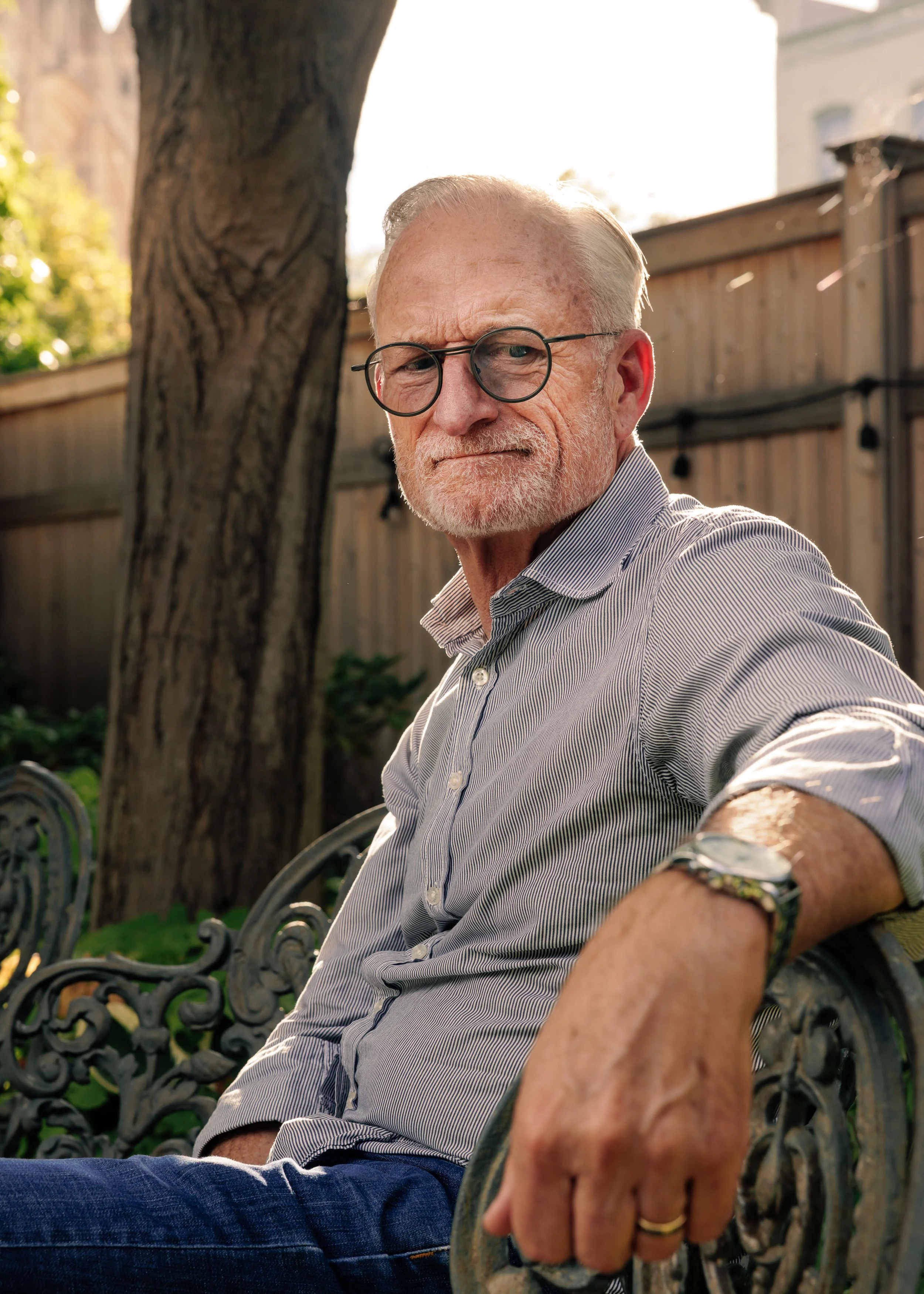
Dale Schafer / Hudson, NY
What was odd to me was that everything they told me was something I already believed, at least innately.
When they told me about the Restoration, it resonated with me. I thought, “That makes sense.”
The next lesson was about the plan of salvation. The LDS Church teaches that we lived as spirit children before this life. I’d always wondered why I felt as though I’d lived before this life. Over time, I’d interpreted that feeling as something like reincarnation, but there was something about their explanation that rang true.
Everything they were telling me felt familiar, as though I had already believed it.
Years after my conversion, I came to think that perhaps my childhood thoughts hadn’t been guided in any particular direction. I wouldn’t say they had been tarnished, but I hadn’t been taught to believe one thing or another. So when I heard these teachings, they rang true.
___
I agreed to be excommunicated. I said, “I’m not going to divorce my husband of 20 years. He’s on disability. I’m not going to throw him out with the bathwater.”
To me, divorcing him just so I could do whatever I needed to do to get into heaven would have been more selfish than staying with him.
What has always stayed with me is my belief in the basics. I strongly believe that the LDS Church is the restored gospel of Christ.
If that’s what I believe, then the policies, the people who might offend me at church, and the church’s latest political positions don’t really matter. There’s a difference between policies and doctrine.
For me, it’s not about the people. It’s about what I believe the truth is. The truth remains the same regardless of who the people are or what the church’s latest political leanings might be.
-
I listened to the podcast, so to go back to your question about how I found it, I honestly don’t recall. But I started listening, and it’s almost an hour and a half long. I couldn’t stop listening. It was really interesting.
I’m not LDS, and there were terms I didn’t understand, but I found them interesting. I could relate to a lot of what you were saying, and I thought it was a fascinating story.
Having listened to your retelling of the story, I’d love to go back to your upbringing and how you came to the LDS Church.
I was brought up without religion. I never went to church. My mother grew up Methodist on a farm in Virginia. Her grandparents were quite religious. My great-grandparents donated part of their farm to have the local Methodist church built. To this day, whenever I go back to visit relatives, we often go to that church.
I never had any religious experiences, although I always felt very spiritual as a child. I was very introverted, and I think part of that introversion was caused by my parents’ divorce. I went through a deep, dark spiral around the age of ten.
We had an old family Bible in the house, and my brother had built a wooden cross for no apparent reason. It was lying around in the garage, and I asked if I could have it. I put it in my bedroom and created this little altar.
I prayed a lot. I kept praying that I wouldn’t be gay. I didn’t really know I was gay, I just knew I was different. I thought there was something wrong with me. I wondered if it was because I didn’t have a dad. My brothers were significantly older than I was, so they weren’t really part of my life.
I was always very inward thinking. I spent a lot of time in the garden, and while I was gardening, I’d think about religion. I would think of weeds as evil, something I was trying to get rid of so that only the good remained. For some reason, I always made these analogies between gardening and God.
I remember asking my mother why we never went to church. Could we go to church? She said, “I don’t really want to, but if you want to go, there’s a Baptist church down the street, about a mile away. Feel free to go if you want.”
This was in California?
Yes. I never went. I was too shy to consider going alone.
I started writing poetry and didn’t really think much about religion. I believed in God, but I didn’t read the scriptures. I’m dyslexic, so reading has never been easy for me, especially reading something like the King James Version of the Bible.
It wasn’t until high school that things started to change. I always dated girls because I got along with them. But in gym class, there was a guy who knocked me off my feet. I had a total crush on him. His name was Tom. He seemed different from other guys. He was just nice. He played on the basketball team and was sort of a jock, but not really. We hung out a little, although we never became close friends.
Then I found out he was LDS. I wasn’t sure what that meant, and somebody said, “Oh, yeah, he’s a Mormon.”
I thought, “What’s wrong with that? What is it?”
I went to the school library and started looking for books. Most of what I found were history books about wagon trains crossing the prairies. I didn’t learn much about the religion itself.
Then I had another sociology class with a kind of hippie teacher who proudly claimed to be an atheist. He made fun of a girl in the class who was a Mormon. He would never get away with this today, obviously, he said he couldn’t believe she could believe something like that, that the whole thing about God was just a bunch of fairy tales.
I found it really offensive, not to me personally, but I felt terrible for her. She had to sit there and endure that.
You found it offensive even though you weren’t a member of the church yourself?
Well, I think he was talking more generally about religion and God than specifically about the Mormon Church. She just happened to be LDS. She was only the second person I’d ever known who belonged to that faith.
For a research paper, I decided to look into the Mormon Church. Again, it was mostly about the history and how the church developed. I didn’t really go into the doctrine or even the founding of the church. I hated that class so much that I honestly don’t even know if I did the report. You could get a passing grade as long as you attended every day, and I think he said he’d give you an A if you did the report. I don’t know.
Anyway, I hated high school. I hated being in San Diego because I felt very much like an outcast.
I had this car, a 1965 Mustang, and a little bit of money in the bank, although not much. I decided that after high school, I’d get in my car and drive across the country. Wherever I ended up, wherever I ran out of money, I’d stay and make a life for myself.
I don’t know how I expected to make a living if I ran out of money, but that was the plan.
First, I was going to visit my dad in the Bay Area. I had some car trouble along the way, and when I got there, I had to put the car in the garage. It took all my money to fix it, so I ended up stuck at my dad’s house.
My dad felt I was a bit lost. He said, “You know, I think you should go to a church.”
I thought, “Really? I’d never been to one.”
He said, “Well, you should look into the Mormon Church.”
I thought, “That’s weird. Why would you think I should go to the Mormon Church?”
He explained that when he was in the Navy, he’d had Mormon friends. They were really nice people who seemed to have their act together.
My father was a very disciplined man, having been in the Navy. He said these people had food storage to prepare for disasters, and he actually followed that practice himself. He thought Mormons were very family oriented and community oriented. They just seemed like good people.
He said, “I’d love to introduce you to them.”
I said, “Okay.”
He told me he’d taken the missionary lessons himself, but they weren’t for him. I asked why, and he said, “For one thing, I’m not going to pay tithing.”
My father wasn’t a particularly demonstrative person, either. He said he just thought they were a good organization.
One day, I was out gardening at his house, and I said, “Don’t call the missionaries.”
Then my father, my stepmother, and my two half-siblings came out of the house and got into the car.
I asked, “Where are you guys going?”
He said, “Oh, we’re just going for a drive. By the way, I called the missionaries. They’ll be here in about 20 minutes.”
They took off, and the missionaries arrived, riding their bikes up the steep hill where the house was.
They came in, and I was nervous. At the time, they taught seven lessons. The first was about the Restoration of the Church of Jesus Christ and how it happened through Joseph Smith. The second was about the plan of salvation: Where do we come from? Why are we here? Where are we going? The third went a little deeper into church doctrine.
They don’t teach those lessons in the same way anymore. Now, they seem to teach more by the Spirit, or through some kind of spiritual guidance.
At the time, though, the discussions were memorized almost word for word. I found that out later when I became a missionary myself.
What was odd to me was that everything they told me was something I already believed, at least innately.
I’d always wondered why there wasn’t a prophet anymore. Why did everything end with Christ? Why did miracles end? Why did the prophets cease? Why did revelation end?
When they told me about the Restoration, it resonated with me. I thought, “That makes sense.”
The next lesson was about the plan of salvation. The LDS Church teaches that we lived as spirit children before this life. I’d always wondered why I felt as though I’d lived before this life. Over time, I’d interpreted that feeling as something like reincarnation, but there was something about their explanation that rang true.
Everything they were telling me felt familiar, as though I had already believed it.
Years after my conversion, I came to think that perhaps my childhood thoughts hadn’t been guided in any particular direction. I wouldn’t say they had been tarnished, but I hadn’t been taught to believe one thing or another. So when I heard these teachings, they rang true.
It was almost as though the veil between the pre-existence and this life had become thin enough for me to feel the truth resonating with me.
That’s how I was converted. Within a few weeks, I was baptized.
What resonated most strongly with you?
At the time, it was the whole story. The whole thing felt true.
Then they brought out the Book of Mormon and talked about it, probably during the third discussion.
You said that the things they explained were things you already thought you believed.
Right. When I was a child, praying in my room and thinking about religion and God, I had these ideas in my head. I’d never put them into words. When the missionaries shared their messages with me, everything came together. I thought, “That’s right. That’s what I’ve always believed. It all makes sense.”
The belief in Christ made sense to me. The Book of Mormon initially seemed a little strange, and I wasn’t sure about it. But then I began reading it and thought, why couldn’t this be one of many religious records that had been lost as the tribes of Israel dispersed?
I couldn’t really argue against any of it.
Of course, I went through a period of reading anti-Mormon literature. A lot of it was compelling, but I always came back to the same thought: “That’s not the whole truth. You’re taking one piece of something and making an issue out of it.”
Soon after I was baptized and confirmed, I moved out of my father’s house and moved in with someone I worked with at a nursery.
It turned out that this guy was gay and living with his boyfriend, who was also Mormon. The boyfriend had left his wife and was divorcing her after coming out as gay. So there was already a lot of complicated drama surrounding the situation.
Then my roommate seduced me, and we had sex. I freaked out.
How long after your baptism was that?
Probably within three or four months, maybe even sooner.
Someone was supposed to pick me up for church, and I said, “I can’t. I don’t think I can ever go back. I’m damned to hell.”
They helped arrange an interview with the bishop, who is something like a pastor. I told him what had happened. This was back when the church viewed homosexuality as a choice rather than something biological.
He said, “You were a victim. You were taken advantage of. That’s not your fault. You’re not a sinner. You just need to put that aside and move forward.”
I said, “Okay.”
Then I came out to my mother. I had already told my father in a letter when I left his house. When I went home to visit my mother, I wrote her a letter saying that I was gay and a Mormon.
She said, “Well, whatever makes you happy.”
She didn’t have particularly strong feelings about it one way or another. I was her fifth child, and she’d already been through a lot with the other kids. This was something new, and she had no idea how to deal with it.
Soon afterward, I went on a mission.
The funny thing is that, during the very last week of my mission, a university student at the Royal University wanted to interview a missionary for his thesis.
Was that in Sydney or Adelaide?
Adelaide.
It was an odd experience. He asked me, “How do you know the church is true? You keep saying you know it’s true, but how do you know?”
I said, “I just do. No matter how much I try not to believe it, or try to make it not make sense, I can’t. I’d just be lying to myself.”
But he also wanted to talk about the gay issue and how the church was dealing with it. That was awkward because I didn’t come out to him. I told a story about myself in the third person.
How old were you when you went on your mission?
I went when I was 19, just before turning 20, and came back when I was 21.
And where did you go after that?
I went to BYU. At the time, returned missionaries were often automatically accepted, so I was able to go even though I hadn’t taken the SAT. I had never thought I would go to college.
I was engaged to a woman from my congregation in San Diego who had waited for me while I was on my mission.
While I was at BYU, I went to the counseling center to try to become straight. It didn’t work very well.
Fortunately, the university had recently stopped using electric shock therapy as part of conversion therapy. That had been happening at the time, and people had been subjected to it shortly before then.
My counselor used scripture instead. That was very ineffective, and the sessions didn’t work very well.
I want to go back a little to your initial conversion, but I also know that you’ve been excommunicated twice. The most recent time was in 2015 or 2016, when you wrote a letter?
It was after the church introduced a policy in 2015, following the legalization of same-sex marriage nationwide in the United States.
Same-sex marriage was already legal in several states, but my husband and I decided to wait until it became federal law. When that happened, we got married in the Episcopal Church.
At the time, I was still an LDS member. I was still on the records, and I was occasionally attending church. I was splitting my time between the local LDS church and the Episcopal church nearby, where Philip was heavily involved.
Within a couple of months of our marriage, the LDS Church introduced a policy stating that people in same-sex marriages essentially needed to be excommunicated.
That really upset my family and some friends who knew I was Mormon.
The local church leader didn’t want to do it, but he felt his hands were tied because he had to follow church policy. He didn’t have a problem with the choices I’d made. He didn’t feel my spiritual salvation was in jeopardy. He saw it as a church policy that he was required to follow for various reasons.
I agreed to be excommunicated. I said, “I’m not going to divorce my husband of 20 years. He’s on disability. I’m not going to throw him out with the bathwater.”
To me, divorcing him just so I could do whatever I needed to do to get into heaven would have been more selfish than staying with him.
Then the church rescinded the policy, so people in same-sex marriages no longer had to be excommunicated. However, they still couldn’t be baptized if they were in a same-sex marriage.
I found myself in quite a religious quandary. I laugh about it now because the whole thing seems absurd.
Where are you now?
I’m in a similar position. I still attend both churches.
I recently got a call from the head of the Episcopal Church vestry asking if I would become a vestry member. I said I didn’t really have the time because I’m always busy. She explained that it would only be until January, filling in for someone who had to leave for personal reasons and was moving out of state.
I said, “Okay, I’ll pray about it.”
So I prayed, and I had this prompting. I’ve been sad about not being able to do more in the LDS Church. All I can do is show up and participate in Sunday school or something. I’m not able to do anything else there.
In my prayer, I asked whether this was something I should do and whether I could handle it. I felt prompted that this was one way I could serve. I wanted to serve people, and this was an opportunity to do that.
Even though my heart is in the LDS Church, I really love the Episcopal Church and what it stands for. This parish sometimes struggles with leadership because it’s small, and I felt I could help in that capacity.
So far, it’s worked out okay.
What really struck me about your story is that you have such a strong faith, yet you’ve been excommunicated twice. You keep returning to a church that has turned you away twice.
In the podcast, you mentioned going to the Episcopal Church and explaining that you hold certain beliefs that align with LDS. The priest said they could work with that. You hold on to your beliefs, and I find that admirable.
I’m curious about that pull of the LDS faith, especially given your experiences with other Christian churches.
Something occurred to me one day while I was driving. I listen to a lot of podcasts when I’m going back and forth to Massachusetts on weekends or driving to clients.
I particularly listen to Richard Ostler’s podcast because he has such a wide range of people sharing their experiences within the church. Some have left and are angry, while others have stayed and are celibate, and there are many other perspectives.
One day, I heard someone talking about why they hadn’t left the church. They said they liked the people, the culture, and the organization. Other people leave for the same reasons, but in a negative sense.
My thought was that the difference for me is that my interest has never been the culture.
Even when I was an active member, I never fit in. I was always the convert who didn’t quite belong. When you’re a young man in the church, everyone loves sports. They want to play sports, and I had no interest in that. I never really connected with the other young people.
The culture and community have never been that important to me because I can find those things at the Episcopal Church or somewhere else.
What has always stayed with me is my belief in the basics. I strongly believe that the LDS Church is the restored gospel of Christ.
If that’s what I believe, then the policies, the people who might offend me at church, and the church’s latest political positions don’t really matter. There’s a difference between policies and doctrine.
For me, it’s not about the people. It’s about what I believe the truth is. The truth remains the same regardless of who the people are or what the church’s latest political leanings might be.
For some reason, that’s what has kept me from walking away.
And Philip, your husband, seems to have a different relationship with religion.
Yes. I don’t know why he goes to church. He doesn’t feel he has any strong convictions. He was raised Jewish and considers himself a Christian now, although culturally he still feels Jewish.
He doesn’t follow the teachings of the gospel very deeply, so we’ve had an interesting dynamic in that respect.
He was culturally Jewish. He had a fascination with religious art because his father used to work at the Metropolitan Museum of Art.
They lived in Larchmont, and when his father went into the city, he would sometimes drop Philip off at the Cloisters for several hours. Philip would wander around and stare at the religious art. It moved him in some way, and he became fascinated by it.
Over the years, that interest continued. He went through a period of doing iconography and made many of these paintings.
He also likes the Episcopal Church because of its pomp and ceremony. I think that resonates with him, without the Catholic baggage, perhaps.
It’s funny because there’s a Catholic church right here, and both of us have gone to the Catholic Church. The Episcopal Church is very similar. The liturgy is pretty much the same, but their doctrines about sexuality and the priesthood are almost the opposite of Catholic teaching.
There’s also the question of authority. Catholics don’t necessarily believe that Episcopalians hold the same authority, while Episcopalians believe they continue that authority.
Even the Mormons are concerned with authority, particularly priesthood authority. In some other religions, it’s less important.
I have a list of questions but I feel like we’ve covered a lot. I suppose one question is: Why is it important to be religious? Or, perhaps more accurately, does it matter to you to have a religious or spiritual faith rather than none at all? Does it matter to be formally connected to a particular faith?
I think it does for me. During certain periods of my spiritual journey, I’ve experienced a kind of peace and, in some instances, joy that have been very important to me.
That contrasts with the period when I completely ignored religion and just pursued my own interests for more than 20 years. I had plenty of fun and enjoyment, but I never found that same sense of peace or meaning.
That doesn’t mean everyone needs religion. My sister-in-law considers herself an atheist, but she’s probably the most Christian person I know. She’s caring, loves people, and is generous.
For me, one of the central things I believe is what Christ said about the greatest commandment: to love God and love everyone. That’s really the foundation of spiritual belief for me.
One thing that’s been comforting about returning to the LDS Church is that the last couple of church presidents, or prophets, seem to have placed more emphasis on love.
When I first joined the church, it felt as though everything was about living the commandments and believing that everything would be fine if you did. Now, the emphasis seems to be more on loving people, helping others, and accepting those who are different from you.
That gives me hope about where the church is going.
But to answer your question, I think I would feel lost without some kind of spiritual belief.
I don’t feel that I’m connected to religion because I need something to fill a void, even though people might assume that. Religion has actually been a struggle for me. It hasn’t offered me an easy path or a convenient sense of community. I’ve always been on the outskirts of it.
For me, it’s about my personal relationship with who I believe God is.
I also recognize that everyone believes a little differently, even within the same religion. People have different interpretations and understandings.
But I keep coming back to this one thing: truth is important to me.
I remember when I was a missionary and that graduate student asked me how I knew the church was true. It’s like asking how I know the sun is shining through this window. I just know.
I realize that might sound like a cop-out, but I can’t explain it any other way. Truth has always been important to me.
That’s probably why I have such a hard time with things that are fake or deceptive. Whether it’s politics or an advertisement on television, I can’t stand it when I know something isn’t real.
I think that answers the question.
I don’t know if it does.
No, absolutely. I know the question might not seem particularly intelligent to ask someone who already holds a religious belief, but that’s part of why I ask it.
It’s actually a challenging question. It’s a good question to ask. I think everybody should have to answer it.