
Jeffery D. Long / Elizabethtown, PA
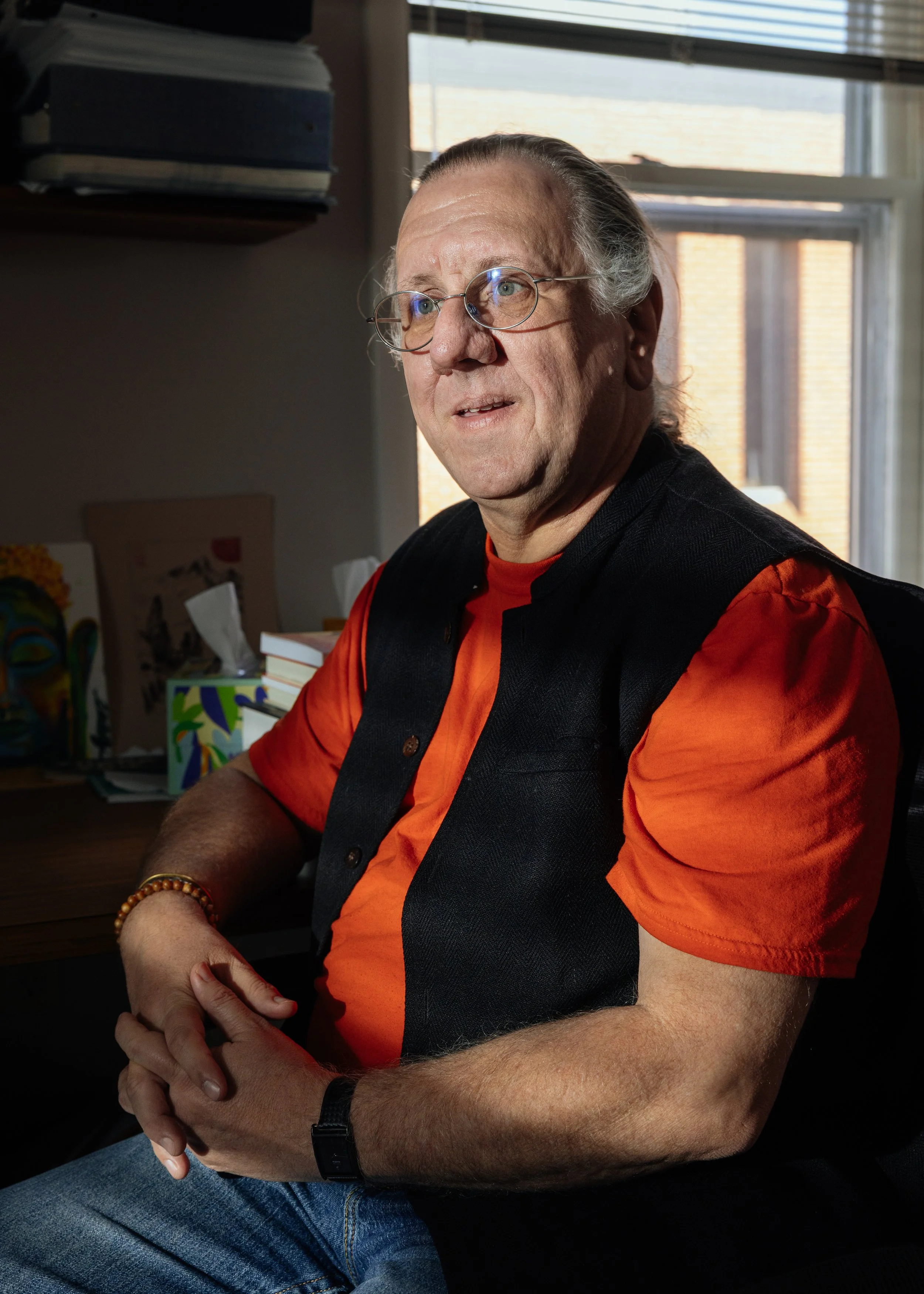
Because of my own experiences and how I interpreted some of the events after my father's death. It was like, this makes sense to me. This makes more sense to me than the standard model that I was being taught of, you know, heaven, hell, purgatory. We're already in purgatory. We're being reborn until we get it right and then we move on,
What I realized there at Notre Dame was that, A, there is profound wisdom in the Catholic Church from which I can always learn and on which I can always draw. And B, that there are also very big fences, walls and limitations if I were to continue to inhabit that as my tradition that I would always be bumping up against. I have a friend who was a theologian at Notre Dame. And when we were talking about this and he said, so basically after studying in our theology program, you left the church and became Hindu. And I said, I never really thought of it that way, but yeah. And he said, oh, my gosh and put his hand on his forehead like, you know, what have we done? But, it was because I had the opportunity to speak with and take classes with these wonderful people, these great intellectuals, that I got to really understand that even though in my own mind I could harmonize Catholicism with Hinduism and with other religions, that wasn't going to work for me if I wanted to function as a theologian and a thinker in the church. I think if I was just going to be sort of like a regular Catholic, I might have reconciled it all in my mind and just kept on going to Mass and being Catholic. But I wanted to teach, and I wanted to write and teach about these things.
I preferred the idea of being in a community that would be supportive of what I was doing, which is what I feel in the Vedanta tradition, that what I am saying and understanding and experiencing is very much in sync with that tradition. And so I'm very comfortable in it. And for me now, like going back to your earlier question , I'm a white person in a tradition that's mostly people of South Asian and Indian origin. The intellectual and spiritual affinity far outweighs any, like skin color and culture and that sort of thing.
-
I listened to a podcast, a conversation with you, from maybe two or three years ago. Okay. It was a Process Theology podcast.
I remember that, with, I think, Jay McDaniel was involved.
And I was really curious how the ceremony that you went through right before your wedding, to be sort of officially in the faith. Yeah. What was that like?
It was a great experience, because in my mind, this was the trajectory I had been on all these many years. But I didn't know if there was a way to formally join, because the tradition itself is so informal. There's no church, or central structure, or anything like that. There's no creed you have to recite, there's nothing of that sort. So I was not sure, could you just start calling yourself Hindu, because you have a Hindu worldview and some practices.
And you'll find, in my own research on this, people are all over the map. So a lot of Westerners who adopt a Hindu practice, some do refer to themselves as Hindu and self-identify that way. Many do not. So I was kind of in that in-between space. And when we wanted to get married through the Arya Samaj, for a very practical reason, it's a relatively simple wedding.
And it's something that you can do in one day, and relatively inexpensive. It's the original Vedic ceremony. There's not a lot of additional trappings or anything. The organization, the Arya Samaj, when they started, one of their goals was to go back to what they regarded as the original Vedic tradition. So you have the sacred fire, and you have the Vedic mantras.
And then we found out they had a requirement that if one of the people getting married was not Hindu, they would need to go through this ceremony to become Hindu. In order to get married in that temple. And so there were legalities connected with that. India is a secular state, but it's different from the U.S. There's not a total separation of church and state. The government actually has... they have rules about if you get married, if you have an Islamic wedding, if you have a Christian wedding, if you have a Hindu wedding. There are different requirements and expectations and so on. So there's actually something called the Hindu Marriage Act. We wanted to get married under that, and to do that, you have to be Hindu.
And there's also just a regular court wedding, but we didn't want that. We wanted something more traditional. And so interestingly, because Hinduism is not a proselytizing tradition, typically, the reaction of my then-fiancé and future father-in-law was, Oh, he shouldn't have to convert. And then I intervened and I said, you know, to me, this is like the next logical step.
This is what I want to do. So I was very happy to do it. And so there was that ceremony about a half hour before the wedding itself started. It's called there's the Nama Karana Sanskara, which traditionally refers to the giving of a name to a baby. So I got a Hindu name.
And then there is the Upanayanam, which normally happens when you're about maybe 13 or 14. And that's an initiation into, ritually speaking, into adulthood. You could compare it to a bar mitzvah or confirmation or something like that. And those two were combined by Swami Dayananda Saraswati, who started the Arya Samaj. He made that the means by which someone can enter the Hindu tradition.
And he did that because of all of the efforts of missionaries back in the 19th century to convert people to Christianity. And then he also recognized that there were many Muslims in India whose ancestors had been Hindu, some of whom wanted to rejoin the Hindu tradition, but there was not a way in. So he made this ceremony possible. I don't think he really had in mind Westerners and people from outside of India joining, but it's been used for that for quite some time now.
So that's how I officially joined. And that was, like you said, how was the experience? It felt like, okay, now I'm finally officially affirming something that has been the reality for me for a long time, that I had been drawn to this tradition. I would say that as a spiritual experience, the even more meaningful step for me was ten years later when we took our initiation into the Vedanta Society. And that happened here in the U.S. with our guru up in Boston.
And because you join the Hindu tradition, but you're not necessarily connected with a particular teacher or a particular lineage or anything of that sort. And I felt a desire to do that. Having grown up in the Catholic tradition, there's the whole idea of apostolic succession, and the popes go all the way back to St. Peter. There's a lineage that goes back to Christ. And so in the Hindu tradition, too, they have this teacher-to-student lineage that traces back to some enlightened master or divine being of the past.
And I felt disconnected by not having that. The Hindu name given to me is Vivekananda, which is a very grand name. I mean, Swami Vivekananda is a famous figure in our tradition. That is my name. I don't use it regularly because I think that it might seem like I was being a little pretentious, because he's such a great figure, it's like walking around saying, I am Abraham Lincoln or I am George Washington or something like that. Though in the Hindu tradition, it's not uncommon for people even to be named after deities. You meet guys named Krishna and Shiva. It's not uncommon at all.
And the other thing is the monks themselves in our tradition don't actually use that name. That's been reserved just for him. So I thought, OK, I don't want to overstep by using that. But I'm very pleased to have it. I feel it's a real blessing to have that, and I was grateful to be given that name.
So it is something I treasure, but precisely because I treasure it, I don't kind of flaunt it. I don't mind people knowing it. Some people in the tradition have completely adopted it. There was a Hindu teacher who actually recommended that people change their name on all their legal documents and everything to fully identify with the tradition. At the same time, you go to India and you find Hindus who don't necessarily have these kind of Sanskrit names.
I met a Hindu named Mohammed once. I think that the naming is a very sacred thing. It's something, like I said, that I prize. But I also, and this kind of goes to how I think about this whole process, I don't feel like I gave up my old identity when I took this on. I feel like it's a more, maybe a more accurate expression of who I already was.
But my given name of Jeffrey, I'm named after my father, and I like to honor him by keeping that. I don't want to give that up. So I just have it all and I'm quite happy with that. But yeah, that ceremony was back in 1995 in Delhi.
And we'll have our 30th wedding anniversary this year. This was in April. And that's also, of course, therefore the 30th anniversary of my formally joining the tradition. So it's a very special time.
Are there any Hindu students on campus?
Very few, very few. The numbers fluctuate. Once you're at a college for a long time, you see what a transient population it is. Students come, then after four years they go.
So we've had times when we had maybe up to a dozen or so Hindu students. We had a big group from Nepal back in the early 2000s. And that's when we started doing a formal Diwali celebration on campus. And that became very popular with students. And we had students from India, Sri Lanka, again Nepal, and then Indian American students, students who had grown up here, but whose parents or grandparents in some cases were from India.
We have a few right now. But it's small. It's in the single digits, I think maybe four or five. And my experience through the years is that some of the Hindu students get to know me very well. And they take courses with me. And they like having someone on the faculty who is serious about the tradition. And then you have other Hindu students like, OK, I've come here to study biology or engineering. And I don't need to study religion. I get all this at home from my parents. That's fine, too. I'm not here to impose myself on anyone. I let students know I'm available if they want to meet or talk. And we've had the experience before of taking students, especially those who are from India the temple, the local grocery store. We have Indian grocery stores and things.
So people miss some of their products and things from home. And showing them where all of that is. My wife and I both have kind of taken on that role a little bit.
Is there a Hindu temple, Hindu community in Lancaster County?
There is. Our temple is actually closer to Harrisburg. It's out in the country. It's about a 30-minute drive away. We've been members there for almost 25 years since we came here.
One of the first things we wanted to do was find out where the temple was. And my wife is Bengali. So we're very active in the local Bengali community organization, too. And so they do things through the temple and also in people's homes and separately. And we're involved in the temple.
Did you seek out any communities when you first started to get interested?
That was hard. Because I was growing up in a small town in rural Missouri. And when I first became interested, I was so young I didn't even have my driver's license yet. So I was dependent on my mother. My father had died when I was 12. And I was really dependent on my mother for transportation.
And of course, the internet didn't exist yet. So I couldn't just look up where's the nearest Hindu temple. That would have been difficult. And there weren't as many in those days. I now know there was the Vedanta Society of St. Louis.
But St. Louis was like two hours drive from where we lived. So I didn't even know about it at that point. But then an Indian family moved into the town. And this is such a stereotype. They were Gujarati and they ran a motel.
And there are a lot of Gujaratis who run motels. But I didn't want to just kind of drop in on them and say, oh, I'm very interested in India and Hinduism. That would be really awkward. It would be weird. And you don't want to make assumptions.
Maybe they were Christian. Maybe they were Muslim. Maybe they were – you really didn't know. But I was intrigued by them. It was like I was hoping I would get to connect with them at some point because I had this fascination.
And then I had an opportunity because my – and this shows you what a small town I lived in. Everybody was related. So my cousin was one of the counselors at the high school. And this family had two daughters. And they were younger, a little girl in grade school.
And then the older sister was in middle school. So some places they called junior high. And I was in high school by that point. And the mother approached the counselor and said, is there anyone out there who – any student who's really good in math who could tutor my daughter in math? She's struggling with math.
So the first person that my cousin asked was a guy who had gotten, you know, state awards in math. He's brilliant in math. He's brilliant in computers and so on. And he said, yeah, sure, he'd do it for – I think it was like $5 an hour or something like that. And then my cousin thought, okay, no.
He saw this as kind of a charity project, I think, that he was going to help this poor Indian family. They weren't poor at all. But, you know, that was his attitude, right? Small town America. And so he wanted to find someone who would do it for free.
So the next person he asked was me because I was a good student. And I thought, oh, this is my opportunity to meet this family. So I became the math tutor, and I tutored her in math, and she did fine in math. But I got to know the family, and they were curious about me. What are you into? What do you like? And I said, well, you know, I'm really interested in Hinduism, and I'm reading the Bhagavad Gita, and I've been reading books by these various authors, Yogananda, Autobiography of a Yogi, things like that. And they're like, ah, you're one of those guys who's interested in all these things. Looking back at my memories from my adult perspective, I think they were kind of amused.
But we became close friends after a while and eventually they moved. Small town, I don't think, really agreed with them. They had lived in Los Angeles before. And my understanding is they moved back to Los Angeles after a few more years.
Monday nights they would do their puja, worship. And they would have Indian food. And it's funny, the kids always complained. They liked their, pizza and their hot dogs and whatever. But they would have Indian food that night, and it's like, oh, I love Indian food.
So I started going there every Monday night, and I would watch them do their puja. And then after a while, I would participate in it. And they were just this family. So husband, wife, and two girls. And then the husband's mother came and stayed for about six months, which I now know is also not uncommon with Indian families in the U.S., that the parents will often come, especially like during the months when it's really hot in India.
Elderly parents will sometimes come and spend long periods. And because of the expense of traveling, and so they come for a long period, right? So they come for like six months or so. And so the grandmother did not know much English at all. But she really liked the fact that I was interested in all these things.
And one time I heard her say, the two words of English I ever heard her say was, “nice boy”. She was very devout. And she liked the fact that I was interested in, puja and all these things. And I asked them questions. We had a lot of great kind of philosophical discussions and so on. My mother and another friend of my mother got to be friends with the lady, with the mom in the family.
We even took them with us to the Catholic church one time. I was fascinated by Hinduism at that point, but I was still part of the church too. Like in my mind at all, I felt I could fit it all together. I didn't kind of give up on church until college. But when I was still in high school, they asked to come and visit my church. So they came and they sat with us and everybody's looking at us. But it was nice.
Then I graduated left. I went out of state for college. I went to Notre Dame Catholic University. And my mother moved to another town.
After my father died, she went to nursing school and became an RN. She got a job at a hospital that was about an hour away. She made a lot of sacrifices for me, for which I'm grateful to the present day. In my last couple of years of high school, she drove back and forth two hours a day to work long shifts as an RN at a hospital. And when I went to college she move to Columbia, MO. Most of my closest friends from high school also moved there for college. I would come back for spring, Christmas or summer break and stay at my mom's place in Columbia and hang out with my friends.
How large was the Catholic congregation back in Montgomery City?
It was substantial. It wasn't huge. Catholics were definitely a minority in a very evangelical region. Persecution is too strong of a word, but we definitely felt like other. I had multiple conversations as I was growing up with people who told me I was going to hell because I was Catholic. Catholic church is bad.
As they got to know me and learn that I was interested in Hinduism, Buddhism, and other things, then they knew I was going to hell. It was like, oh, you're hopeless. But those conversations really kind of formed a lot of my worldview, because this whole idea that you're going to hell just because you follow the religion that your family taught you didn't seem to fit with the idea of a loving God at all. Forget a loving God, even a just God. You don't have to even be loving, but it's not fair to punish someone for eternity because of who they are.
And so I rejected that. But I definitely had a sense that we were a minority. But we were a big minority. I don't know what percentage of the town was Catholic, but if you look at the United States, Catholics, I think, make up about 20% of the population, typically, at any given time. But in some areas it's more or less.
Ours was a pretty big church. But there were a lot of other churches. In fact, for such a small town, we had over a dozen churches.
And in fact, it's funny, there's this old Frank Zappa album, 200 Motels, and they're going through what they regard as small-town America. And they there's this line, Churches, Churches And liquor stores. And that was Montgomery City, Missouri. We had about a dozen churches and about a dozen bars and liquor stores.
You've got the churches and you've got the people drinking. And sometimes it's the same people. There were three Baptist churches in our town. And they were divided not theologically, but by class. There was the First Baptist Church, where the wealthy white Baptists went. There was the Faith Baptist Church, which was where the poor white Baptists went. And there was St. John's White Chapel, which was the African-Americans Baptist Church. It was very segregated. Culturally, it's on the fence between the Midwest and the South. Missouri was pretty Southern in that sense. There was segregation. Not legal and forced segregation. It's just how things were. It played out in St. Louis and Ferguson.
But in terms of religion, when my grandmother was a little girl, she remembered the Ku Klux Klan burning a cross in front of the Catholic church because the Klan did not like African-Americans, Jewish people, or Catholics. All three. People forget that because the Catholics in America have kind of made this alliance with the right wing now. But it wasn't always that way. And Catholicism was the religion of immigrants. Irish, Italian, and Polish. And they didn't like those people. And so I had a sense of coming from kind of a minority background, which I think helped me in terms of following my chosen path because you worry less about what the majority of people think about you. If you're a minority, it's like, well, those people aren't going to like me anyway, so I don't really care what they think.
So I could be Catholic, I could be Hindu, I could be Jewish, I could be whatever, and they would still not like me.
Let me do me, as the kids say now.
Exactly, exactly. Neil Young has that great line, Don't feel like Satan, but I am to them.
That's kind of been my attitude through a lot of my life. And I think about one of my big role models in terms of spiritual life, George Harrison. You have the choice to be popular or there's God-realization. Now which one do you pick?
Well, to me that's a no-brainer. But at the same time, like I said, I don't feel like I've been persecuted or harassed excessively or anything like that. I just always felt like kind of an outsider.
And how do you feel as a convert, as a white American in the Hindu community?
Well, that's a funny thing too, because I'm unusual even within the tradition that I follow.
There are two aspects of this. There's what I would call the positive, but then there's a negative element. I feel kind of like a celebrity when I'm in a Hindu environment. People have been very respectful and very kind and very supportive and very accepting of me. I think that that is also because I write about the tradition, I speak about the tradition.
And people find that very affirming. But then here comes the negative side. For so long, not just Hindus, but the Indian community as a whole has been at the receiving end of racism and colonialism and stereotyping, the white communities that are looking down on them and so on. I think part of the warmth with which I've been received is a sense that a white person is saying good things about us. And I think in the ideal world, they wouldn't care at all.
I look forward to the future where I'm just an ordinary Hindu, that there's nothing exceptional about someone like me being in the tradition. I appreciate the warmth, and I think most of the warmth and kindness is truly sincere. People are just appreciative. I know one thing in our local area, that whenever there are interfaith initiatives or interfaith panels, they often like to call upon me. So I think part of this is someone who sort of grew up speaking English in America and knowing the lingo here and having academic training.
I think people don't always feel as confident in their own ability to articulate the tradition and their experiences. And so they're happy to have someone like me do it. And I'm happy to be in that role and be of service in that role. My guru once told me that your job is to be a bridge between India and the West. I feel very happy, blessed, privileged and fortunate to be in that role. I'm very grateful to be in that role. And I never want to be arrogant about it. I want to be very humble and see it as a responsibility.
I like explaining Hindu traditions to people. I like serving in that role as a bridge. I feel it's what I was born to do. So I feel good about it.
But yeah, it means I don't get to be just an ordinary person in the temple or in the Vedanta society. If I go to any event, very often I'm asked to get up and say something. And again, I don't mind it. I enjoy it on one level. But it is interesting because it's like I've never just kind of fit in, wherever I've been.
It's always been this sense of being in an unusual role. But I'm not complaining about that. But that's the answer to your question. I'm very warmly received. I've really had no negative experiences to speak of in the Hindu community.
Of course, in the online world, sometimes you'll get people who will say critical things or not like something you said or something you posted and so on. But when I've had the time and been able to do it, I've often engaged with those people and then often ended up having very nice conversations. They don't expect that engagement. They don't expect someone to come back and say, well, that's actually a fair point that you raised and I'd like to talk about it with you. And so I've sometimes ended up engaging with people who said something initially very nasty online. And by the end of the conversation, whether it's on email or out there in public for everyone to see, by the end of it, having a good dialogue. Because I want to create bridges of understanding. Unless someone's just totally obnoxious, I’m going to engage with them.
I have another friend. I don't know him from meeting in person. It's all been entirely online. But he's another white guy from the Midwest who became Hindu. And every now and then, it's extremely rare, but every now and then, and again, this mainly happens online. As a non-Indian person, you'll get challenged, on your Hindu identity? And he told me a really funny story. A lot of these people, and I think this is true not just in the Hindu community, I think it's true generally. Other people that are really aggressive on the internet are young men. And so someone was questioning him about, you know, how could you be Hindu?
And he told his whole story about how he was drawn to the tradition. And as the dialogue went on, finally, this friend of mine said, you know, how old are you? And the guy said, 19. And then he said, and you were born Hindu? He said, yes.
So my friend said, I've been Hindu longer than you have. Because he was older and he had been drawn to the tradition at a young age. And he formally became part of it. I don't know exactly at what age, but I mean, he's about my age now. So like me, he's been at this for 20, 30 years.
So he said to this person, I've been Hindu longer than you have. Which I thought was a great comeback. So, yeah, and I am aware that there are valid reasons that people in the community would be suspicious of white people coming in. There have been so many people who have culturally appropriated elements of Hinduism and then tried to pass it off as their own brilliant insight. Or have done various things where the community felt violated by those people.
There's always that worry. There's actually a term that's come up in the community, in the discourse around this. Is someone sincere or are they a Trojan horse? They use that expression from the Iliad and the Odyssey, which is interesting. Is this a Trojan horse?
I've been doing this long enough that I've established a trusting relationship with the community. At least with the people I interact with. But I've also been very clear that I'm not claiming to speak for the whole tradition. Or even my own tradition.
I think my perspective is my own. But I am speaking from within the Vedanta society, within the Ramakrishna tradition.
What did your mom and your grandparents think when you started reading the Bhagavad Gita?
They were always very supportive. One nice thing about my family is that they were religious but not fanatical. I had friends growing up whose parents were far more strict and far more fundamentalist in their views. And these were not Catholic friends.
These were coming people from more evangelical backgrounds. And they would often, in fact, most of them are atheists now. So that kind of tells you what happened in their lives. In my family they liked the fact that I was a good kid. I didn't get in trouble. I wasn't into drugs. In fact, if they worried about me, they probably worried that I wasn't getting out and being social enough. I would come home and read.
I had a group of very close friends that I hung out with. And we're still in touch today. But because I was a good kid and I was reading, I was studying, I was into intellectual things, they thought that was very good. And they wanted to encourage that. And, in fact, my mother had a kind of a crisis of faith after my father's passing and was not a big churchgoer.
Once I knew how to drive, I would go and Mom often would not. She still felt some connection to the church and I think she was very happy that I went to a Catholic university. hey were not inclined to get into the details of theological and philosophical argument.
There were two moments when my family maybe realized how truly other Hindu tradition was from what they were accustomed to. Before I was involved in the Vedanta tradition I was involved in something called Siddha Yoga, which I got to know about in college.
During the summer between college and graduate school I wanted to go to their ashram in upstate New York. My mother and I used it as the opportunity to take a vacation. So we went to upstate New York. I went to the program at the ashram for a few days. And we stayed with the family of my old roommate from college. One day I took Mom with me to the ashram. I just wanted her to see it. From her perspective, it looked kind of weird, right? It looked sort of cultish and so on. And she said, you know, if this is what you're into, I don't know if I can relate to it. And I said, oh, you know, it's not really that different from the church in certain ways.
I sort of reassured her. But what I think reassured my family was that unlike what people call cults, I didn't get involved in something that involved any radical change in behavior or demeanor on my part or in my relationship with them. So it's not that I had cut off relations with my family or that I didn't shave my head. I didn't change my name. I didn't do anything radical.
They were fine with all that. The other thing was when I met my wife. We met in the summer of 93 at the University of Chicago. I was in grad school at that point andI had not talked about getting married. I hadn't had a serious girlfriend. I was very intent on my studies and my interests. And my spiritual interests and my academic interests were closely connected. I was focused on becoming a professor. I'm going to be a writer. And then we met that summer. We got engaged very quickly after having met. I finally found this other person who gets me. We both had the same experience.
I went from not even having a girlfriend to suddenly coming back during the summer for about a week for a visit and announcing to the family thatI'm getting married. They were really taken by surprise. My mom's first question was, well, what about your Ph.D.? I said, well, what about it? I'm going to get my Ph.D., you know.
My wife also was finishing her Ph.D. at the time but they didn't get to meet her at that point because she had had to go back to India. So that unsettled them.
And then I went to India. I got permission from my university because University of Chicago wants people to go and study where the culture and the religion are practiced, right? So if you're studying an Indian tradition, you won't be taken seriously if you haven't spent some time and done serious research in India. So I got affiliated to the same university where my wife was teaching.
They had a Sanskrit professor. My professor in Chicago said, well, just keep up with your Sanskrit and, you know, you'll be fine. And so I went there, and I ended up being in India for almost two years. We got married there. The thing is, when I told my family I was getting married, I knew that they would just love my wife and vice versa.
I knew that. But they didn't know that until they met her, obviously. So they were a little skeptical. Even one of my close friends was skeptical.
In fact, there was this great experience. Shortly after we returned from India, we spent some time with my mother. And during that, we also went to spend some time with my grandmother, who lived out in the country. And my grandmother just adored my wife. YThey really hit it off.
When we came back to my mother's place there was a voicemail. This was back in the age of answering machines, right? So there was an answering machine message from my grandmother. “Oh, Mahua, I just really miss you. It's been really quiet here since you all went back. And I just wanted to let you know that I missed you. And, you know, it would be nice to talk with you. And I miss you, too, Jeff. But, Mahua, I really miss you.”
It was like I was the afterthought. But I love that because I think the best arrangement you can have when you get married, in terms of relations between the two families, it's good if your in-laws like you a little more even than they like their own child and vice versa. And we had that because her father and I were very, very close.
He liked me right away, and we got along great. And yet he would be very hard on her. He'd be very critical of her. My family, and especially my grandmother, who is really the matriarch, just adored Mahua. Whereas I, I mean, they love me, too.
But I was doing weird things like reading the Bhagavad Gita. So Jeff's doing his thing. But they really liked her. They just hit it off. And so that kind of sealed the deal, right, in the sense for in terms of family relations.
Because they knew she was Hindu. They knew she grew up Hindu. And was she religious?
She was, yes, but not, how would I say it? Almost like my family. Religious but not fanatical or extreme. She's a pretty westernized, I would say. And I'm a pretty Indianized westerner. So I think we just kind of meet somewhere in the middle. And I think that's one of the reasons we got along so well.
We like the same, I mean it's funny, we're from opposite sides of the world, but like the same music, like the same books, and similar attitudes. Hindu tradition is a lot of wisdom that we want to make part of our lives, we believe in it, we're on that path. But again, not like very conservative or what you might call fanatical. Swami Vivekananda always preached against fanaticism. And we have some friends who are not religious at all.
In fact, they're kind of anti-religion. And they know we're very serious about it. But they feel comfortable with us because we're not pushing it. We're not in their face about it.
I mean, for us it's all about acceptance and seeing wisdom everywhere. Our friends say that science is where you get knowledge. And our attitude is, hey, we love science, science is good. But from our point of view, science and the teaching of Vedanta is perfectly in sync.
I wrote a piece about this a few years ago about what it means to be a scholar practitioner. I’m an academic scholar of this tradition, but I’m also practicing it. Are there tensions that come from that? Because in scholarship, you're supposed to be objective. Does being a practitioner make you not objective and so on? And my argument was that, well, in both cases, you're interested in truth.
And the criteria are in some ways the same. You have to ask questions. It has to make sense. You have to produce evidence and have an argument. This has been my personality all these years. If it makes sense in my mind, then I'm quite happy with it. And then it doesn't matter to me if other people disagree or object. It's like, yeah, well, I know the answer to that question in my mind. So I'm fine with that.
My attitude has been that if you're interested in truth and you're willing to take on any question and any perspective, there's nothing unacademic. In fact, it is very much in keeping with the values of the academy.
Do the scholarly and the spiritual quests sort of go hand in hand?
I think so. I think they do. And a lot of the great minds of history of many traditions have been scholars and spiritual people.
I'm not the stereotypical angry ex-Catholic. There's a lot of the Catholic Church and its history that I admire. And the intellectual heritage of the Middle Ages is fantastic. People call it the Dark Ages, but they don't really know what people were doing in monasteries and in universities. I mean, what we call science today, a lot of that was born there.
And so to me, there's no clash between. And if you look at the Hindu tradition, and this is big in related traditions like Buddhism, for example, the Buddha was an incredible critical thinker. He critiqued his own experience. He took it apart and he observed what was happening in his mind and then gave an honest accounting of that. And without any kind of dogmatic imposition.
And so that kind of very critical phenomenological type of approach, I think, is what you need in spiritual life to keep it from just becoming repetition of what other people have said. But it also is very much in sync with the scientific outlook. The idea that science has to mean materialism and that there's nno reality beyond the sensory world. I think that's just a dogma, actually.
There's a great book called The Great Partnership written by, he was the chief rabbi of the UK, Rabbi Sacks. And he wrote the book about how science and religion are not mutually exclusive.
Yeah, yeah. In fact, I've seen a lot of affinity in the rabbinic tradition with the Hindu tradition in that regard. That particular attitude is very strong in both traditions.
To the extent that it's Jewish students who've taken my classes, I've often formed very close bonds with because they say, oh, this is very much how we think too. And it's interesting because superficially you would not think Judaism and Hinduism would have much in common because you see all the various deities and so on. And then, of course, Judaism is aniconic and so on. But then you get into the philosophy and it's very close. I have a good friend, Phil Goldberg, who's written a fantastic book called American Veda about the influence of Hindu ideas in the Western world.
One thing that he and I've talked about, we don't have sociological data to back this up, but it's just an observation. A lot of the Westerners who become Hindu or Buddhist come from Jewish or Catholic backgrounds. There are Protestants, too, who do. But I find overwhelmingly, if I just look through the friends I have, the people I know who have become Hindu or Buddhist, most of them started out Jewish or Catholic. And in the Jewish tradition, you're still Jewish, right?
Even if you're practicing Buddhism, there's this term, Jubu. And then Phil uses the term Hinju. Because rather like Hinduism, Judaism is not about a dogma that you have to believe. It's a way of life that you basically are born into. Though you can also become Jewish just as you can become Hindu. In both cases, the traditions are not seeking out the converts, right? They're not trying to get people to join.
Phil himself, the professor through whom I got to know about Siddha Yoga. He was Jewish in his background. Fr. Francis Clooney has a deep affinity with Hinduism. He's been studying it for years as a comparative theologian. And he's spoken also at the Vedanta Societies. We've become friends through the years. He's at Harvard currently.
There's something about Catholicism and Judaism. There's a sort of an academic, kind of a scholastic reasoning outlook that fits really well with the Hindu tradition also.
I've seen that connection a little bit in Zen Buddhism and monastic life. I’m thinking of Thomas Merton.
Thomas Merton, oh yeah. It was a big early influence on me. I love Thomas Merton's work. And the extent to which a lot of these traditions, a lot of it is experiential. So there's not really a dogma to argue about or fight about.
It's like, okay, this is what I've experienced. Once you've experienced something, you can question the experience. You can question what it means and interpret it. But once you've experienced it, you've experienced it. I mean, it's kind of unquestionable in a certain sense after that.
I'm reminded of the famous conversation where Carl Jung was asked, do you believe in God? And he said, no, I know there is God. Because through his reflections and contemplative experience and so on, he'd experienced a presence. And once you've experienced that presence you can explain that in a lot of different ways. But the experience is undeniable.
And it's often life-changing. I mean, it becomes the definitive experience of your life. So because that is so central, then it makes it easier to coexist with diverse viewpoints because they're all just different takes on the same experience. And they all have maybe some validity. And in some ways, they all fall short.
Because ultimately, as the Upanishads say, words recoil from that place. There is an experience that you just can't explain. You have to experience it. And so then it's not about fighting over, are there three persons of the Trinity or two? Is there one God?
That becomes more of an academic question. But how does this reflect that experience that you've had? Is it authentic to that experience? Or does it somehow fall short?
And I really like that emphasis on the experience. And I see that in Merton. And I see that in the Upanishads. I see that in Zen. The dogmas exist to point you to the experience.
The famous Zen image of the finger pointing at the moon. And so let's not fight about the finger. Let's look at the moon.
Did you have these conversations early on with anyone in the church?
I did, especially once I got to college. When I went to Notre Dame, I met just wonderful intellectuals.
Really some of the best minds in the church were there. In fact, one of my teachers was himself a student of the person who was then Cardinal Joseph Ratzinger, who later became Pope Benedict. So I was getting it, you could say, straight from the horse's mouth in terms of the teaching of the church. What I found at Notre Dame was that there were very broad-minded, very sort of pluralistic theologians who were quite open to this kind of conversation.
And there were people who were more on the, what I would call, not fanatical, but on the conservative side where they would say, okay, but this is what the church teaches. For me a big topic of interest has been reincarnation and rebirth. And this is something that for the most part, with some interesting exceptions, the church has tended to just reject. It's like this is not correct. And you should not believe this.
But because of my own experiences and because also of how I interpreted, and I think you've read about some of this, like how I interpreted some of the events after my father's death. It was like, no, this makes sense to me. I mean, this makes more sense to me than the standard model that I was being taught of heaven, hell and purgatory. It's like, well, we're already in purgatory. We're being reborn until we get it right and then we move on.
What I realized there at Notre Dame was that, A, there is profound wisdom in the Catholic Church from which I can always learn and on which I can always draw. And B, that there are also very big fences, walls and limitations if I were to continue to inhabit that as my tradition, that I would always be bumping up against. And so that was, and it's funny, like I have a friend who's, he's now retired but who was a theologian at Notre Dame. And when we were talking about this and he said, so basically after studying in our theology program, you left the church and became Hindu. And I said, I never really thought of it that way, but yeah.
And he said, oh, my gosh. And he like, you know, kind of, you know, put his hand on his forehead like, you know, what have we done? But, yeah, it was because I had the opportunity to speak with and take classes with these wonderful people, these great intellectuals, that I got to really understand that even though in my own mind I could harmonize Catholicism with Hinduism and with other religions, that wasn't going to work for me if I wanted to function as a theologian and a thinker in the church. I think if I was just going to be sort of like a regular Catholic, I might have reconciled it all in my mind and just kept on going to Mass and being Catholic. But I wanted to write, I wanted to teach, and I wanted to write and teach about these things.
And I knew that if I followed that path, I'd be one of these people getting in trouble with the Vatican, you know, about, you know. And I always admired those people, but I preferred the idea of being in a community that would be supportive of what I was doing, which is what I feel in the Vedanta tradition, that what I am saying and understanding and experiencing is very much in sync with that tradition. And so I'm very comfortable in it. And for me now, like going back to your earlier question about, you know, I'm a white person in a tradition that's mostly people of South Asian origin, Indian origin. The intellectual and spiritual affinity far outweighs any, you know, like skin color and culture and that sort of thing.
The longer I'm in the tradition, definitely, yeah. Because, I mean, I will soon reach a point in a few more years, if this body keeps on living and functioning, where I've been Hindu most of my life. And this is my tradition in that it's not, you know, yes, I came from the outside, but I think that is going to get further and further, you know, as they say in the rear-view mirror. And what's going to be more immediate is, well, this is what I've been doing all this time. So, yeah.
I'm kind of skipping all around.
Not a problem at all! This is all very interesting.
Maybe this is not fair to ask of a professor and a theologian, but how has your understanding of your family's tradition, Catholicism, changed since becoming a Hindu?
I see it as one of the paths, one of the paths to the infinite. One of the things that drew me to Hinduism and to Vedanta in particular, and Ramakrishna's teaching in particular, is the idea that all paths ultimately lead to that goal of realization of our true self, realization of our true nature, realization of God. And there's this wonderful, one of my favorite verses from the Bhagavad Gita is the 11th verse of the fourth chapter. It says, Krishna is telling Arjuna, in whatever way living beings approach me, thus do I receive them.
All paths lead to me. Which tells me that if a Catholic goes to God as Christ, then Christ will receive them. And they will receive the divine grace through that form, through that understanding. And that, in fact, I think it's a very powerful way to approach God because I grew up with that tradition. A couple years ago, Mahua and I traveled to Rome and we went to the Vatican, a lot of the great cathedrals and so on.
And we both just loved it. We were very moved by it. Now that I'm not officially in the church and I'm really in a very different tradition in many ways, I feel I can draw what I like from it without feeling like I'm, like I mentioned those walls and barriers earlier, I don't feel those now that I'm outside of it. And so I can look at Catholicism in the same way I look at Buddhism or Jainism or Judaism, various traditions and say, this is something I can draw wisdom from. This is a source, but it's not the only source.
It's not the one true source. So I can appreciate everything in it that I find wise and good and helpful and just leave the rest. And probably there are people in the church, I'm quite sure there are people in the church who do that already, but again, I felt because I wanted to write and speak that I'd always be having people say, well, but that's not right.
I don't have to deal with that now. So I have this nice distance where I feel that I can appreciate it more than when I was in it. Because when you're in it, you kind of feel the walls closing in on you. I think the more I talk about it with you, I feel like it was almost like a claustrophobic sensation that I began to have about the church near the end of my time with it. Now I can breeze through.
It almost sounds like Catholicism has become more meaningful and useful to you because you can actually take something from it.
Exactly. My attitude toward it is more positive now because I don't feel caught in it. I don't feel stuck in the parts that I know. In the limitations.
In the Vedanta tradition, I don't feel those limitations at all. They're not present. Our teachers, if you read books by a lot of our Swamis, of course, they're drawing mainly from Hindu scriptures and traditions but they'll quote from the Bible and they'll quote from Buddhism. They'll quote from science. They'll quote from Einstein or Oppenheimer in there.
They'll quote from the rabbis. Because it's all wisdom. In fact, there was a nice posting on Facebook not too long ago where a Hindu friend of mine said, don't think of Hinduism as a religion. It's just a name for the process of seeking knowledge that we are all engaged in.
And we have this very rich and ancient tradition of texts and teachers that we can draw from. But we can draw from other traditions too. It's all knowledge. And this is an attitude I've had for a long time. That you could make an analogy between scientific knowledge and spiritual knowledge.
Because if you think of the example of gravity, someone would have eventually come up with that idea. Because it's there. It's a real thing. So if the soul is a real thing, if God is a real thing, if karma is a real thing, those also we would eventually come upon in some fashion. And we have, and then we've written about it and talked about it in the language of whatever culture or tradition we came from.
But if we look at all of those sources as results of that experience and that encounter, then we can draw from anything. So yeah, I think of it as this very expansive view. Now sometimes I've had friends say, well, okay, thinking that way, why do you identify as Hindu? Why identify with any one tradition? Well, then that gets back to, for me, two things.
One is that sense of wanting a connection with a lineage. That I know that the guru, the person who gave me my mantra and who connected me with this tradition, was also the recipient of that from his teacher. And he, from his teacher, who was the holy mother, who was, there she is, the wife of Ramakrishna. And Ramakrishna also was her teacher. And that my belief is that Ramakrishna, as our tradition says, had these amazing experiences and was really completely at one with and plugged into the divine.
Through that lineage, I have that connection to him. So I don't have that if I'm just like a free-roaming spiritual person. And then the second thing is, and this is, one can debate this, but my perception is that this tradition is so old and has preserved so much that it has, like, I don't think any one tradition has the complete picture of reality. But that I think the most complete one you have is here. Just because it, I mean, if you look at Hinduism, just about every one of the major world religions is in some way reflected in it.
Because you have Hindu traditions that are very much like Catholicism. So you look at the tradition of Ramanuja, Vishishtadvaita, the Sri Vaishnava tradition, very much about divine grace and mediated through the Vedas and through the tradition. You have traditions that are almost like the evangelicals and Pentecostals. You've got the Hare Krishnas, you know, this ecstatic worship and so on. And then you have the very intellectual, you know, the Advaita Vedanta, and using the critical mind in order to get at the nature of consciousness.
You have elements that are like Buddhism, right? Like Zen, meditation. The word Zen is the Japanese word for the Chinese Chan, which is how the Chinese pronounce Dhyana, which is the Sanskrit word for meditation. So Zen is basically just, you know, it's Raja Yoga, right? It's Dhyana Yoga. It's the practice of meditation. So we've got the four yogas.
We've got this sort of this almost comprehensive kind of matrix in which any type of spiritual experience can find a home. So because of that, I mean, I'm quite happy to be part of that because it allows you to be sort of wide open and find the path that works best for you. And because of my guru and because of my particular spiritual makeup, I'm very drawn to the non-dualistic kind of path. But other people are more ecstatic and other people are more inclined to, you know, other things. And that's also okay. I don't have to fight with anybody.
Would you have any tips for a person who is spiritually curious and is considering a conversion as such?
I actually do encounter this because I have students who will come to me after class and they'll say, I want to be Hindu, I want to be Buddhist. And I always tell them, just keep reading, studying, exploring, be open-minded. And don't jump into anything. My process took several years.
And don't be in a hurry. In the Western world there's this idea that we just have this one lifetime, so you've got to hurry up and learn everything now. You've got time. And just keep learning, keep exploring, read everything, learn everything. And then if you really feel inclined toward a particular tradition and you make a personal connection with a teacher, with someone in that tradition, then, you know, do that.
And it may be the Hindu tradition, it may be another tradition. But, yeah, we're not proselytizing. Now, if someone's interested specifically in Hinduism, I'll tell them. It's like, okay, here's a bunch of books to read. And come to me if you have any questions.
And check out these various teachers on, you know, YouTube and so on. And if we lived in more of an urban area, I could just tell people, well, go to the Vedanta Society of New York and talk to them there. But we're in a little bit more isolated area, so it's like they're dependent on the Internet and on books. And you get caught up into anything that’s extreme or fanatical or, you know. There's so many, I hate to say it, but predatory people in the spiritual world, right?
And no tradition has a monopoly on that. You'll have teachers who it turns out basically they just want your money or your adulation or something. I always remember the true teacher is within yourself.
One thing I like about being a professor is that I don’t get put in the role of a guru or people think that I'm like their spiritual master. I'm like, I want you to think critically for yourself. And so I can tell you what I think and I can tell you what my process has been but you have to do this yourself. I mean, one person I like in this regard is Krishna Murthy, Jiddu Krishna Murthy.
He was a teacher who always emphasized finding the answer for yourself. And people would come to him as a guru, right? It was, oh, tell us, oh, master. And he's like, yeah, figure it out for yourself. Or Ramana Maharshi, right?
He would say to people, ask, who am I? And pursue that path of self-inquiry. And then you'll find that answer within yourself. So I think a bona fide teacher teaches you to find the answers yourself. And so the nice thing about being a professor is you’re, just by nature of your job description, we're supposed to have a little bit of skepticism.
Once you've had a certain experience. You've had a certain flash of intuition. Now think about it. Now what does that mean? Now what does that apply for the rest of your life?
This constantly questioning I think is important. Some topics you eventually reach a settled view on maybe. But not to become fanatical or complacent. I think it's really, really important. There are people that I think are bona fide gurus, spiritual teachers.
They typically will not present themselves as such. The true guru will tell you the real teacher is there within yourself. And your physical guru, the person that maybe gives you your mantra, that you admire and follow their teaching, is really kind of an externalization of something that's there within yourself. And I wrote a piece to that effect. And I sent it to my guru to see what he would think of it.
And he gave his approval. So I have it on the authority of my guru that, you know, you are ultimately your own guru, ultimately, the self within. And I just think that's so important. Because so many, I think there have even been historically teachers, and again in many traditions, who started off sincere and with a genuine desire to help people and elevate their consciousness. But just the adulation and, you know, the whole culture that gets built around adoring and admiring a person can inflate the ego of even a very highly evolved.
It's almost better if the adulation happens after the lifetime.
Exactly. I think one of the things that keeps, for example, my own tradition, one of the many, there are a number of mechanisms that keep it from becoming a cult. But one of them is that our main sacred figure passed away in the 19th century. So there's no living person that people are going to start kind of piling on around and promoting as someone to follow. And then that person becoming egotistical and saying, yeah, obey me and do what I say.
Yeah, there's so many stories of people who've fallen prey to those people. And then those teachers themselves I feel badly for. They've strayed. They're generating some bad karma for themselves. So I think it's better to just encourage people to find their own way.
And that's what I do. M real mission that I find in my teaching and writing is ensuring that people have a positive and accurate view of these traditions. All the negativity, all the stereotypes, all the hatred you see in the world, I think that can be dispelled with knowledge.
So that's what I'm in the business of promoting to the best of my ability.