
Kochava / Garden City, NY
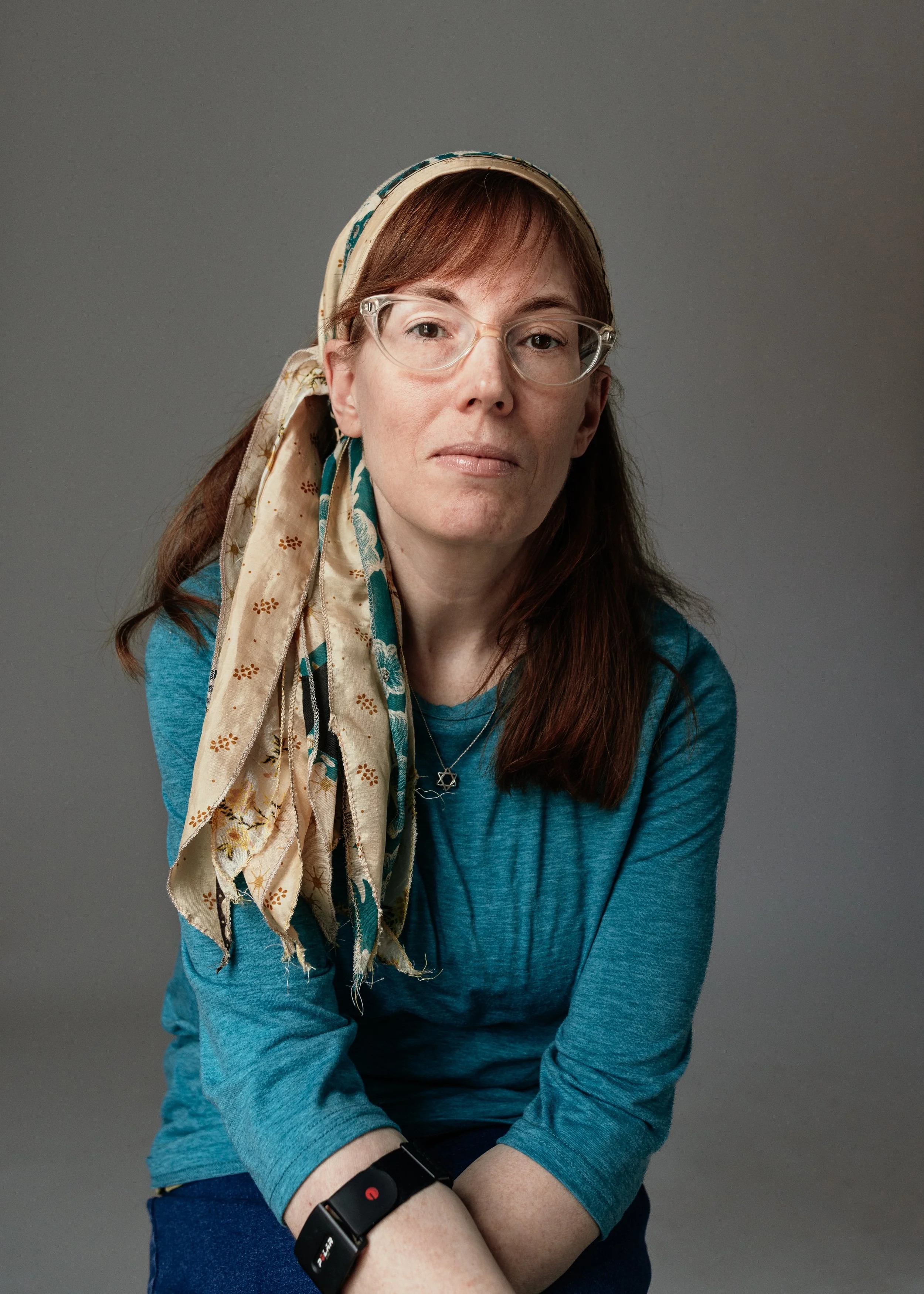
In high school, I actually had my first conversion to Catholicism. So technically, I have three conversions under my belt. I had to go through classes and all that sort of thing, but I was also attending a nondenominational church.
Church was a source of punishment from my mom in particular. She really hated Christianity and religion, and she really hated that I was trying to be religious. I would be punished by having to write out “honor thy father and mother” 100 times.
When I was 19, I met my first really serious boyfriend, and he had been raised Jewish in Scotland.
One day, he made a joke that I needed to be Jewish to have his babies if we were going to get married. We were talking about getting married, and I said, “I’ll look into that.”
I started researching, and I thought, “I really like this.” It kind of speaks to how I had always thought about the world and the worldview I had naturally developed. It put words to it.
I started pursuing it then, but it became a big problem because my boyfriend had a complicated relationship with Judaism. My becoming more Jewish, and my interest in Judaism, became a problem.
-
I guess the real beginning is that I grew up in the Bible Belt in Tennessee, and both my parents were atheists. They had been raised Southern Baptist in very rural Tennessee towns, and both left the church as teenagers. They were kind of black sheep in their families for doing that.
My parents caught a lot of flak for being atheists and having a baby. Family members tried to find ways to get custody of me because they said that atheists couldn’t raise children. It was hardcore. But they had settled and figured all that out by the time my memories start, so I don’t remember any bad blood around it.
I grew up in the suburbs of Knoxville, which is a pretty good sized town. It was extremely religious, and I faced a lot of bullying for not being Christian and not going to church. At the same time, all my family members were telling me that my parents were wrong about this foundational part of the world.
I went to church with family members over the years. But I dealt with a lot of bullying, with people telling me I was going to hell and the whole “you can’t sit with us” sort of thing. Sometimes it even came from teachers, especially in high school.
Religion was always a big deal in my life. It was always a driving force.
Around middle school, I started identifying as Christian and going to before school meetings of Christian groups. I picked up a lot of that in high school.
In high school, I actually had my first conversion to Catholicism. So technically, I have three conversions under my belt. I had to go through classes and all that sort of thing, but I was also attending a nondenominational church.
Church was a source of punishment from my mom in particular. She really hated Christianity and religion, and she really hated that I was trying to be religious. I would be punished by having to write out “honor thy father and mother” 100 times.
She would say, “You say you believe in this book, and you need to be living by it and listening to me.” The first thing that would happen when I got punished was that I couldn’t go to youth group.
So your atheist mother used Scripture against you.
Yes, which is funny because you hear that most from people who grew up in extremely religious environments, and it really harmed their relationship with the Bible.
I never really could figure out where I fit. As much as I tried to make myself believe in Christianity, it never really clicked. I was going through the motions, really, and it was very peer pressure oriented. It was like, all these other people have figured it out, so there must be something to it.
I was an only child, so I didn’t get a lot of socializing, and church became a huge part of my life for that reason. But then I went to college and kind of dropped away from it.
When I was 19, I met my first really serious boyfriend, and he had been raised Jewish in Scotland.
I had never known before that the UK was technically a theocracy. They have an official state church, and a lot of things are influenced by that, like the schools. He dealt with a lot of antisemitism growing up, particularly being excluded from Christian church events at school.
He would be walked out in front of everyone whenever they were doing Christian things, supposedly to be multicultural and not force him to participate. While everyone else was having the Christmas party, they would make him do homework in the office. He had a really complicated relationship with Judaism.
I only learned later that it was even more complicated because only his father was Jewish. Traditionally, Judaism goes through the mother, so many Jews wouldn’t consider him Jewish in the first place.
One day, he made a joke that I needed to be Jewish to have his babies if we were going to get married. We were talking about getting married, and I said, “I’ll look into that.”
Religion had influenced my life so much. I got the Internet in sixth grade. The very first Internet search I ran was on Yahoo, back when it was basically the only search engine. It wasn’t really a search engine, though. You had to click through categories. The first category I went to was religion. I clicked through and started reading about all these different religions on Yahoo.
Judaism was never something I clicked through to. It never even occurred to me to look at it because, obviously, that wasn’t me. It wasn’t something that was open to me.
I think on some level, it just really wasn’t real to me that there were actual Jews in the world because there were so few around where I grew up. We had one Jewish kid in my school, as far as I knew.
So it never felt truly real to me. But then my boyfriend made that joke, and I thought, “Oh, I’ll look into that.”
I started researching, and I thought, “I really like this.” It kind of speaks to how I had always thought about the world and the worldview I had naturally developed. It put words to it.
I started pursuing it then, but it became a big problem because my boyfriend had a complicated relationship with Judaism. My becoming more Jewish, and my interest in Judaism, became a problem.
I looked around, trying to figure out where I might fit Jewishly. I went to the College of Charleston in South Carolina. It was one of the few college campuses in the country that had no Hillel, no Chabad, and no national Jewish organization on campus. It just had a Jewish student union.
It was rapidly Reform, and anyone who didn’t want to be that kind of Jew was treated nastily. The same dynamic played out at my law school in California.
I made two Jewish friends, two girls, and they ended up taking me to the Orthodox synagogue. There was a young rabbi, and he was so nice and down to earth. I liked it.
I’m a very worldly person. I studied languages. I originally wanted to work in foreign film production, and I studied linguistics. I’ve studied several languages, and thankfully, I eventually got the opportunity to travel around the world a lot.
Being in an Orthodox synagogue was completely alien to me, totally in another language. I was just feeling it out. I was around 19 or 20 years old.
It was so comfortable for me, even though it was also wildly different. Trying to figure out how to do the right thing was really hard, especially because I didn’t know at the time that I was autistic and had ADHD.
I had no idea that I had these limitations that were making things harder for me. At the same time, my autistic superpower is being a systems figure-outer. I’m good at figuring out systems, and this was a system. I found so much joy and pleasure in figuring it out and applying it to my life.
Eventually, my boyfriend and I were talking about getting married, and we went to talk to the rabbi. It wasn’t his finest moment. He said, “Why would I marry two non-Jews?”
It was so hurtful and unkind. He could have handled it in a much nicer way. But we ended up breaking up, and I continued being involved in Jewish stuff on and off throughout college.
I stayed at the Orthodox synagogue. I really didn’t have a good time at the Reform and Conservative synagogues.
The Reform synagogue was a trip. I don’t even think a synagogue like that exists today. The Reform synagogue in Charleston is one of the oldest congregations in the United States.
When I was living there, the rabbi was so old. He looked like Skeletor. He was very old school Reform, the traditional kind of Reform that rejected tradition.
The first time I went, I was sitting in the pews, and someone walked in late. The rabbi stopped his sermon to yell at the man to take off his yarmulke.
I was just like, “What the hell?” I found him frightening. He was a scary, scary dude, so I didn’t like going there, although that probably would have been a much more natural fit at the time.
Nowadays, they have a new rabbi who represents a very modern Reform approach. They’re very into traditions now and taking on practices that have meaning to you. It’s the polar opposite of traditional Reform.
I love the phrase “old-school Reform.”
I’m sorry. It was just that I couldn’t make Orthodox Judaism work in my head. It felt very limiting, and I had very few role models.
There weren’t many people under retirement age. It was mostly a bunch of men in their seventies and older, and me in the synagogue each week. There were hardly any women at all, and the rabbi’s wife had a full-time job and was obviously very busy. I didn’t have much face time with her.
I thought I needed to leave it for a while and see if I really wanted this.
I ended up getting the opportunity to teach English in France. You might know about the language assistant program. I was a language assistant in France.
Where?
A really rural area near Strasbourg.
It’s called Sarrebourg. It’s about halfway between Strasbourg and Nancy and Metz.
I lived there for a year teaching English, and I tried to give up this whole Jewish thing. But it just kept pulling me back.
I continued researching it, although this was much earlier in the Internet age it was hard. They had a very hardcore internet blocking system at the school where I lived, and I lived on campus.
I was trying to learn things, but I also learned that the environment for Jews in Europe was very different.
There was a synagogue in my town, but the entrance was hidden. I couldn’t find it. It took me months to find anyone to talk to who could tell me how to show up and go.
I studied Spanish and almost have a degree in it. I didn’t study French. I took French 101 and 102 before moving to France, but the language barrier was insurmountable when I went to the synagogue. Not only did I not speak French, but I also didn’t know Hebrew or Yiddish words.
We just couldn’t communicate, so I didn’t go back. But I thought, “I need to return to this when I get back to the States.”
Then I came back and went straight to law school. I lived in Sacramento, California.
I tried doing a little Jewish stuff, but the first year of law school is just drowning the whole time. You’re busy.
I tried to continue researching and consuming Jewish content, but I didn’t have a sense of where I could belong. I still had no long term plan at that point. I wasn’t dating Jewish people or anything like that.
Later in law school, I tried walking away again. I thought maybe I should put this aside and date people who weren’t Jewish, so we wouldn’t have to deal with this question.
It just didn’t work. But I also didn’t feel that the Orthodox synagogue was right for me, even though I liked it. I felt like it was something I couldn’t do.
Eventually, I went to a Conservative synagogue, and I liked it. It had a very nice rabbi who was very funny. He described himself as an Orthodox rabbi of a Conservative synagogue full of Reform Jews because he had Orthodox ordination.
He had that Orthodox background, which allowed me to have much more useful conversations with him. He could understand where I was coming from. I was extremely unknowledgeable in a lot of ways, but I also had a ton of knowledge, just Orthodox knowledge.
He was able to help me translate that into the Conservative environment.
I formally started the conversion process for the first time there. I took a beginner’s introduction to Judaism class, which was hilarious because I already knew everything. But I made some good friends through it.
I got to the point where I was going to have my conversion, and I was dating a nice Jewish boy at that point.
His parents did something that was so mean that it really bothered me. They sat him down one night and said, “It’s nice that you’re dating this girl. We like her, but a convert will never be a good Jewish wife.”
It was so hurtful. But we continued dating, and the Conservative conversion was moving along.
The week it was supposed to happen, my rabbi’s mother became very ill, so he had to leave for a couple of weeks. He called in another rabbi to take his place, and this guy was a nightmare during my conversion process.
I don’t know how much you know about the process itself. It ends with an oral exam called the beit din, which means a rabbinical court. It’s made up of three knowledgeable Jews. In the Conservative and Orthodox movements, they’re all male.
Even though the Conservative movement is egalitarian, it has a policy of putting only men on its beit din to make the conversion more widely acceptable. So in my case, it wasn’t three rabbis. It was two laymen and a rabbi, although usually it’s three rabbis if you have that many rabbis available.
This rabbi was just nuts. He had Conservative ordination, but he was no longer a Conservative rabbi. He was kind of like a different version of my rabbi at the time. I think he was a Reconstructionist rabbi.
All I knew about the Reconstructionist movement at the time was that you could be an atheist and a Reconstructionist. I was freaking out in my head, wondering whether this was even kosher and whether my Conservative conversion would be accepted because this guy was a Reconstructionist rabbi.
But he held me to actual Conservative Judaism standards, which require adherence to Jewish law. It’s not terribly different from Orthodoxy, but it’s egalitarian.
I was shell shocked. I thought, “I’m lighting Shabbat candles, but I’m not always doing it before sunset. I’m just doing it in what I thought was an acceptable way in my community.”
He said, “No, you need to be doing it at the right time every week.”
I thought, “Okay. I want this conversion to go through.” It had been about five years of going back and forth, so I really wanted it to work. I was willing to agree to anything.
My understanding was that I was essentially agreeing to a Modern Orthodox standard of observance, for the most part.
The second part of completing an Orthodox conversion is circumcision if you’re male. If you’ve already been circumcised, they just draw a drop of blood. The third part is the mikvah, a ritual bath.
You have to be naked in the mikvah. Everything about that day was wrong. The whole day was wrong from start to finish.
The members of the beit din invited my boyfriend along. I had explicitly not invited him because I wanted this to be mine. I didn’t want anyone saying I was doing it for my boyfriend. I had been involved in Judaism for years before I ever met him.
But they invited him, and I couldn’t uninvite him.
Then we got to the mikvah building, where an attendant helps you. For some reason, the rabbi told the attendant, an elderly woman named Goldie, to sit in the bathroom with me while I got ready.
This woman, who must have been about eighty, was sitting there on her cell phone, chatting away to a friend while I was showering and naked, trying to get ready for the conversion.
I didn’t feel I had the power to say no. I didn’t want to upset the apple cart and ruin the chance of getting this done. I just wanted it done.
I knew Goldie. I had known her for months. She was a sweet old lady. She wasn’t trying to hurt me. Her intentions were good, but clearly, none of this was good or okay. I didn’t have the vocabulary for that at the time.
We did the mikvah and celebrated.
I’m pretty sure I never went back. That time is hazy. I sometimes have a hard time with memories because I had a traumatic childhood. This was one of those periods of such high stress that a lot of my memories are missing.
This was in Sacramento?
Yeah.
I’m pretty sure I never spoke to the actual rabbi of the community about what happened. I just stopped going because everything had been so bad.
I became convinced that I had made the wrong decision and should have been Orthodox from the beginning. I felt that this was the universe hitting me over the head to tell me I was making the wrong decision.
In retrospect, I don’t know if that’s really what it was, but that’s how I felt at the time. From that day forward, I decided I was converting Orthodox, and I just didn’t go back.
I started going to the Orthodox synagogue, but unfortunately, that synagogue had a horrible rabbi who was just a terrible human being. He was a bully and bullied me relentlessly. He bullied a lot of people relentlessly. He eventually got fired over his treatment of conversion candidates.
He just didn’t like converts, and he expressed it in a very condescending way.
In that community in Northern California, in Sacramento, there were a lot of converts. A lot of people had come in during the religious revival movements of the sixties and seventies associated with Shlomo Carlebach.
We had a ton of converts. The rabbi would always do things like introduce someone by saying, “And this is so and so. He’s a convert.” You’re not supposed to do that. It’s bad manners to automatically disclose someone’s background to a stranger when introducing them.
He did it all the time. He was always pointing out that people were converts.
Did he do it so that you would feel some kind of kinship with them, or…?
People interpreted it as a way of saying these were a different kind of Jew, emphasizing the difference much more than was necessary, especially when it wasn’t necessary.
Like there’s a Jew, and then there’s a Jewish Jew.
Yes. People theorized that it had a lot to do with his own background. His mother was Jewish, but his father wasn’t, and he was raised without religion. He became religious fairly young. He couldn’t have been much older than me at the time.
A lot of people felt that he had an inferiority complex. He worried that people thought he was less than because he had come to religion later in life.
I got involved with a beit din out in California, and it was just horrible. Every step of the way was terrible. Every meeting I went to with them ended in tears, and I’m not a person who cries. I’m pathologically self sufficient, a stiff upper lip kind of person.
It was terrible. They were so mean, and I also dealt with a sexual harassment situation there.
It was really only after Me Too that I fully reckoned with it. Me Too profoundly changed my life because I had always thought, “Well, what he did wasn’t that bad.” But then I thought, if he did that to me, what was he doing to other people?
I reported him multiple times at the time.
The first person I reported it to was Barry Freundel. I don’t know if you’ve heard of him. He was the rabbi in DC who was caught installing cameras in the mikvah.
He went to prison for a couple of years for that. He’s out now, but he was the person I was supposed to report this to because he was in charge of conversions for the United States.
In retrospect, it’s ironic that this guy was my white knight, riding in to investigate this beit din for being abusive in various ways.
He had put out a call among the converts he was working with, asking for people who had had bad experiences with that beit din. My friend connected me with him, and I happened to have a meeting scheduled with him to talk about what I had been experiencing.
It was the same day I got kicked out of the beit din.
I’m one of the few people who has been kicked out of a beit din, lived to tell the tale, and still ended up Jewish. I’ve had the worst-case scenario for most people.
I graduated from law school at the height of the Great Recession, in 2011. I ended up moving to New York because one of the things they had made me cry about was that they wouldn’t work with me unless I moved to Los Angeles or New York City.
So I got kicked out and moved to New York City. I figured there were only two acceptable options, so I would move to the other one. I’m originally an East Coast person, too, so being closer to my family was nice.
I converted in less than six months after that.
Did you study for the bar exam here in New York at the same time?
Yeah, New York and New Jersey. I have my law licenses, but I’ve never actually practiced law.
I finished my conversion at that point, and I was really happy and well integrated into a community.
Part of what had happened was that I found a best friend my age in Sacramento. There just aren’t many young people in Orthodox communities outside large metropolitan areas.
This guy had moved to Sacramento to attend the University of California, Davis. His name was Elon.
He became my best friend. I met his parents when they came out to visit him from Teaneck, New Jersey, which has a huge Jewish community.
The week after I met his parents, he died suddenly of a heart problem that had never been diagnosed. It was a complete surprise.
I flew out to Teaneck, and his mother practically adopted me. His whole family was so nice, and his friends adopted me, too.
I had my blog by that point. I started it pretty soon after I began becoming Orthodox. I started asking random strangers on the Internet for help with Jewish questions, and they were so nice about it. We called ourselves the Twitpacha.
It was a group of Jewish people, religious and not religious, who interacted on Twitter and through blogs.
It was such a nice community.
I thought it was dumb that I was finding all these answers from people and then the next person would have to reinvent the wheel. I started posting the answers to questions on a blog so other people could find them. That’s how my blog started.
I had this blog, and I wrote about trying to find out what had happened to Elon. I wrote a post that basically said, “I know he’s died, but I don’t have access to any information about it. If you know anything, reach out and let me know.”
That blog post went kind of viral among his friends. People started reading my blog and learning my story.
He had talked about me to at least some of those people. He had told them I was in the process of converting, and he vouched for me.
People took his word seriously because he was a mensch. His friends and family adopted me.
I think that’s really why I was able to get converted. I had a whole community of people behind me saying, “This person is the real deal. This is someone who should be converted.”
Connections matter in the community. If you don’t have people standing up for you, it’s easy to throw you away. I had a lot of people who were very vocal and very angry on my behalf.
Elon’s mother was actually the one who set me up with my husband a few months later, through Internet dating.
That’s the conversion story.
We got married two weeks after Sandy hit. It was madness. We got married the day after gas rationing ended, so some people were saying, “Oh, we can actually come now that we have gas.”
My husband is from the Rockaways. Do you know the Rockaways? Everything was destroyed. He was homeless when we got married.
Everyone had been evacuated, so our wedding was the first place many of them got to see each other after Sandy.
It was so nice, but it was madness because we had no idea who was coming to our wedding anymore. We ended up making it open invite because we’d paid for all these seats and had no idea who would show up. Everyone had been evacuated, and we knew we wouldn’t have enough people to fill the seats we’d paid for.
We said, “Feel free to come.”
Wow.
Yeah, it was wild. All my Jewish stories are wild.
You mentioned that during your time in France, at different stages, you had put your Jewish interest on pause. But you felt a pull. Could you describe that pull and what it felt like?
It’s more like what people describe when they say, “Don’t think about an elephant.” The first thing you do is picture an elephant.
Things just kept popping up in my head about Jewish questions. I’d think, “I wonder how they handle that,” or, “This holiday must be coming up.”
I’d see Jewish things in pop culture. I’d come across it all the time and think, “Oh, I know that,” or, “I don’t know that. I wonder what that’s about.”
It was just those almost déjà vu moments. I couldn’t escape it. It kept popping up in my head and all around me.
It also sounds like you’ve had a lot of struggles within the community during the conversion process. What’s it like for you in the community right now?
That’s a good question. I don’t know where I fit anymore.
It’s complicated by COVID. Multiple members of our household have kidney disease, so we were still living fully under COVID lockdown until this summer.
I was homeschooling my kids. We wore masks everywhere, and this summer was the first time I took mine off at all. My kids are now in public school, and they have significant learning disabilities, which is why we stopped homeschooling and had to reenter the world.
I feel really conflicted about it.
Those five years away meant that I lost almost all my friends. Everyone moved on without us.
I have a lot of feelings about how disabled people were just left behind. People don’t seem to care. As the head of the CDC under Biden said, it was really good that only the disabled were dying.
That’s not a good thing to say. That’s my family. That’s my kids.
It’s rough. The community, and life in general, are difficult for me right now. I don’t know where I fit, and I’ve had to relearn how to make small talk.
I’ve really enjoyed not having to make small talk for so many years.
I don’t trust Orthodox institutions. It’s interesting that you mentioned that a lot of what was driving this project was harm against institutions. I’m very dismayed by the damage to the reputation of public health institutions, too.
But Orthodox institutions have shown me that they don’t care about helping victims of sexual harassment. I reported it again and again. They always said the right things and then ghosted me.
They even put procedures in place that were supposedly meant to prevent it from happening again, but they never actually implemented them. I found out four years after they were supposed to have been created that they still hadn’t been implemented.
Anyone who says you have to listen to a rabbi needs to remember that rabbis are human.
That’s been a huge theme of my blog and YouTube channel: Rabbis are human. Everyone involved in this process is human. We’re all making mistakes, and we’re all going to screw up.
So many people portray everything as ideal, and there’s such a push not to talk about dirty laundry. But it’s a problem that we’re not talking about financial abuse, emotional abuse, or sexual abuse in the conversion process.
We’ve created a situation where it’s easy for people to get into positions of power and hurt others, and there’s zero institutional will to do anything about it.
I don’t know where I stand, and I feel really conflicted about it. It’s been very hard to be a blogger about Jewish conversion because I’m bitter and cynical in a lot of ways.
It always makes me laugh because I think the persona I hope I’m putting forward in my work, especially on YouTube, is “angry Mr. Rogers.”
We treat people like crap so often and act as though the more you suffer, the purer your motives must be. A lot of people use that as an excuse to treat converts like crap.
Why didn’t you just give up? Why didn’t you say, “To hell with it all”? Be a Presbyterian or something instead.
I knew Judaism was right for me, and if anything, the more people put roadblocks in my way, the more determined I became to finish.
As I’ve grown older, I’ve realized that I’m extremely stubborn. Telling me I can’t do something is probably the quickest way to make me do it.
Do you think your personal connection to Judaism is stronger than the institutions that are preventing you from…?
It’s hard because the other big theme of my work is that Judaism can’t be done in isolation. It is a community, for better or worse, and that’s why I’m trying to promote more honesty and accountability within the community.
I get so many comments from people in real life saying, “Well, you don’t need rabbis anyway.”
I’m like, “Try getting divorced.” You need a rabbi if you’re going to get divorced. You need a rabbi if you want to convert.
You have to integrate with institutions at some level in many areas of life. You can’t avoid them completely. Understanding that they can be a threat to you is important so you can mitigate that threat.
We see that in the Orthodox context of divorce. There’s a lot of anger among women, and some men, about the agunah crisis. Have you heard of that?
I think I’m essentially bringing the conversion version of the agunah crisis. These institutions could act better and are choosing not to.
I practiced law to some extent in California. I worked in divorce law, child custody, and related matters. Anything an abuser can use as leverage, they’ll use. The get is an extremely convenient way to gain leverage.
I’ve personally known people whose husbands said, “Give me $25,000, and I’ll grant you the get,” or, “Sign over your rights to your Social Security retirement benefits.”
There are efforts to address it through the secular legal system, but it’s difficult to do.
The issue gets the most attention in the Haredi world because sometimes people resort to beating men up. That’s usually when you hear about it.
There are also shame campaigns and efforts to get synagogues to turn these people away if they show up. But it’s prevalent in all areas of Jewish life. I think it’s more likely to happen the more religious you get because there’s more of a patriarchal system that doesn’t place much value on women.
Are your parents still alive?
My dad is alive. My mother is dead.
How did your parents react when you converted?
I think if you had told my parents when I was born that I would grow up to be a New York City Jewish lawyer, they would have been shocked. All of those things would have seemed absolutely crazy, much less all three together.
I’ve always gone my own way and done my own things. Now I realize that’s because I’m autistic and don’t place much value on arbitrary social rules.
I think, “This is what I’d like to do, and there’s no good reason not to do it, so I’m going to do it.”
I’ve done a lot of other things in my life, too. I lived more before I turned thirty than many people live in their entire lifetimes. Now I’m so boring.
It’s wild. I think my parents were always just wondering, “What’s the next new thing?”
You mentioned that you went to church even though your parents didn’t. You decided to do that, and you even converted to Catholicism and went through catechism. How do you see the Catholic Church and Christianity as a whole now that you’re outside of it? How would you describe that relationship?
I think more about my relationship to Christianity in terms of dealing with the rise of Christian nationalism. I’m concerned about those aspects of Christianity.
I’m happy for people to have their own religion and practice it. I get really upset when people try to force it on others, and I’m very concerned about the merging of Christianity and politics today.
You’ve also been politically involved over the years.
Yes.
I know you live in a very Jewish community in the Northeast, in New York. But outside the Jewish community, have you faced bigotry or misconceptions?
Most of it is very well-meaning.
My own parents once made a comment about Jewish bankers. It was just like, “Yeah, because of course your people are bankers.” No.
It’s so deeply ingrained in our culture. One thing that’s been hard for me is unpacking and uprooting the antisemitism I breathed in like air for most of my life.
There are a lot of parallels with antiracism work and trying to disrupt racist narratives when you automatically think them, so you can actively choose differently. The same process has to happen with antisemitism.
It’s very hard. You automatically feel so much shame. You think, “Oh no, I thought something terrible about Jews. I automatically thought this stereotype about Jews, and I’m a Jew.”
Knowing that these are things that kill people like me is one of the things that makes conversion so difficult. You’re putting yourself in harm’s way, and you’re putting your children in harm’s way, too.
That was all very academic until I physically had a child. I thought, “It’s fine. I understand that my children could face this danger one day. I’m dealing with it right now. I’m facing this danger every day when I go into a synagogue or whatever.”