
Matthew Stein / Glastonbury, CT
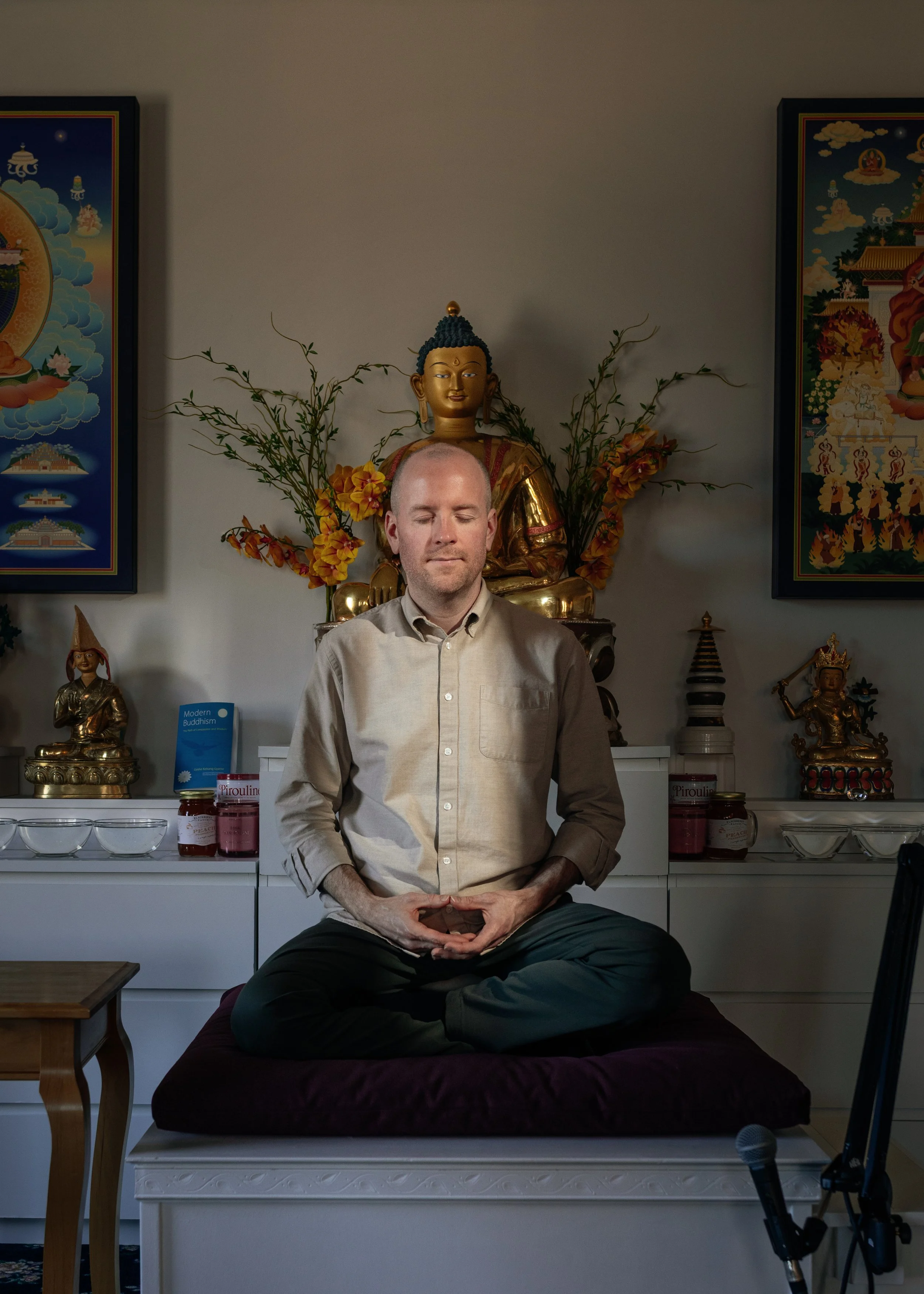
I was a full-time musician. I was in love with jazz and all sorts of music, and I spent my time immersed in that world.
Then I suffered a bit more and realized that I needed something more than just music. For some people, music might be enough, but I needed something to protect my mind and help me transform my difficulties into something more meaningful.
It was definitely a natural progression. By the time I had that empowerment weekend, about twenty years ago, I think I was there.
That weekend really stands out in my mind. I left feeling, “Okay, now I’ve got both feet in. This is amazing. This is something I want to make central to my life.”
I was still just as interested in music. Buddhism wasn’t taking anything away from that. It was simply another part of my life, and I felt that I was a Buddhist now.
We sometimes think of these teachings as medicine. I don’t see it as me giving someone a teaching that they need to follow. I feel fortunate to be able to share something that all these realized masters have benefited from.
If it helps someone even slightly as much as it has helped me, then I feel very fortunate to be able to share it.
-
I guess a big turning point in my life, which I only realized much later was probably what drew me to Buddhism, was that my father passed away when I was ten years old. We were on a camping trip in the Adirondacks. It was unexpected. He just had a heart attack while canoeing. As a ten-year-old kid, that was a lot to deal with.
I also experienced a lot of death in general throughout my life, with other friends and family members passing away over the years. I won’t go into all of that, but I think death was this ever-present thing in my life.
I have an amazing mother who has always been a spiritual seeker. She did some pastoral counseling and various other things. I think she always had an interest in Buddhism.
She did an amazing job raising my brother and me after my father passed away, all while going back to school to become a physician assistant. She had just started that process, and she’s amazing.
I guess when I was in my early twenties, she heard about a Kadampa Buddhist class in northeastern Pennsylvania. A temple had just opened in Glen Spey, New York, and they were offering classes in the surrounding areas. She heard about it right away and went to the first class. I think it was basically what she’d been looking for her whole life.
She invited me along shortly afterward. Gradually, she introduced me to it. She was very skillful about it because she didn’t push it down my throat. She would just say, “Hey, if you want to come to these meditation classes, come up to the temple with me.”
Meanwhile, I was a full-time musician. I went to college in Philadelphia. My father was a huge music lover, so I grew up with music. At the time, that was my spiritual path, in a sense. I was in love with jazz and all sorts of music, and I spent my time immersed in that world.
There were a few years when I thought this Buddhist thing was cool, but my mom was into it. I was still an immature kid, and I thought it couldn’t be that cool if my mom was into it!
Then I suffered a bit more and realized that I needed something more than just music. For some people, music might be enough, but I needed something to protect my mind and help me transform my difficulties into something more meaningful.
A few years after my mom got into Buddhism, I had a turning-point weekend. I went to what we call an empowerment at the temple in New York. We have special festivals where people from all over the country, and sometimes all over the world, get together to draw close to a particular Buddha and receive profound teachings. They’re big, inspiring events.
One of these was particularly transformative, and that’s when I feel my practice really started.
Gradually, what I love about the Kadampa Buddhist path is that, from an early age, I was interested in spiritual things. I studied Eastern traditions in particular because they were around the house. But I didn’t realize I was seeking one particular path until it appeared in my life.
That’s really all I can speak to: Kadampa Buddhism. Sometimes we have this idea about Buddhism that you have to go on retreat or abandon your friends and family. There are all these strange ideas about what it means to be Buddhist.
One thing I love about Geshe Kelsang, the founder of our tradition, is that he emphasizes that it’s simply about training your mind in your daily life. It’s about learning ways of thinking and working with your mind.
It’s good if you can do some formal meditation, of course, but you don’t need to change anything externally or spend a lot of time meditating to experience the benefits.
That helped me for many years as I continued my music career. My practice kept going deeper, and I started doing more retreats.
To make a long story short, when COVID hit, a lot of things in my life flipped upside down and shifted, probably as they did for many people.
I ended up transitioning from life in Philadelphia, with a certain community and a career as a musician, to losing a job. That ultimately turned out to be a blessing in disguise because it freed me up to move to the temple in New York full-time.
If I were to ask you today to label yourself, would you say you’re a Buddhist?
I would, yes.
When did you start calling yourself that?
Interesting. I’ve never thought about that.
It was definitely a natural progression. By the time I had that empowerment weekend, about twenty years ago, I think I was there.
That weekend really stands out in my mind. I left feeling, “Okay, now I’ve got both feet in. This is amazing. This is something I want to make central to my life.”
I was still just as interested in music. Buddhism wasn’t taking anything away from that. It was simply another part of my life, and I felt that I was a Buddhist now.
I don’t know if this is related to what you’re asking, but in Buddhism, we talk a lot about how we identify ourselves and the power of the mind.
For me, saying I’m a Buddhist doesn’t carry the weight of saying I’m Buddhist but not something else.
Yes, it’s not an exclusion of everything else.
Exactly.
There are some wisdom teachings about that which I find beneficial. We use the word imputation, which basically means assigning a name or label to something.
When I say I’m a Buddhist, it reminds me that, because I’m a Buddhist, I’m not going to harm living beings. That’s a central teaching. So reminding myself that I’m a Buddhist has that benefit. It’s just a label that we can take lightly.
When you started becoming interested in Buddhism, you were in Philadelphia and working as a musician. When you talked to friends and colleagues about it, if you did, how did they react?
That’s a good question.
It feels like a previous lifetime now. It’s not a path that a lot of people take.
No, I guess it isn’t.
There are probably more jazz musicians than Buddhist teachers!
That’s true.
I do remember, now that you mention it, a period in my life when I struggled with it. It was earlier in my practice, after that weekend I mentioned.
I’m the type of person who, when I get into something, really gets into it. Before that, my life had been all about music. Then I discovered this tradition and became inspired by it.
It’s such a rich tradition. We have twenty-three incredible books, and there are teachings available all the time. You could devote your entire life to the practice if you wanted to. For a while, I struggled with how to balance these two things.
Fortunately, I had a friend in the city who was a cellist and a professional musician in Philadelphia. She had been a Kadampa Buddhist for many years and was an inspiring example of someone who showed me what I’d been talking about earlier: that you can integrate Buddhist practice into your life. It doesn’t have to be an either-or situation.
Perhaps everyone has to work through that question in their own way, but she helped me realize that I love music and I love the Dharma, the Buddhist teachings. I could simply keep doing both. Once I relaxed into that, I actually began to enjoy music much more.
There were aspects of the environment in which I studied jazz in college that I didn’t fully resonate with. There was a certain amount of ego involved, with everyone competing for gigs and things like that. To some degree, I had lost a little of my enjoyment of music.
Funny enough, once I got deeper into my Buddhist practice, I felt that everything musically improved. I enjoyed it much more, started getting better opportunities, and probably improved as a musician, too. I felt that the two worked beautifully together.
I love that you asked because I haven’t thought about it in a while.
It’s not as though I deliberately sought out Buddhism to help my musical career. I wasn’t intentionally looking for something that would improve my music. It was more that I found this practice, and then I realized it was improving all areas of my life. Naturally, I began to enjoy music more and improve my relationships with other musicians.
One simple benefit I remember from early on was learning about the Buddhist concept of rejoicing. It’s an important practice in Buddhism. Whenever someone else is happy, doing well, or succeeding at something, you can simply be happy for them. We call that rejoicing. It’s an easy way to increase positive karma in your own mind, and it protects you from the unpleasant mind of jealousy.
I remember another bass player who was getting gigs in the same music scene as me. If I’m honest, I felt a little jealous. Then I received a teaching on rejoicing, and almost overnight, that feeling went away. I thought, “Good for him!”
We ended up becoming really good friends and played together a lot, including bass duets. We’re still good friends today.
There are probably a dozen other stories like that I could tell.
Do you think a spiritual life, or a religious life, if you want to use that word, is better than having no religious or spiritual life at all? Buddhism is a practice-based religion, which is an amazing thing. Do you think having a spiritual practice is better than not having one?
I like how you described it as practice-based because we actually define Buddhism as the practice of Buddhist teachings. I’ve always loved that. It’s like a verb.
I think it depends on how we define spirituality and so forth. There are probably different ways of looking at the question, but overall, yes.
I would never tell someone else that they needed it. But when I look back at my life before I had a practice, the contrast is so stark. I try to reflect on that fairly often to remind myself how far I’ve come.
On a spiritual path, especially a long-term one, it’s very common to become discouraged. Everyone encounters obstacles and difficulties.
I try to use my memory wisely and remind myself, “Before you encountered these teachings, your mind wasn’t in a good place.”
Sometimes, the alternative of not having spirituality feels frightening to me. I honestly don’t know how people get through life without meditation, without somewhere to rest their minds and find some refuge, some inner protection.
But everyone is different. For me, that’s what encourages and inspires me to share these teachings almost every day at the center.
Even if I’m benefiting just one other person, it feels worthwhile to share something meaningful.
We sometimes think of these teachings as medicine. I don’t see it as me giving someone a teaching that they need to follow. I feel fortunate to be able to share something that all these realized masters have benefited from.
If it helps someone even slightly as much as it has helped me, then I feel very fortunate to be able to share it.