
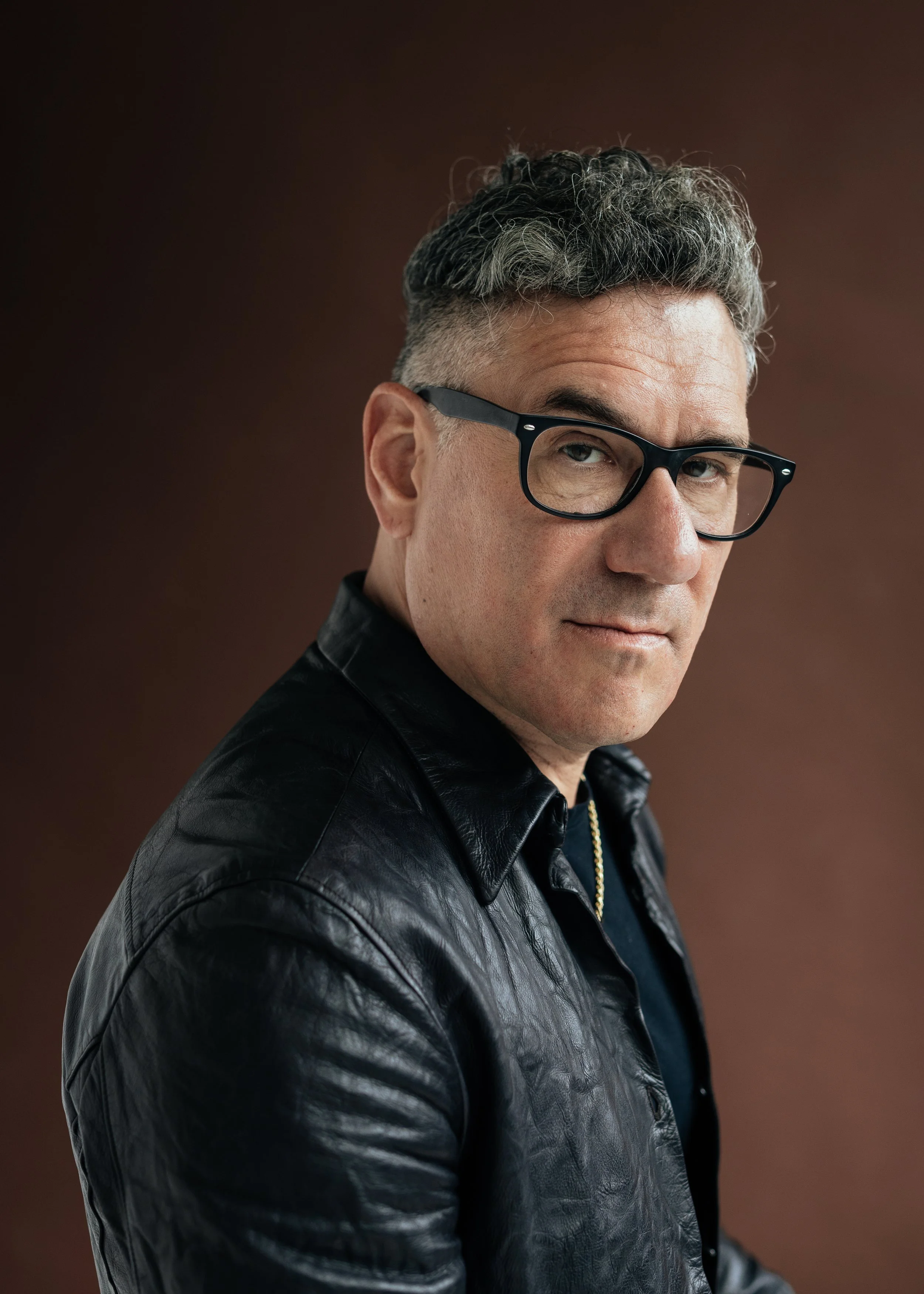
Mitch Horowitz / Brooklyn, NY
I think the problem with a lot of our religions, both Eastern and Western, is that they ultimately view the world that we dwell in as illusory, temporal, less than. Compared to the greater, invisible world. And I came to question that.
Of course, this world is temporal in the sense that we will all experience physical decline and mortality. There's no exception to that.
But I do believe there there is an unseen world. I know there is an invisible world, and I can defend that in all kinds of ways. But none of us know how it works. None of us know what it is.
None of us know, for example, how the prayer appeal works, or how ESP or telepathy, as validated in empirical, clinical, laboratory studies, of which many abound, works.
I think what really happened for me, and I would say somewhat recently, maybe, oh, I don't know, in the past 15 years, is I came to really feel that self expression, creativity, aspiration, as defined by the individual, were not things to be qualified or tempered, but to be run towards in fullness and completeness.
I think that at this juncture in my search, I don't make any distinction between inner and outer, higher and lower, attachment, non-attachment, identification, non-identification, personality, essence.
-
In terms of spirituality, I grew up in the borough of Queens, here in New York City, in a traditional Jewish household, way out in eastern Queens, in a town called Belrose.
The subways did not go out there, and we thought of Manhattan as the city.
This was someplace that you could take a trip to.
I think for me, when you said your project was about religious conversions, I never experienced a formal conversion in terms of awakening, or a born-again experience, or making the decision to leave one faith and affiliate with another.
But I think what really happened for me, and I would say somewhat recently, maybe, oh, I don't know, in the past 15 years, is I came to really feel that self expression, creativity, aspiration, as defined by the individual, were not things to be qualified or tempered, but to be run towards in fullness and completeness.
I think that at this juncture in my search, I don't make any distinction between inner and outer, higher and lower, attachment, non-attachment, identification, non-identification, personality, essence.
I ask myself, where does the individual feel his or her sense of fullness?
For me, for example, that fullness arises from writing, speaking, appearing in public.
There's a happiness there. There's a good joy there.
And I think the problem with a lot of our religions, both Eastern and Western, is that they ultimately view the world that we dwell in as illusory, temporal, less than. Compared to the greater, invisible world.
And I came to question that.
Of course, this world is temporal in the sense that we will all experience physical decline and mortality. There's no exception to that.
But I do believe there there is an unseen world. I know there is an invisible world, and I can defend that in all kinds of ways. But none of us know how it works. None of us know what it is.
None of us know, for example, how the prayer appeal works, or how ESP or telepathy, as validated in empirical, clinical, laboratory studies, of which many abound, works.
None of us really know what are the implications of multi-dimensions, let's say.
One goes back to the Schrodinger's cat experiment in the 1930s, when Schrodinger disturbed the whole Western world by saying, guess what, these oddities that we observe on the particle level do have implications in our world, and the Schrodinger's cat experiment was intended to force physicists to come to grips with the outlandish implications of what they were documenting.
So let's say we can generalize from the Schrodinger's cat experiment and say we live in a multiverse, or we live in many worlds, infinite worlds, perhaps.
I can't even conceptualize what that would look like, even though evidence exists for it.
And so, it seems to me, it's all one whole, it's all one thing.
I would never dismiss what goes on in this life as temporal, otherwise we wouldn't try so hard to hang on to life.
And people describe experiences, near-death experiences, out-of-body experiences, transpersonal experiences, and I venerate those things.
But we're still just on our knees kind of peeking through a keyhole at one element of what they did, and I encourage people to pursue that, but I suggest not getting lost in strictures that degrade our physical, actual world, because it's what we know, and it's for this moment what we occupy.
So I really began to think very acutely about what made me happy, and my assumption is, and I explore this a lot in the new book, Esoterica, my assumption is that no individual life is exclusive, and as such, I do think it's possible for anyone to generalize from their life to another person's life, maybe not in every case, but we do experience human universality, we cry at the same things, we laugh at the same things, we watch the same movies globally, so obviously there's a universal language, and it seems to me that the chief vacuum that exists in people's lives is a lack of self-expression, and that can be very broadly defined.
And I think a lot of the sorrow that people go through life with, maybe the depression, the anxiety, the addiction, the anesthetizing effects of falling asleep watching television, all of these things maybe are due to or heightened by a lack of self-expression.
It's broadly defined. For one person, that could be very different from another, obviously.
And I take that very seriously, and I believe in the primacy of the individual, and I really am interested in that question.
I also have very little faith in human nature.
Somebody was just saying to me on a podcast, a good man, that we're all Buddha in potential, or we're all Christ in potential. I see you smiling at that, and I smile at it too, because I don't, first of all, those examples are so far away, they almost amount to no possibility whatsoever.
I don't even know that Christ and Buddha existed, I don't know that Moses existed, I don't know that Socrates existed.
I think he did, but we don't really know.
And these examples are so far away, so far away. To have to reach for them almost suggests the very impractical nature of what's being proposed.
I don't really believe that every individual has the capacity to be Christ or Buddha. I'd be a committed Christian, or I'd be a committed Buddhist.
Why wouldn't I? I don't believe that. And if it's true in one of a million cases, isn't that really just the equivalent of something effectively not being true? It's so rare. Is it really true if it's that rare?
And yet I also recognize these are ideals, and I read the Beatitudes, I read the Dhammapada, I read all the great religious literature, and yet the issue is that none of it penetrates, none of it penetrates.
Everybody sits reading the sayings of Buddha or the Tao Te Ching in a chair and says, oh yes, absolutely.
But then when we get up from the chair and go into the frictions of life, the emotions take over, physicality takes over, all these ideals are gone, instantly.
And everyone around the world agrees that war is horrible, war solves nothing, there should be no more wars, and yet we keep having them.
And it doesn't matter that every individual agrees, absolutely, war is terrible, it should never occur. I don't think you can meet anyone on earth who would not say, “yeah, it's really awful”. But we just keep having them.
And so what does it matter, all this wisdom literature, if it fails to penetrate me?
And so I place very little stock in humanity, but I am interested in the individual. And there are certain sensitive, beautiful individuals with very fine emotions, and I love them, but I don't love humanity as a whole by any stretch.
You said that lack of self-expression is an ailment.
Yes.
Isn't there a dichotomy?
Maybe, maybe. I mean, I wrestle with that because, I don't know, I must acknowledge, within humanity there may be a certain scale of coarseness to fineness of emotions. And say people with fine emotions are empathic. People with coarse emotions, they lack a sense of ethics, maybe they do not aspire to more than crowd pleasures.
And I understand crowd pleasures. I understand the energy that one feels in a massive soccer stadium and in a massive concert. It's exciting, it's thrilling and I too have participated. And then it fades, and then a person goes back to consuming and doing whatever he or she does in life. So I maybe things are grimmer than I even allow. Maybe there's not a wish for self-expression.
But I concern myself with those few people I meet who I really feel have a question, have a fineness of emotion, who aspire to something more.
That's my energy.
That was my conversion.
I stopped thinking in terms of Christ and, I don't know, the Jewish tradition is kind of interesting. Everybody's flawed.
King David, very flawed. Moses, flawed. Abraham, flawed. I like that. Because I, and I find that within the Hellenic gods as well. They're all just bigger versions of us. Mercury, flawed. Zeus, flawed. Filled with jealousies and stupidities.
And I like that because I don't want people to feel that the invisible world is so far away from them. Maybe the invisible world is very similar to ours, filled with all the same problems, just on a different scale.
Maybe. So, that's where my search has brought me. I guess you could call it a conversion. In that it, it is, I'll put it this way, in Alcoholics Anonymous they talk about a moment of clarity.
I like that.
I guess I could say this was a form of clarity for me. I don't know if I'm right, but it certainly organized a lot of different ideas for me.
When did you become aware that the invisible world is here somewhere?
I always believed it was there. As a child, I felt that the prayer response did elicit something. It really did. And I think that persuaded me. As a child, I also, and this has stayed with me to this day. Maybe it's illusion, maybe it's conditioning, but when you grow up in a traditional Jewish home, people criticize this, but it's the truth. You do see God as, there are people who won't like my saying this, as the great man in the sky. And if you are good and follow the rules, he will bring down rain on your fields and you'll prosper. If you're bad and violate the rules, you're going to suffer.
And that cause and effect relationship to a father figure called Yahweh or Jehovah or God or whatever you want to call it. Within Judaism, God is a loving, but also punitive parent. A very tough parent who loves you, but will get very, very rough with you if you break the rules.
And you find this throughout the Old Testament and the prophets and the rabbinical stories. That has never left me, that notion that we have a relationship with the unseen world.
Nowadays, I might think of it more in terms of reciprocity, a pendulum swing.
A Hindu might call it karma. I don't like using the word karma because within classical Vedas or Hinduism it's so large a concept. And like anyone else, I want to believe in what John Lennon called instant karma. And I think sometimes that does occur, but that's not really the classical view of karma. It's so large an idea, I don't like to just cherry pick it.
But I do believe in this kind of cause and effect spirituality. And that probably comes from my Jewish youth.
And it's interesting, Judaism, very rules-based, a lot of mystery, but a basic abiding belief in cause and effect. I think you find that in Christianity as well, with a greater emphasis on the afterlife. You find that obviously within Islam.
It's hard when you grew up within that to think outside that framework. But I just accept it. I accept that I think that way. But I do try to remember, I might think differently if I grew up in Polynesia or something.
And how did you first encounter thoughts outside of Judaism?
Well, early on growing up, I encountered it. I was fascinated with all the different occult and esoteric ideas that were popular and bubbling up. In the 1970s, I was fascinated with astrology. I was fascinated with Pennsylvania Dutch folklore. I was fascinated with UFOs, Bigfoot, flying saucers, ESP.
My big sister brought home the books of Carlos Castaneda. And I remember feeling then, as I do today, there's something here. We're all supposed to hate Carlos, but there's something there. The cynics will never understand it. So there were ideas other than the traditional Jewish ideas that ran through my household.
Of course, as I got older, and now especially, I realize that there isn't the neat line of division among these ideas.
For example, astrology played a role in early Judaism. We draw these artificial lines with Judaism. You find teachings of reincarnation. You find validation of ESP. You find great openness to every conceivable occult conception. And you don't even have to go into Kabbalah or what have you. It's there in folk tradition.
So I never felt distant from any of those things. I think the same is true of Catholicism. So I never felt distant.
In your search, you never necessarily felt like you renounced or took a step away from Judaism?
No, not really, no. I stepped away from congregational spirituality. I am left very cold by congregational spirituality.
I understand the Christianity, the Pentecostal and the charismatic Christians. I really understand that. But congregational spirituality leaves me really empty.
And so I realized in my early thirties that I didn't want to be part of that. It just didn't speak to me.
You said that a lot of these thoughts and teachings, astrology and so forth, has been weaving through a lot of religious traditions. And so therefore it might be difficult to maybe… I guess my question is, if you identify now with a particular teaching, or if you would label yourself with anything. What would that be?
Chief and above all, I label myself a seeker. That's the title that I use.
I call myself a believing historian.
If someone called me an occultist, I wouldn't object to that.
I am very interested in what is sometimes called the left-hand path, which is in modern parlance, I think, a western path that emphasizes the primacy of the individual.
I'm very, very interested in early conceptions of what the Hebrews called HaSatan, or what we call Satan, before millennia of conditioning solidified a view of that concept of the invisible world that makes it almost impossible to communicate about.
But it's fascinating to look at the fragments of the earliest iterations of our religious traditions, because you will find the use of terms like demon, for example, in Greek, that are neutral.
The demon was simply a kind of worker bee spirit, like what we might consider a genie in Arab tradition.
The figure of HaSatan, or the prosecutor, the adversary, the disturber, was not a negative force. It was a force in nature to the early, early Jews.
And then centuries and centuries and centuries of conditioning make these things impossible.
But I'm trying to, in my current work, and I do this in the new book to the degree that I'm capable, I'm trying to go back and back and back.
I'll never accept these modernist interpretations and conditioned ideas. Let's go back as far as we can to the earliest human expressions, the very earliest expressions. They're just fragments that have reached us. I'm trying to understand something about what our most primeval ancestors meant by this term or that term.
I've been doing that ever since I've been a kid. When I was a kid, a little kid at nine, I was fascinated with newspaper astrology. And anybody would say to me, it's all bullshit, it's all bogus, you're a sucker.
I didn't care for an instant. How do they know? These symbols go back to ancient Mesopotamia. How does my grandfather know that it's not true? I wanted to know where this came from? How did the ancient Mesopotamians? Admittedly, it's very far away. We don't have that much insight. But based on what we do have, what did they think? Why did they think it?
And so I'm really, really interested in primeval spiritual expressions. What did our ancient ancestors think prior to centuries and centuries of conditioning? That's my approach.
I know you're a historian, and also a seeker. So why is the beliefs of people that long ago of interest to us here today? Haven't we evolved our own thinking at this point?
Absolutely. And I don't think an idea is valuable just because it's antique. Nor is an idea cheapened because it's new.
But the ancients did lead very precarious lives, of course. The line between life and death was very narrow. They sought allies. They sought help. And I'm interested in that. I'm interested in allies. I'm interested in sources of power.
And when I say power, it's such a difficult word to use because people hear it as force. I certainly don't mean that. But I do see sources of power.
And so I'm very interested in what our earliest ancestors were doing. Their lives were very precarious. They had very, very deeply felt needs.
One of the things I've written about recently that's just fascinating to me, even going back to our pre-human ancestors, Neanderthals.
Neanderthal men and women had little statuary that in the 19th century came to be called Venus figurines. It's a bulbous feminine form. These are thought maybe to be appeals to a fertility goddess or a mother goddess. We don't know. They had talismans, eagle talons, bear claws. Maybe these were appeals for help with the hunt. It's fascinating to me because they are a lot like us, but they're not us. They have a different physiology, they have a different gait, they have a different spine, they have a different cranium. They're not us but very similar.
So it tells me that there's some kind of realization in spirituality. These are beings who, let's see, I guess the last of them must have died out 40,000 years ago. And we have just these threads of their existence. But the fact that we in the 21st century could look at one of their presumably religious statues and recognize it. It's incredible.
What were they in touch with? What were they praying to? Of course, a cynic would just say it's just all imagination, but I don't know that. They had a life that was different from ours, but similar too.
I saw that you spoke at the Theosophical Society.
Oh, well, I just love Madame Levinsky because she was so outrageous and she just blew open the Western world. And she died so young. She was only 59 years old when she died. The level of achievement that that woman attained, her most vociferous critics, they just cannot understand her. And they cannot escape her. I mean, she died in 1891, a long time ago. And people to this day in places of lettered authority, they fulminate over her.
When I was working in publishing, we issued a biography of Madame Levinsky, a very good biography. We got these thunderously negative reviews in Harper's Magazine and in the Paris Review. We never even sent the book to them. I wasn't really thinking of the Paris Review when I published it. And yet they were possessed of the need to hold forth on the subject of Madame Levinsky. They'll never contain her. They'll never understand her. She was remarkable.
Because they feel like she should not be in the papers or polite company?
Yes, exactly. And then I suppose they feel that she unleashed all this irrationality into the world. They have no idea what she unleashed into the world. In the most quotidian terms, she was a professor in influence on Mahatma Gandhi. Gandhi wrote about this all of his life, right up until his assassination. He said that meeting Madame Levinsky in London in 1889, he was a young guy. He was studying to be a lawyer, very unhappy, very lonely. He met her and he said he got his first glimmer of his philosophy of human equality, of human universality. He couldn't have been plainer about it. Wrote about it. Talked about it. Spoke of it in interviews. So, that's just one tiny thread of what Madame Levinsky brought into the world. Her fingerprints are on so much.
I wouldn't be able to search as freely and as fully as I do were it not for her influence. She made it possible. So, I have a lot of affection for her.
You mentioned that you have two sons. Have you tried to teach or influence their individual search in any way?
Not really. I wasn't able to. I mean, I think kids have to rebel. They have their own wishes and interests.
I'll catch them saying things that I'm proud of. You know, sometimes my younger son who's now 19 said to me, “I was reading the Quran last night”.
I said, “yeah, what did you think?”
And he said, “it's a lot like the other Abrahamic religions”. I thought, okay, I appreciate that.
My older son, sometimes there'll be intrigues going on in his circle of friends and he will refuse to gossip, refuse to participate in any of that stuff. Which is something I'm trying to work with him. So, I appreciate that. I'll be happy hearing things like that versus them saying, you know, we're joining Dad at the UFO conference or something.
Which they're not going to do. Although you never know. We'll see where their search takes them.
I’m curious, do you have any rituals, practices?
Well, I practice Transcendental Meditation. I do that twice a day.
By yourself?
Oh, by myself, yeah. I'm very interested in, as you'll see in Esoterica. I’m interested in the properties of thought and the properties of the psyche to select circumstance, select experience from reality. I work with that a lot. I'm very interested in the powers of emotionalized thought and that might be expressed through visualization, affirmation.
I am particularly interested in honing the quality of one's wish. I think that a wish finely honed and defined, passionately felt, with absolute lack of embarrassment and private reality is possibly the most powerful turnkey to the causative properties of the psyche.
And so, I'm very interested in that. I work with that quite a bit.
I'll have private practices where I might seek assistance through prayer or what have you.
I suppose early on or throughout, has there been any people in particular who inspired you, guided you through research?
I was inspired by the figure of G.I. Gurdjieff, the Greek-Armenian mystic. His thought has influenced me more than anyone else. I spent about eight years in a group dedicated to working with his ideas.
I'm inspired by the figure of Neville Goddard, who I have a tattoo of on my arm. He was a British Barbadian mystic who died in 1972.
Neville's essential teaching is that everything you experience is the outpicturing of emotionalized thought and that we are literally beings who self-create all of our reality through our mental pictures. He formed, without question, the most elegant mystical analog to quantum theory and the many-worlds interpretation, which he spoke of in ways that almost were ten years or so ahead of their time. It was quite remarkable.
So I would say Gurdjieff, huge influence. Neville, huge influence. The philosopher Jake Needleman, who is now dead, was an influence on me. A teacher of mine at the Gurdjieff work, who I reference frequently in the book, was a huge influence on me.
You spoke of this a little bit, but has everything that you've learned in your search, has it changed how you view the Judaism of your childhood? Or have your views on Judaism changed?
I wouldn't say it's changed. I'm probably, in frankness, the same person today that I wasn't before. I don't think it's changed it, really.
I just had a certain point in my life, in my early thirties, where congregational spirituality was not of interest to me. I personally have never resonated with Kabbalah. Everyone always asks me, oh, you must really be into Kabbalah. But it never really spoke to me.
I think probably this notion of gleaning something about the cosmic order, I was satisfied with what I found in the ideas of Gurdjieff.
I'm very interested in hermeticism, ancient Greek-Egyptian philosophy. There, too, one finds a schema of reality with which I'm very satisfied. These things do not contradict Kabbalah. But the thickness of Kabbalistic tradition never personally spoke to me.
I found, insofar as I'm interested in cosmic order, expressions that I connected with more fully in hermeticism than in Gurdjieff.
Is a religious or spiritual practice better than none at all?
It entirely depends on how that practice plays out and on the sensitivity of the individual.
Jacob Needleman used to say, “I would much rather have a searching atheist than a settled religious practitioner”.
My only interest is in the individual who possesses a real sensitivity and has a question. So if that question is held by an orthodox religious figure, if that question is held by a strict physicalist, then that's my friend. Otherwise, I'm not interested in that person.
So I don't think there's anything inherently better about a life marked by spiritual search so much as a life marked by the holding of a question.
Is that different? Holding a question or spiritual search?
I think it's different in so far as, for me, spirituality is extra-physicality, and if a person abides only in extra-physicality and doesn't have a question, they're just an ideologue.
I guess I could say that maybe I could meet somebody who does not share my outlook in the existence of an extra-physical world, but if they have a question, well, we might be able to talk about inter-dimensionality, we might be able to talk about ESP research.
They might find that their strict physicalism is not so unbridgeable to my own metaphysics.
They might find that my interest in the individual meshes well with whatever they're interested in. We might be able to talk about ethics on an emotional scale.
I wouldn't say that somebody needs to abide the extra-physical in order to have a meaningful search, so much as I think there has to be sensitivity, a question, and that can't be manufactured. I'm not sure that can be taught at all, any more than curiosity can be taught.
I spent 27 years in corporate publishing, and I would see young people flow in and out of that profession. Some of them, a very slender minority, would read the books that the company was publishing, and most wouldn’t. I couldn't explain to the most who wouldn't why they should. They would look at me blankly and find me boring. And those who did usually went on to interesting things, but they were the minority, and they couldn't be taught.
You've been writing and talking about these things for some time. Have you noticed a difference, a change in how these ideas are being perceived now?
Well, I have certainly noticed that the New Age spiritual interpretation of quantum physics and quantum theory has moved closer to the center in terms of what would be tolerated within the framework of discussion, both within the sciences and the mainstream media.
It used to be that if someone like me, someone just uttered the word quantum, it would be enough to instigate a witch trial. And now that's changed.
Now the discussion of the quantum on terms that spiritual people have adopted has become more mainstream and more tolerant within the circles of hard science, including in journals like Scientific American, where now and then maybe somebody goes on vacation or something and they write an article on quantum physics that sounds a lot like the spiritual interpretation. And then they'll run to insist that it's just a blog piece. It doesn't represent our point of view, but it does appear within the magazine. And so that's good. I've seen a change there.