
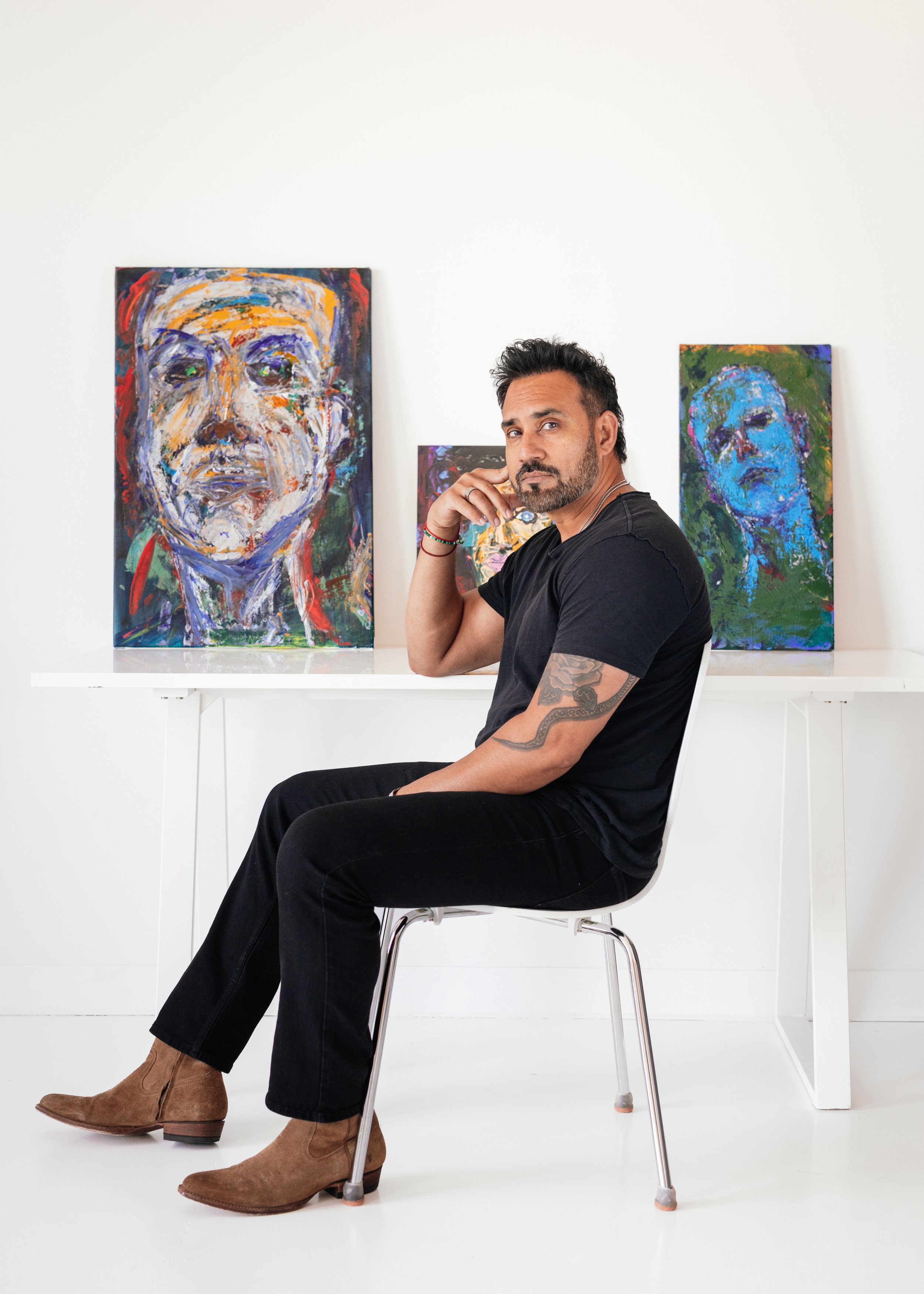
Naeem Fazal / Charlotte, NC
So we prayed. I prayed for Jesus to come into my life and all that. But I said something like, “Jesus, I don’t know who you are, so I can’t say you’re the Lord of my life. I don’t know who you are. I can’t say I love you. I can’t say any of those things. But if you save me from this, I’ll give you my life.”
The room had been replaced. Whatever evil presence had been there before was gone, and now the room was full of something else. It felt as though I were in a different dimension. I don’t know how to describe it.
I looked, and there was a figure. It said, “I’m Jesus, and your life is not your own.”
His presence was so intoxicating. I couldn’t keep my eyes off him because I was thinking, what is this? But I also couldn’t keep my eyes open. It felt as though my body couldn’t remain in his presence, as if we were in two different dimensions.
I was looking at him from a distance, but I remember saying, “But I’m inside of you.”
I was looking at him, but I was inside him. I don’t know how to explain it.
He put me to sleep, and the next morning I woke up feeling as though I’d received a vision of what my life was supposed to be. I felt that I was supposed to be in ministry.
-
I guess I just want to take it back to the beginning. Tell me about yourself, your background, and how you became a Christian.
I have two brothers and two sisters. We all grew up Pakistani in Kuwait. We were an immigrant family living in Kuwait, and we grew up Sunni Muslim.
We were conservative. My sisters covered up, and we would go to Friday prayers, all those things. But we weren’t radical Muslims or anything like that. We were culturally Muslim.
My brother got accepted to a university in America after he graduated from high school, so he came here. Then he came back the next summer and told me that he was a Christian, that he had given his life to Jesus, and that he was born again.
He was saying all these things I didn’t understand, but he was also very adamant about it. He was going to tell Mom and Dad about this and everything. When he started telling me, I got so angry. In fact, it got pretty intense. I threatened to kill him. I grabbed him by the neck and cursed him out. It was so intense that he decided not to tell Mom and Dad.
Because it felt like a betrayal?
Yeah, I felt like it was a betrayal.
The reason Islam can make conversion feel like such a betrayal is that Islam is like a global nationality. When you convert, you’re seen as defective, a traitor to the nation, to the movement of Islam. You’re also saying that you don’t believe the Prophet Muhammad was true. So a lot of things are implied when you stop believing. You’re saying he’s false. That’s why.
After that, my brother went back to the U.S. In 1990, he was still here, and we were still in Kuwait when Iraq invaded. We were stuck there during the war.
In 1992, I got a chance to come to the U.S. My dad asked me what I wanted to do. I hadn’t graduated from high school yet, and he said I could either start working or try to get a work visa for Kuwait. He said, “Or I can get you a tourist visa to come to the U.S. Maybe you can stay. Maybe you can get into college.”
I was 18 at the time, so I thought, okay, let me take that chance.
My brother was living in Charleston, South Carolina, so I went to stay with him. I knew he was Christian, but I wasn’t interested.
Your parents didn’t know what was going on? No one knew?
I knew, and my siblings knew. My sister was knew it, too.
When I came here, my brother started introducing me to his Christian friends from day one. They were all very committed Christians, and I wasn’t interested in any of that.
Everything they did was Christian-related. They went to a Christian group on campus called FCA, Fellowship of Christian Athletes, and they invited me to come along. I said I wasn’t interested
My brother said, “Hey, you want to meet people? There are girls there.”
So I thought, all right, I’ll go just to hang out. He said, “You’re good. You’re just going to come hang out.”
That’s where I heard about the gospel, about the difference between Islam and Jesus, and what makes Jesus’ teachings unique.
The difference is that, in other religions, you have to prove that you’re worthy of God, or prove that you love God by doing all these things. With Jesus, what he did was proof that God loves us. He came down. He is God with us, Emmanuel. He paid the price. He pursued us more than we pursued him.
That was very intriguing to me, but it wasn’t enough to make me convert or anything like that. I wasn’t interested.
My brother kept telling me that Jesus was so real that he would actually show up and reveal himself to me. He was supernatural.
I told him he was crazy.
For a couple of weeks, he kept insisting that if I just asked, Jesus would reveal himself to me. One night, I actually did ask, in a way. I said, “If this is real, I want to know.” But it wasn’t really a prayer or anything like that.
A couple of nights later, I was in my room, and this is where the story gets really crazy.
I think you’ve heard this story, right?
Yeah.
Do you want me to say that?
Yes, please. I’d love to hear it.
I was in my room, reading a book. There was a lamp on right next to me. My brother was in the other room, I think asleep or something.
All of a sudden, I felt that the room changed, like something was happening. My body began reacting to something I couldn’t really see but could sense. My heart started racing. I was thinking, what’s happening?
I looked around and felt like I could see things in the room. I definitely felt evil and death. The room had changed so suddenly.
As I was looking around, wondering what was going on, something grabbed my shoulders, dragged me down, and pinned me to my pillow. I tried to react and get out of it, but I was being held down. There was a wall behind me, and I realized I couldn’t move anything. Something was holding me down. I couldn’t move at all.
I kept thinking, what’s going on? Am I dreaming? What’s happening?
I started screaming and calling for my brother, but I realized I couldn’t really say anything. I couldn’t hear myself speaking. I wondered whether I was dreaming, but I hadn’t even fallen asleep. I wasn’t ready for bed.
Then the door opened. I thought my brother had heard me, but something walked into my room. I couldn’t believe what I was seeing. It was like a walking gargoyle, like those old statues of gargoyles you see on cathedrals, but in a shadowy form. It looked two-dimensional, almost like a shadow, but also like a figure.
I was shocked by what I was seeing. Then I heard it communicate something to me: “I’m going to kill you. You’re going to die tonight.”
At that point, I joked that I was praying to every god out there: Allah, Buddha, Oprah, everybody.
Then I thought, man, maybe I’ve upset some gods. I’d made fun of Jesus a lot, and then I’d gone to a Christian event. I wondered whether this was Allah, whether it was Jesus. I didn’t know what to think.
It got closer and closer, until it reached my bed. I was thinking, oh my goodness, this is happening.
Then, all of a sudden, it disappeared.
I thought, what? Whatever had been holding me down let go. I felt like something had stopped it, but I didn’t know what had happened. I still felt as though things were in the room. It was just weird.
I slowly got out of bed, ran out of the room, woke up my brother, and told him what had happened.
He said, “This stuff is in the Bible.”
I asked him what he was talking about. I’d never read the Bible. He started telling me about the supernatural things in the Bible, about Jesus and all these things.
I asked him, “What does it want from me? What do I do?”
He began telling me about spiritual warfare. He said maybe there was an enemy who wanted to keep me from getting to know Jesus because he knew what might happen. He didn’t know for sure, but he explained that there could be something trying to prevent me from getting closer to God.
He told me I was standing at the top of a hill and could fall either way. If I went back to where I had been, I would go all the way down that path. But if I went to the other side, toward God, I would go all the way in that direction.
He was telling me all these things, and I was terrified. I just needed help. I asked him what I should do.
He said, “Well, you were making fun of Jesus, right?”
I said, “I guess.”
He said, “Well, I only know one person who has authority over demons and angels.”
I asked, “Who?”
He said, “Jesus.”
I replied, “All right, let’s do that.”
So we prayed. I prayed for Jesus to come into my life and all that. But I said something like, “Jesus, I don’t know who you are, so I can’t say you’re the Lord of my life. I don’t know who you are. I can’t say I love you. I can’t say any of those things. But if you save me from this, I’ll give you my life.”
That sounds very honest.
It was, yeah.
My original language is Urdu, but I also grew up speaking Hindi and Arabic, as well as English.
I prayed with my brother, and then I said, “Amen.”
He said, “All right, man. I’ll see you in the morning.”
I told him I wasn’t going back into my room. We had a whole fight about it. I kid you not, he gave me a Bible that was as big as your notebook. It was one of those small Bibles.
He said, “Read John. I’ll see you in the morning.”
Finally, I went back into my room. He told me, “Listen, you’re good. Jesus is going to protect you.”
I didn’t feel any sense of calm after that.
You didn’t feel a sense of calm after that?
No. No calm.
I left the door open and kept the lights on. I went back to bed, but I wanted to make sure my brother could still hear me.
I read for an hour or an hour and a half. It was getting late, almost dawn, and I was exhausted. Finally, I thought, man, what am I doing?
Then I got angry. I thought, whoever God is, I don’t care. I don’t want to be part of this. I don’t want any of this.
I was going through so many emotions. I’d just been through a war, and I was thinking, I can’t have demon problems right now.
So I shut out the lights. My brother had fallen asleep in the other room. I just looked up and said, “Jesus, if I die tonight, it’s your fault.”
I don’t know why I said that.
Then I put the covers over my head, curled up, and tried to fall asleep. I didn’t want anything to hold me down again. I was just hoping nothing would happen.
A few minutes later, it seemed like something was trying to wake me up. I felt like something was trying to move me, and I thought, oh no, it’s happening again.
Then I realized I was sitting up in bed. I looked around because I was wondering what was happening in the room.
The room had been replaced. Whatever evil presence had been there before was gone, and now the room was full of something else. It felt as though I were in a different dimension. I don’t know how to describe it.
I looked, and there was a figure. It said, “I’m Jesus, and your life is not your own.”
His presence was so intoxicating. I couldn’t keep my eyes off him because I was thinking, what is this? But I also couldn’t keep my eyes open. It felt as though my body couldn’t remain in his presence, as if we were in two different dimensions.
I was looking at him from a distance, but I remember saying, “But I’m inside of you.”
I was looking at him, but I was inside him. I don’t know how to explain it.
He put me to sleep, and the next morning I woke up feeling as though I’d received a vision of what my life was supposed to be. I felt that I was supposed to be in ministry, that I was supposed to do this and that.
I told my brother. I didn’t know anything about denominations. I’d never read the Bible or been to church. I didn’t know a lot of things.
That experience started my journey.
For the next three years, I focused on that. Then I found out I’d been granted asylum by the government, so I stayed in this country and started college. I spent those years really focused on my faith. I felt very in tune with what I was supposed to do. I would feel called to do something, and I’d say, okay, I’m going to do it.
That has led to where I am in my life now, with all my siblings also coming to Christ.
And your parents?
That’s a whole story. The book Ex-Muslim chronicles all of that.
These are also my gifts to you.
Oh, thank you. Thank you. I actually started reading this.
Oh, no way!
And your parents? What happened with them?
The short story is that it was very hard for a long time. I told my mom, and we tried to move everyone here. There was a lot of turmoil.
Recently, my dad actually came to faith. The book Tomorrow Needs You is dedicated to my dad because he tried to commit suicide. He believed that nobody needed him.
After the attempt, he was in the hospital. I visited him, and he was deeply depressed. He said, “I can’t even kill myself. I’m useless.”
I told him, “Dad, don’t say that.”
He said, “No one needs me.”
I told him, “Your grandkids need you. We need you.”
He said, “No one’s going to forgive me. Your mom doesn’t forgive me.”
At that point, my mom refused to come to the hospital because she was so angry.
My dad also said, “Allah isn’t going to forgive me,” because in Islam, suicide is forbidden. It’s haram.
I told him, “Jesus will forgive you.”
He asked, “Really?”
I said, “Do you want to pray to Jesus?”
He said yes.
So right there in the hospital room, my sister, my brother, and I prayed with him.
Six to eight months later, his condition got worse, and he passed away.
My mom is still here. She’s still Muslim, but we have a great relationship.
Since your conversion, how has your view of Islam changed? Has it changed?
Yes, my view of Islam has changed.
I knew Islam as a religion, and I think all religions are unique, but they’re also similar in certain ways. They usually have a holy text, certain things you have to do, a definition of morality, and an idea of how you get to heaven.
But the message of Jesus is very different to me. As I’ve learned more about it, I’ve come to see that Christianity isn’t just about getting to heaven. It’s about bringing heaven down here.
There’s a sense of God’s Holy Spirit living inside us. There aren’t holy places; there are holy people. The teachings of Jesus are very radical.
Islam, when you read the texts, has a very human and patriarchal structure. You see that in the writings, in the way society is organized, and in the treatment of women, men, children, and different groups of people.
Another thing about Islam is that it has political roots. Muhammad was a political figure and a conqueror. He went back and took over the land he had been driven out of.
In that sense, Moses and Muhammad are more similar than Jesus.
Jesus wasn’t about land or conquest. He reached out to Jews and Gentiles and brought them together. That was his whole thing.
Because Islam is rooted in that political history, I think its teachings have often been weaponized by political figures with their own agendas. Some Arab countries have unstable governments and weak institutions, while others don’t. But there are plenty of texts that Muslims can use to justify extreme actions.
Think about it this way: if we didn’t have the New Testament and were supposed to live only according to the Old Testament, Christianity would look very different.
We have the New Testament, which says that Jesus is the fulfillment of those things. The Old Testament reflects humanity trying to understand who God is, while also trying to justify a lot of things.
Other than your brother, who influenced you early on in your journey to Christianity?
This whole experience happened within three weeks of my arrival. I hadn’t expected it to happen, and I didn’t have time to get to know anyone.
I met other people afterward, but they didn’t know what to make of me.
I don’t know what kind of Christianity you’re familiar with, but some Baptists, for example, don’t believe these kinds of supernatural things happen anymore.
There are denominations that believe supernatural events used to happen but don’t happen today. They believe that the things described in the New Testament, like speaking in different languages or performing miracles, no longer happen.
When I told some Christians my story, they didn’t believe me. They would say, “Oh, you had a dream?”
I’d say, “Okay, man, I didn’t have a dream.”
It is a unique experience. If you took a poll and asked people whether they’d had similar experiences, I think it would probably be extremely rare. But maybe that’s also why it was so impactful.
Oh, for sure.
I will say that it’s rare, but I’ve had people come up to me and tell me they’ve had very similar experiences.
In the Middle East, there are all kinds of stories about people seeing a man in white. That could be very similar to what I saw.
But people don’t share these experiences publicly because they live in closed countries. They don’t have a public ministry like I do, where they can talk about these things. They could become targets or face other consequences.
But these things do happen. I’m definitely not the only one.
Your family in Pakistan and Kuwait, your aunts and uncles, did they find out about your conversion? Did they know?
When my siblings came to faith, we didn’t tell the extended family. If you’re reading Ex-Muslim, I tell the whole story of how each of them came to faith in detail.
No, I don’t have Ex-Muslim.
You should read it.
I definitely will.
What happened was that, after all my siblings had come to faith, I told my mom and dad. They were trying to move all of us to the U.S.
They were embarrassed by what had happened and didn’t tell anyone. They knew people would treat them differently, so they didn’t tell my cousins for eight or ten years.
It eventually came out because my mom told one of my uncles. He told other people, which created a very bad situation.
This happened around the time of 9/11.
My mom was deported in 2003. She was deported to Pakistan.
We were trying to get her status sorted out, but the government was deporting a lot of people at the time, and they sent her back.
I was young, and I was trying to figure out what to do. I’d already converted, so I went back to Pakistan.
My mom told me, “You can’t tell anybody you’re a Christian. You’re not married, you’re not a pastor, and you’re not a teacher. You’re Muslim. We’re going to see your cousins, and you can’t tell anybody.”
I also had to go to the American embassy in Pakistan to sort things out.
My mom had already told one of my cousins. When I came back, my cousin didn’t exactly blackmail her, but it was pretty close. He wanted money, and she refused to pay.
So he told our family that Naeem and the others were Christians and pastors.
My mom’s sister threw her out of the house, and her brother took her in. My mom went through a lot of persecution.
Eventually, I was able to sponsor her, and she came back to the U.S. She lived with me, my family, and my dad for a while.
Then all the cousins started finding out, and now everybody knows. But I haven’t talked to them. It’s just difficult because of the situation in Pakistan.
You had a very unique and powerful experience. What advice would you give to someone else who wants to convert? Maybe not just someone coming from a Muslim background, but someone from any background? You’re a pastor, so this is something you deal with professionally.
Let me do this. Can I just text two people really quickly?
Of course, of course.
I got a call because we’re in the middle of buying a property.
Oh, wow. For the church?
Yeah. The space behind our wall is something we’ve been hoping to expand into for about ten years. We’ve wanted to get it, and the doors are finally opening.
At one point, there was a big inflatable structure there. Then another church came in and rented the space for a few years.
Is there a sizable Muslims community here in Charlotte?
It’s not huge, but it’s substantial. I’ve gotten to know some of them.
It’s difficult for some of them because they don’t trust me immediately. For me to convert is, again, like being a traitor. It’s not just haram. You’re not just an infidel. There’s another word they use for someone like me, murtad, which is a very harsh term for an apostate.
My outreach is more about bringing people together. Right now, we’re scheduled to have an event with Muslim imams and rabbis.
I’m involved in interfaith work.
I’m also part of an organization that goes to Washington, D.C., to lobby for religious freedom around the world. We’ve met with Sudanese and Vietnamese ambassadors.
I’ve gone to the Justice Department to try to understand how we can engage world leaders about the laws they establish.
For example, if it weren’t for the legal framework that led to my receiving refugee status, the government might not have granted me protection. Under certain interpretations of Sharia law, someone like me could face imprisonment or even assassination.
Those kinds of laws can have serious consequences.
Look at India, for example. The political party in power has a very fundamentalist approach. There are groups of people who are minorities and who help one another. Christians and Muslims are both minorities in some places, and they face persecution and discrimination. People are beaten and terrorized. It’s a bad situation.
I have one final question. It’s a big, general one. Do you think having a religious or spiritual life is better than not having one at all? I’m using those terms interchangeably. Is it better to have religion than not to have religion?
I would need you to define what you mean by religion. Are you talking about religion or any kind of spirituality?
Both. I don’t want to define it so you can answer anyway you want.
I would say that having some kind of religion or spirituality is better than having none, regardless of what it is. Here’s why.
It’s like being in a room where there are things you can access that you couldn’t access otherwise. Even if you’re not sure what you’re looking for, if you’re in the room, you have a better chance of finding it.
But if you’re never in the room and you don’t know what you’re looking for, you’re less likely to find it.
Think of all religions as a room. A religious person is in that room, and there are so many different paths and possibilities. They might not know exactly what they’re looking for, and some of those paths might not be helpful. But they’re still in the room.
There is a risk, of course, because you can be traumatized by a religious experience and decide you want to leave the room and never come back.
But I think you’re more likely to discover who you are if you remain open to the possibility.
What I tell people is that you should ask questions. Be curious. Ask the right questions about all kinds of faith.
One thing I think Christians have stopped doing is asking really good questions. They want answers, but they don’t even consider that they might find some truth in another religion.
That’s really sad because there are things in other religions that are genuinely true. I’m not saying everything is true, and I disagree with some things, but there are truths that people push away instead of acknowledging and thinking about.
There’s beauty in meditation, in taking the time to be quiet and reflect. Some traditions place a high value on that. But Christians in the U.S., or modern Christians, can sometimes be focused on action. We want to go, go, go. Everything is sensory overload, and there’s never a quiet moment.
Who needs meditation? We don’t need that.
But then you miss out on how God might actually speak to you.
I think there are beautiful things in different traditions that we can learn from.
In Islam, for example, there’s a commitment to ritual and consistency. There’s something beautiful about that. If you bring that consistency into your own spiritual life, there’s value in it.
If you follow a practice five times a day, every day, you’re going to see results.
It’s like anything else. If you do something five times a week, you’re going to see results.
And if you eat doughnuts five times a day, too, you’re going to get results!
Exactly! Yeah, yeah.