
Robert Sansone / Holliston, MA
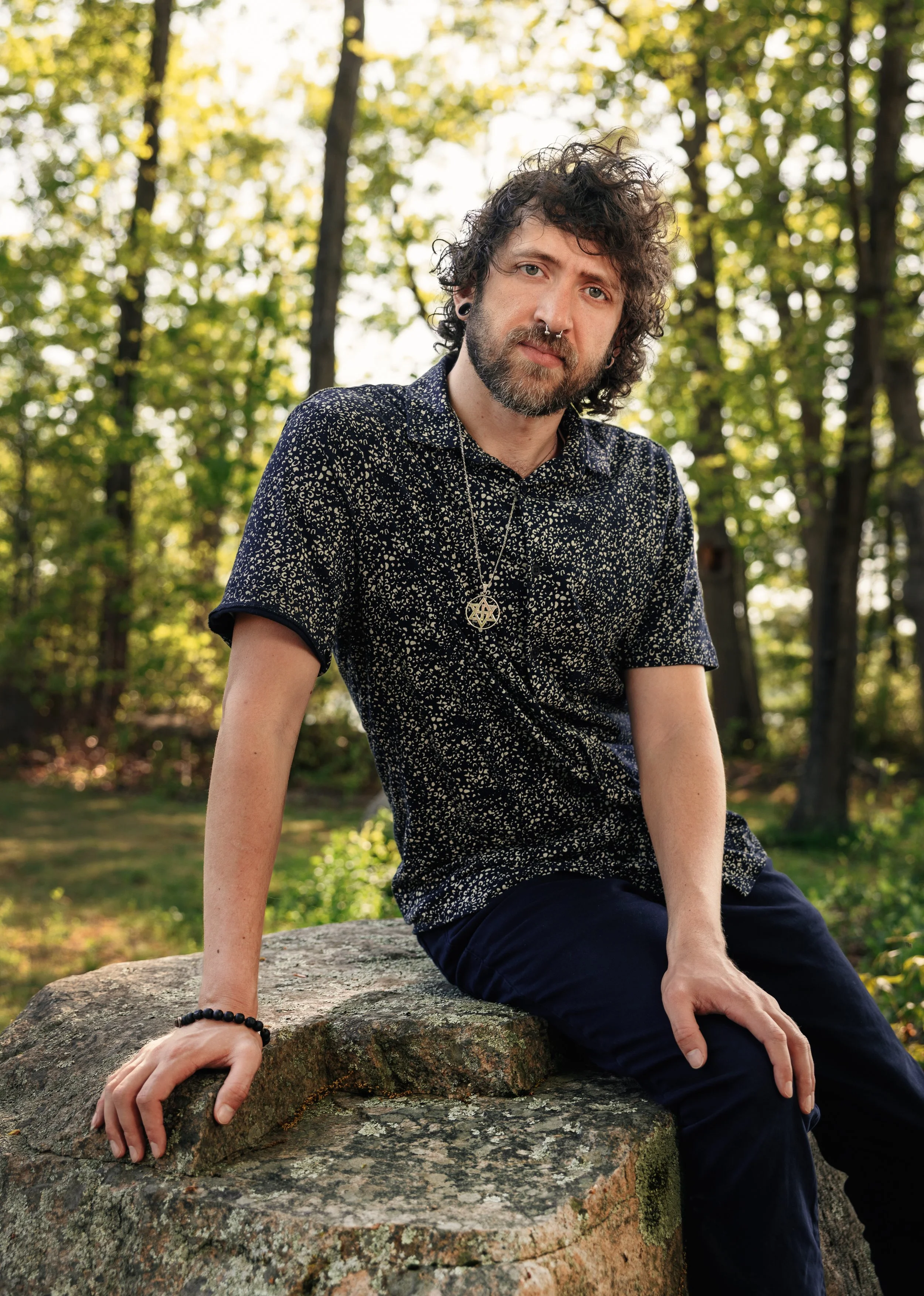
I came home from school and read the book in one sitting, from around three in the afternoon until nine at night. Every page was like, “Oh my gosh, this is it. I already believe this.”
It was a unified explanation of everything, all in one package. That made sense to me.
I wanted to know the truth. I wanted to understand what was out there.
What I liked about the Raelian explanation was that it brought everything together. The different prophets of the various religions, not just Moses, Jesus, and Muhammad, but also the Buddha, Confucius, and Joseph Smith, were all prophets of the extraterrestrials who created life on Earth. We call these extraterrestrials the Elohim.
The heart of our explanation is that there’s nothing supernatural. There’s no God, no soul, no heaven or hell, no ghosts. We try to find a scientific explanation for everything.
I think it’s important to be spiritual. It’s important to feel that there’s something beyond what you grew up with, that the world is bigger than your own immediate surroundings.
-
I want to understand what what you're looking for, so I can, like, answer in a way that's useful.
Sure, I just want to say that you can answer, or not answer in anyway you want.
My interest in this project comes from the fact that I’m not from the U.S. I’m from Sweden. I grew up religious, kind of evangelical, which was very unusual in such a secular country. Then I moved to the U.S. at a young adult.
I’m not particularly religious anymore, but when I came here, I found Americans to be quite religious. There’s the phrase “In God We Trust” on the money, presidents put their hands on the Bible, and religion is very outwardly expressed. I come from a very secular country, where religion is perhaps a much more personal affair.
I also found that people here come from all over the place, but tend to group themselves with others. We’re all Americans, but we have our groups. You might be Irish, you might be Catholic, you might be Jewish. We have our little tribes.
I became very interested in people who stepped outside those tribes and shifted their identities. And it’s not just about identity; it’s also about personal beliefs. That’s what interests me.
It’s a uniquely American thing, and I think it’s wonderful. America was founded on religious freedom.
I didn’t express that very well, but that’s really all it is. I’m just curious. I’ve met a lot of people from different backgrounds and faiths, and I’d love to hear your story.
Where should we start? What do you know about the Raelian movement?
I know about it, and I’ve known about it for some time. I’m interested in your personal perspective, your story, and how you came to the movement.
I was very young, a teenager, when I first heard about it. I was probably 16. I’m 38 now, so in a sense, it’s been part of my life for so long that it’s almost all I’ve known as a mature individual.
When I was around 13, a friend brought a voodoo doll to school. He meant it as a silly joke. You were supposed to poke it to curse someone or something. But it sparked a realization in me: there are other religions. This isn’t just a toy. Someone actually practices this, and it’s part of a religion.
That got me wondering what other religions existed, and it spiraled from there.
Many people in the Abrahamic traditions believe that only their religion can be right and that everyone else must be wrong. That didn’t sit right with me. So I started reading and exploring.
This was in the early or mid-2000s, when the internet was becoming more popular and information was easier to find.
Eventually, I stumbled across a website called BibleUFO.com. I don’t think it’s still around. I looked for it a few years ago, but couldn’t find it.
The website presented the idea that UFOs, or flying saucers, were actually angels sent by God, and that we’d been mistaking them for something else.
But that’s not how I interpreted it. I thought it was the other way around. Maybe I was skimming the website and not fully understanding it, but I thought, no, we’ve mistaken aliens for angels and gods. That was more in line with the Raelian idea.
The website had a disclaimer saying it wasn’t associated with the Raelian movement. It also described the movement as occult and dangerous and said it didn’t support human cloning.
This was around the time the movement was in the news. George Bush was president, and he made a statement about human cloning. The Pope made a statement, too, and there was a lot of condemnation of the idea.
So I looked up the movement and ordered the book. I remember it was a Friday in February. I actually looked at the calendar a few years ago to figure out the date.
I came home from school and read the book in one sitting, from around three in the afternoon until nine at night. Every page was like, “Oh my gosh, this is it. I already believe this.”
I wanted to know the truth. I wanted to understand what was out there.
As I mentioned, I had a problem with the exclusivity of the Abrahamic traditions. I felt that either everything had to be wrong or everything had to be right.
What I liked about the Raelian explanation was that it brought everything together. The different prophets of the various religions, not just Moses, Jesus, and Muhammad, but also the Buddha, Confucius, and Joseph Smith, were all prophets of the extraterrestrials who created life on Earth. We call these extraterrestrials the Elohim.
It was a unified explanation of everything, all in one package. That made sense to me.
I didn’t want to simply say, “You’re wrong, and I’m right.” I thought there might be some truth in everything.
That’s what I appreciated about the movement when I discovered it.
So you were in high school at the time. You read the book in February. At what point did you begin to call yourself a Raelian?
Probably around October. Let’s say it took about six months.
Looking back, it probably shouldn’t have taken that long. I read the book and felt that this was it. I just spent some time reading other things to make sure.
By that point, even before reading the Raelian messages, I had considered myself an atheist.
When I read about Rael, I thought, well, America is very Christian, so maybe he’s the Antichrist. Maybe there is a God. But then I thought, I don’t believe in God anyway, so how could he be the Antichrist? That didn’t make sense to me.
So, yes, I think I considered myself a Raelian after a few months.
However, I didn’t officially join the movement until years later. At the time, I felt awkward about reaching out to someone and having them come to my parents’ house. Maybe it was a crazy cult. I still didn’t know, because I hadn’t spoken to anyone involved.
I’m not sure when I first spoke with a Raelian. I’m sure I communicated with people by email, but it was a while before I officially joined.
What did it look like when you officially joined?
It’s similar to.. we would call it demystified baptism.
The heart of our explanation is that there’s nothing supernatural. There’s no God, no soul, no heaven or hell, no ghosts. We try to find a scientific explanation for everything.
To become a Raelian, you participate in something we call the transmission of your cellular plan. It’s a demystified explanation of baptism.
Within the movement, there are guides, whom you might compare to priests, although it’s not quite the same thing.
If you want to become a Raelian, you go to a guide, who dips their hands in water and places them on your forehead. This takes place on certain days of the year, when the Elohim are ready to receive the signal.
Your DNA, or cellular plan, emits an electromagnetic frequency, like anything else. Water is a good conductor, so it allows the signal to be transmitted more easily.
In this way, the Elohim can recognize that an individual has acknowledged them as their creators.
I think I did that in 2008.
How old were you then?
Twenty.
So you had a few years in between?
Yes. During that time, I spoke with people on the phone and communicated by email. I didn’t have a cell phone. It was a different time.
What was your religious upbringing like?
I wasn’t raised religiously.
I was adopted by my grandparents. My grandmother, who was technically my mother, had been raised Catholic, but by the time I came along, religion wasn’t as important to her.
I’m sure I occasionally went to church on holidays, but that was about it.
If a kid at school asked me what religion I was, I’d say Catholic. That was all I knew.
So when I saw the voodoo doll, I started wondering what else was out there. It was probably also around the time when you begin learning about other religions in school. They don’t teach you about Hinduism in fourth grade, for example.
Are your grandparents still alive?
My mother is, yes.
Did you tell them about your spiritual quest and journey?
Yes. I don’t think my dad cared very much, but I was passionate about it.
I had younger cousins who were going to church and participating in things like First Communion and Confirmation. I didn’t want to participate, and I didn’t want to support it.
We would argue about that.
At the time, I felt strongly that I couldn’t support it. I thought it was a bunch of lies, and the abuses of the Catholic Church were becoming more widely exposed, too.
When you told your family that your beliefs differed from theirs, how did they react?
I think they wanted to support me, but they also wanted me to support my younger cousins. They didn’t want me to be so antagonistic.
I think they also hoped that the Raelian movement wasn’t a crazy cult. They were skeptical, and that was frustrating.
For example, the Raelian movement organizes annual events called Happiness Academies. You practice meditation and participate in different workshops. The goal is to teach people to find happiness internally rather than relying on external factors.
These events last about a week. At the time, they were held in Valcourt, Quebec, at a large campground, and the event lasted two weeks.
During my senior year of high school, I remember registering for the event and receiving all the information in the mail. I really wanted to go, but my mother wouldn’t let me.
I was really disappointed.
It would be years before I finally attended. My mother’s reasoning was that I was too young to drive to another country by myself in their car. I understand that, I guess, but I was really passionate about the movement. I was very committed and driven, and I felt that I had to go.
I resented her a little for a while because I felt she wasn’t letting me grow in the way I wanted to, as quickly as I wanted to.
Eventually, when I was around 20 or 21, I finally went. By then, the event was no longer held in Valcourt. They had started holding it in the United States, and it was only about a week long.
How was it when you finally got to attend the Happiness Academy?
I had understood the philosophy intellectually. I had read the books and practiced meditation at home, but I hadn’t experienced the community.
There wasn’t much of a local community in Syracuse. There might have been one other guy, although I’m not sure whether he lived there at the time or moved there later.
We didn’t have many members.
Even now, there are probably only about 100 active members in the United States. In other countries, the movement is much more prevalent. In Côte d’Ivoire, for example, there are hundreds, perhaps thousands.
Here in the United States, there aren’t that many of us, and we’re spread out across a huge country.
Our goal isn’t necessarily to convert people. It’s to spread the messages and let people know about them.
Nowadays, I’m not sure you need a lot of people. You have the internet and social media. It’s better to have a small, passionate, committed group than a large group of people who are only somewhat interested.
Are you involved in local meetups?
There’s one other Raelian who lives in Boston. But most of our meetings are online, which allows people from across the country to come together.
It’s extraordinary that there are so few of you and spread out over the country yet you’re able to maintain the community.
Yes. As I mentioned, there are guides who have a deep understanding of the philosophy and the messages and who teach other Raelians about meditation and other practices.
I just returned from Las Vegas, where I attended a small guide seminar over a weekend. I think there were about 14 of us.
We’re a close-knit group.
Are you a guide yourself?
Yes.
When you first started reading, you mentioned finding a website that wasn’t affiliated with the movement. In fact, it explicitly stated that it wasn’t affiliated. But then, when you began reading the Raelian material, you said, “I already believe this.” Can you explain what you meant?
When I found the BibleUFO website, I misinterpreted what it was saying.
The website was saying that there is a God and that there are angels. When people see UFOs, those are actually angels sent by God. They’re manifestations of God’s glory.
That went over my head because much of the website discussed passages describing angels as burning wheels, lights descending from the sky, and other things that, to me, sounded like spaceships.
I didn’t understand that the website was saying angels simply looked like UFOs. I interpreted it as evidence of extraterrestrials.
It was an oversight or misinterpretation on my part, but I had already decided that my interpretation was correct.
Even before I became a Raelian or looked into what the disclaimer said, I was thinking, yes, these must be aliens.
I think the idea was becoming more popular around that time, too. A few years later, the television series Ancient Aliens came out on the History Channel. It’s not a new idea.
That’s what I mean when I say I already believed it. I was already suspecting that extraterrestrials might be involved. Reading Rael’s books confirmed that suspicion. I thought, “Oh, wow. Here’s someone who says he met them and had this encounter.”
I ask because many of the people I’ve spoken to grew up in one faith or tradition but never really felt that it belonged to them. Later, they encountered another religion, and their initial experience was something like what you’re describing. They felt that this was what they had always believed, that it fit something already inside them.
That was my experience, too.
We started talking about the first Happiness Academy I attended and why it was life-changing. It felt like coming home because I had read the books and practiced the meditations, but I hadn’t experienced the community.
When you attend and there are hundreds of people meditating together, participating in workshops, and practicing meditations you might never have tried before, you begin to experience the culture of the religion, not just its ideas.
Imagine someone sitting alone in their room, reading the Bible and deciding they’re Christian or Jewish, but never going to a church or synagogue. Five years later, they finally attend a service. Their understanding would be different because they would see the ideas put into practice. They would see how the religion affects people and changes their lives.
I think this is true of many religions and many conversion stories. A lot of people struggle with depression, suicidal thoughts, drug use, or other difficulties before finding a religion.
Many Raelians were in those situations, too. They discovered the books, and Rael teaches that you shouldn’t smoke, use drugs, or drink too much alcohol. Many Raelians quit those habits.
That’s a great thing. It can save your life, not just change it.
You see people whose lives have been transformed, and that’s inspiring. It makes you feel as though you’re coming home. You want more of that experience.
That’s beautiful. Are you open about your affiliation and beliefs with other people?
Yes.
Have you faced prejudice or misconceptions because of it?
Of course. It’s frustrating and disappointing.
Over the decades, there have been many controversies and accusations, and from my experience, those accusations don’t reflect the movement as I know it.
There’s a documentary on Netflix about the movement. I haven’t seen it.
I know the documentary you’re talking about. I haven’t seen it either. I didn’t want to watch it before meeting you because I didn’t want those ideas to influence me.
The documentary interviews Raelians, former Raelians, and people who aren’t Raelians.
There’s one journalist who attended a Happiness Academy in Quebec. She says she was pressured or forced to go naked in a group and describes it as a traumatizing experience.
I don’t want to outright dismiss what she said, but I’ve never seen anyone forced to do that.
We do want to teach people to be proud of and happy with their bodies. This is how we were created, and we should love ourselves. We hold nude workshops, but participating nude is optional. I’ve seen people attend those workshops without ever being nude, and they’re not ostracized.
So it’s difficult for me to reconcile my own experience with someone’s claim that they were forced to participate.
I’ve had friends and acquaintances hear these rumors and make assumptions about the movement. That’s disheartening because I’ve found something beautiful, something I think could help people.
I’m not talking about converting everyone. Rael discusses different ideas for helping society and preparing it for the future.
For example, everyone is worried about AI taking their jobs. Twenty years ago, people were very afraid of human cloning. We still are, and I don’t think it’s legal anywhere to do it.
But Rael teaches us to embrace these technologies and try to use them for good.
If you had a child who died in an accident, wouldn’t it be beautiful if you could bring that child back? What parent wouldn’t want to do that?
And if we could use robotics to perform manual labor, shouldn’t we try to free people from the burden of work?
People are afraid of AI taking their jobs, but in a sense, that’s what we want technology to do: free us from work. The problem is that governments and corporations need to support people who lose their jobs because of technological advances.
That doesn’t mean the technology itself is bad.
I think these ideas are valuable to society. The meditations are valuable, too, and decades of research have demonstrated the benefits of meditation.
I’ve found something really beautiful, but people dismiss it as a cult or assume someone is simply swindling people out of their money. That’s just not what I’ve experienced.
Do you have any advice for someone who is perhaps a teenager, like you were, searching for a faith? Or maybe it isn’t even faith they’re looking for, but meaning or purpose? I’m not necessarily asking about converting to a religion, but about the search itself.
I think the journey, the search itself, is important.
I might criticize other religions. I think monotheism is inherently dangerous because it can be exclusive. But if that’s where you end up, I think what matters is that you’re a kind and compassionate person.
At the root of Christianity, for example, Jesus was a prophet of the Elohim. His teachings about love and forgiveness are beautiful and important, regardless of whatever criticisms you might have of Christianity, or that I might have of it.
As long as you embody those teachings and practice them, I think that’s okay.
Wherever you end up, I think what matters is that you’re kind and have an open heart.
But I do think you should go on the journey. You should search for the truth. I think it’s important to find somewhere to land rather than simply accepting what other people prescribe for you.
You said it’s important to land somewhere. I’ve wondered whether you think it’s better to have a religion than not to have one.
We don’t have to use the word religion. We could talk about spirituality versus no spirituality, or belief versus no belief.
I think there’s a difference between religion and spirituality.
The Raelian philosophy encompasses both. You can practice meditation, for example. We believe the universe is infinite, that there was no Big Bang, and that the universe will never end.
When you meditate and feel at one with the world and the universe around you, you don’t need to be a Raelian to experience that.
At the same time, we are a movement with a goal. We want to build an embassy to welcome the Elohim back openly, publicly, and officially.
To an outsider or a skeptic, that goal might seem as dogmatic as the goals of any other religion. I think that’s where people who are turned off by religion sometimes get caught up: the dogma.
I think it’s important to be spiritual. It’s important to feel that there’s something beyond what you grew up with, that the world is bigger than your own immediate surroundings.
The world is bigger than just “America first.” We’re one species and one civilization.
So I see a difference between spirituality and religion. I think spirituality is important, but you don’t necessarily have to be religious.
Where would you place yourself? Would you consider yourself both spiritual and religious?
As a guide, I represent the movement.
You use the word “movement” rather than faith or religion.
It is a religion because we’re dedicated to the people who created us. Raelians are connected to one another because of that, and I think that’s what makes it a religion.
I suppose there are Raelians who aren’t particularly spiritual, but I consider myself spiritual. I practice meditation, probably for an hour every day.
I try to develop and cultivate myself spiritually on a personal level.
But as I said, our movement is an organization with a goal. We want to make people aware of these messages because we believe this future is inevitable.
Our goal is to build an embassy to welcome the Elohim back. They’re watching us now, and they have a prophet here, Rael. They’ve asked us to build this embassy so they can return.
We’re an organization because we have a goal, and we work toward achieving it.
That might be different from other religions, although I’m not entirely sure. The Catholic Church is an organization, too, and its goal is to bring people into Christianity and encourage them to practice the faith.
But we have a very specific intention and a clear idea of what we’re trying to accomplish. We’re close-knit, too.