
Roy Schoeman / Gloucester, MA
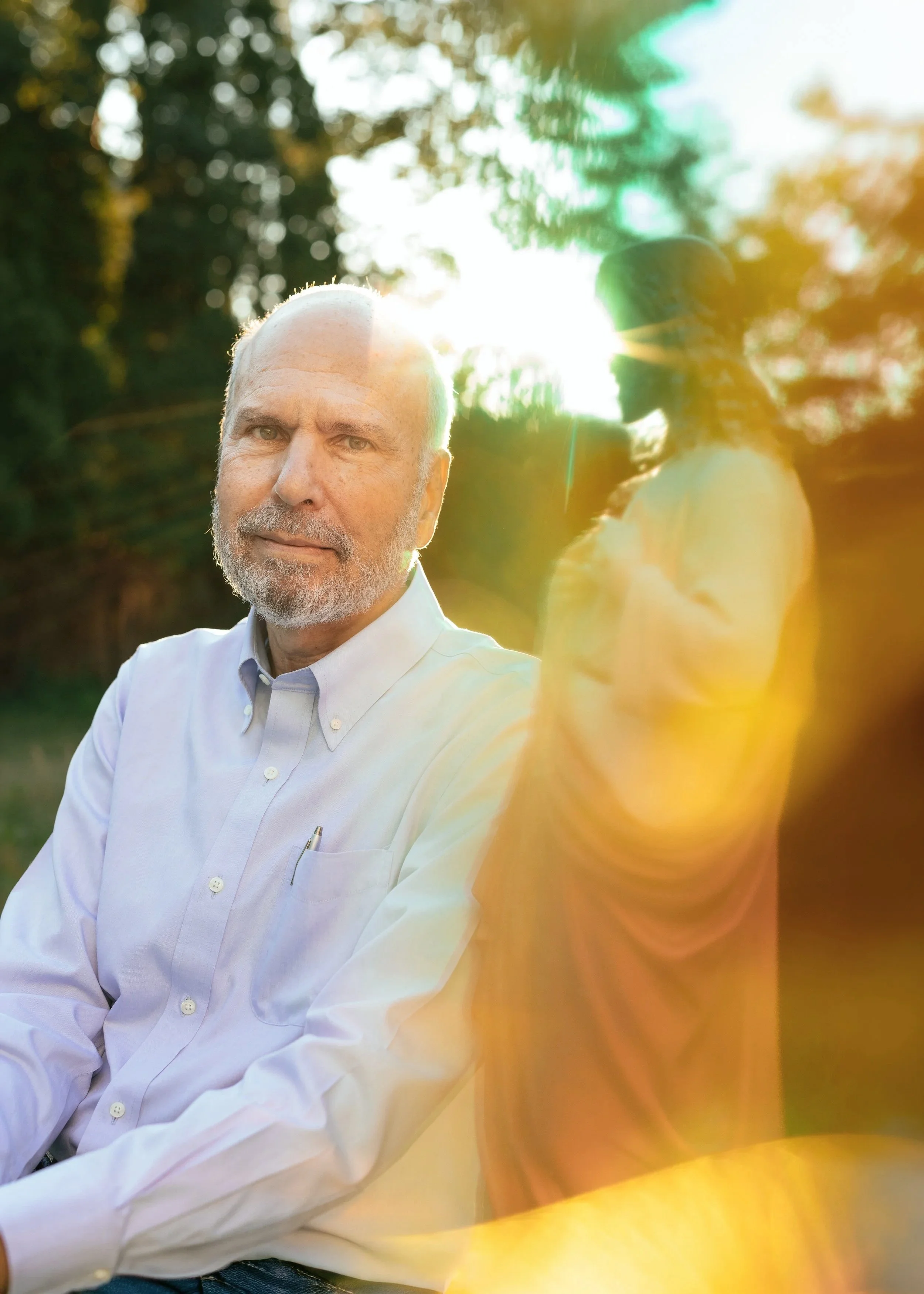
Once I was a professor at Harvard Business School, if that wasn’t enough to give my life meaning, nothing would. There was nothing else I could imagine. So I got really depressed because we’re just a chemical accident, we live for 80 years, and there’s no meaning or purpose to anything. There’s no meaning or purpose to anyone else’s life, either, and I couldn’t even think of a reason to be good. I couldn’t work through why it matters whether one chemical accident is charitable toward another chemical accident, so to speak.
I was in a very dark place, and I was walking in one of the national parks on Cape Cod early one morning when I received a tremendous gift.
From one moment to the next, I had long since stopped believing in God or even praying, but suddenly I found myself very immediately in the presence of God. I was seeing into the spiritual world, but more importantly, I was in a state of extremely intimate communication with God. I couldn’t have a question in my mind without being given the answer.
By the time I left the Carthusian monastery that first time, I understood that the Catholic Church doesn’t actually hate Jews and Judaism. It sees itself as the continuation of Jews and Judaism. That enabled me to embrace the Catholic Church.
-
My parents were both German Jewish Holocaust refugees. They were both from Germany, and my father left just around ’33, after Hitler came to power. I don’t actually know the year anymore, but it was around then, and he was able to leave before it became impossible to leave.
My mother got arrested by the Gestapo, and she ended up escaping from a train on the way to the concentration camps. So she was more messed up by the experience. I mean, they both were, but my father landed in New York with the classic two dollars and fifty cents in his pocket, so it wasn’t a great situation, but it was great compared to my mother’s. They both made it, and they married. They met here and got married, and I was born in 1951.
My parents’ whole world was defined by having escaped the Holocaust, obviously, so I grew up very Jewish. There was a lot of enforced separation. Basically, Englewood, New Jersey, where my parents lived, was the only town in northern New Jersey that allowed Jews to buy a house. I was almost out of high school before the local country club decided to allow Jews to join.
So it was an entirely Jewish world, not entirely out of choice, because of the separation. Of course, my parents also had German accents, and their English took a while to become perfect. It’s not like they weren’t separated in that way, too. I had a German accent, by the way, until probably the end of grammar school. Teachers thought I was from Germany or something because I learned English from my parents.
So anyway, I was very pious. I had a tremendous, visceral hunger for God and love of God from a very early age, from my first memories. Obviously, the only context for that was Judaism, and it never occurred to me to question the fact that Judaism was the real pathway to God.
There was a real connection with God, and I actually remember my first day of Jewish religious education. I was happier than ever because, I don’t know how to put it, I felt like a fish that had found itself in water for the first time.
I was much more God-oriented than my parents and was always leaning on them to be more religious or pray more. Growing up, I wasn’t in a super-religious Jewish home. My parents weren’t strictly kosher; they were semi-kosher. They weren’t strictly Sabbath-observant, not very Sabbath-observant at all, actually. But our lives revolved around Judaism, and I couldn’t get enough of religion.
In my senior year of high school, I fell into the entourage of a Hasidic rabbi. The rabbi I fell into the entourage of was a very early Chabad rabbi. We’re talking about the late ’60s, when Chabad started as an outreach of Lubavitcher Hasidim, an outreach from the heart of the Hasidic community to less religious Jews. I was a prime target, a prime candidate, because I was like a Jewish hippie.
Who was the rabbi?
It was Shlomo Carlbach.
Oh yeah, the singing rabbi!
Yeah, the singing rabbi. So what do you know about Shlomo Carlbach?
I know his music and read about his work with the counter culture in San Francisco.
Yes, he had a house of love and prayer in San Francisco for Jewish hippies. I was entranced by him, and I spent the summer between high school and college in Israel with his traveling community. I don’t know what to call it, but there were a bunch of 15- to 25-year-old Jewish hippie types who followed him around. They attended his prayer meetings and concerts every night and got everyone up to dance for the chorus and stuff like that.
I did that, and I actually thought about not beginning MIT in the fall but staying in that world. But I didn’t. I went back to the United States, and I still hung around him as much as I could, although it wasn’t all that much.
I started MIT and tried to juggle serious Judaism with being a college freshman hippie in the late ’60s and early ‘70s. I had friends at MIT who were seriously Orthodox Jews, but at the same time, the worldview at MIT was that you could choose to believe in religion only at the expense of being rational. In other words, you couldn’t be rational and believe in Judaism. To believe in God, I should say, was a choice to leave reality and believe in God.
You had to suspend science in order to be religious, almost?
Yeah, suspend science, but with the assumption that science represents reality and all of reality. It was unthinkable not to believe in evolution. It was unthinkable to believe in creation. You could probably believe in God if He didn’t have anything to do with the world, or if He was this amorphous life force behind existence or something.
The second leading rabbi I fell under the influence of was, I doubt that you’ve heard of him, Artie Green, or Rabbi Arthur Green. He was a leader of Reconstructionist Judaism in the ’70s.
Yes, he taught Brandeis right?
Yeah, he taught at Brandeis, and then he was recruited to lead a seminary. He was probably simultaneously in two places because he was so high up.
In Philadelphia also?
Oh yeah, that’s right. Are you sure you’re not Jewish? You have a lot of weird knowledge. Anyway, he was a bit of a would-be guru to the Jewish hippies in his entourage. What can I say? He went full New Age theology, although he doesn’t admit it. I have a quote of his on tape where he says the relationship between God and creation isn’t between creator and creation; it’s the relationship between deep structure and surface appearance.
It’s straight from Spinoza. It’s this kind of monism.
Reconstructionism is an attempt to maintain Judaism without a literal belief in God. The founding text of Reconstructionism is Judaism as Civilization, and the point of that book is that we don’t have to believe in God to recognize the incredible value of Judaism to the world. What I knew about his personal life didn’t help either, by the way.
By the time I got out of MIT, I was hypocritically religious. In other words, I still liked prayer, liturgical prayer, synagogue and stuff like that, but I was somewhere between agnostic and atheist. I don’t even know if that’s a meaningful distinction, but I had a completely worldly life. I’m what’s essentially, as the expression goes, a three-day Jew. The Catholic version of that is a cafeteria Catholic.
I worked designing computer systems for a few years and then went on to Harvard Business School. They invited me back to join the faculty, and by then I was completely worldly.
That was the big crisis because, growing up, I knew that there was a meaning to life and that it came from God. I thought that when I got older, I’d come to know God. Then, when I got distracted by all this other stuff, I thought there would be meaning in all that other stuff.
Once I was a professor at Harvard Business School, if that wasn’t enough to give my life meaning, nothing would. There was nothing else I could imagine. So I got really depressed because we’re just a chemical accident, we live for 80 years, and there’s no meaning or purpose to anything. There’s no meaning or purpose to anyone else’s life, either, and I couldn’t even think of a reason to be good. I couldn’t work through why it matters whether one chemical accident is charitable toward another chemical accident, so to speak.
I was in a very dark place, and I was walking in one of the national parks on Cape Cod early one morning when I received a tremendous gift.
From one moment to the next, I had long since stopped believing in God or even praying, but suddenly I found myself very immediately in the presence of God. I was seeing into the spiritual world, but more importantly, I was in a state of extremely intimate communication with God. I couldn’t have a question in my mind without being given the answer.
The biggest part of the experience, by far, was that there were a number of things going on at once. One was that I was given this tremendous theological vision in which I saw that we live forever. I saw that every action has a moral purpose. I saw that every time we take advantage of an opportunity to do something of value in the eyes of heaven, we will be rewarded for all eternity. I saw that absolutely everything that had ever happened to me had been perfectly arranged and had come from the hands of an all-knowing, all-loving God.
The biggest part of this experience was coming into a very direct experience of God. Before this experience, even though I’d been a Jew all my life and had been a devout Jew, it had never occurred to me that God knew me personally. That God knew my name. You don’t see that in the Old Testament, by the way.
Then, all of a sudden, I knew. I knew directly from God that not only did He know my name and arrange everything that had ever happened to me, but from the instant of my creation, or I should say existence, He had been obsessed with me, leaning over me and paying attention to me as though I were the only creature He had ever created.
He cared about me in such a deep and emotional way that, in a very real sense, everything that made me happy made Him happy. Everything that made me sad made Him sad. He was just totally obsessed with me, and at the same time, He was the God who had created existence itself.
That absolutely changed everything. I didn’t know who He was. I didn’t know what religion to follow, but I knew that every moment of my life had an infinite depth of meaning because it offered the opportunity to do something of value in the eyes of heaven.
I’m careful about using the word heaven because I’d had this experience of a personal God, but my mental framework didn’t encompass a personal God, so there was a little juggling there.
I knew that every moment offered the opportunity to do something of value in the eyes of heaven, for which I would be rewarded for all eternity and which God would care about. So I knew that the meaning or purpose of my life was to worship and serve my Lord, Master, and God, who was revealing Himself to me.
I didn’t know what His name was or what religion to follow, but I knew I wanted to. So I prayed. I was still walking, fully conscious and aware of the world around me, even though I could see through it into the spiritual world.
I prayed, “Let me know Your name so I know what religion to follow, to worship and serve You properly. I don’t mind if You’re Buddha and I have to become Buddhist. I don’t mind if You’re Krishna and I have to become Hindu. I don’t mind if You’re Apollo and I have to become a Roman pagan, as long as You’re not Christ and I have to become Christian.”
He respected that. He didn’t tell me His name.
Everything changed because I understood. Have you ever seen a Woody Allen movie? I was this totally anxiety-ridden, despairing, dark, Woody Allen-type Jewish man, a New York Jew. From one moment to the next, I realized there’s never any reason to be anxious about anything. We’re loved more than we could ever hope, and absolutely everything is being controlled for our total benefit by the creator of the universe.
I was just walking on air, and everything changed. I lost all interest in teaching Harvard MBAs how to make more money. I was a marketing professor, and all I wanted to do was find out who this God was and what religion to follow. Essentially, I was very greedy about it: I wanted to gain as much merit for all eternity as possible.
I lived in Harvard Square, and I went back. My career at Harvard Business School dried up because eventually they noticed I had no interest. Obviously, anyone I told about my experience thought I was nuts, but the people I didn’t tell could still tell that my heart wasn’t in it. I was only there for another two years, maybe.
I was spending all my time trying to find out more about who this God was and what religion to follow.
It had been a mystical experience. I’d never heard of a mystical experience. I didn’t know miracles still existed. I didn’t think there had been any miracles since the times of the Old Testament.
I was still Jewish, but this was a mystical experience, so I found a mystic to talk to. He was involved in a kind of Hindu-based meditation group, and he seemed familiar with the world I was describing. I thought he was a great expert because he was actually the first person I met who had a context for what had happened to me.
So I joined his Hindu meditation group. I basically spent a year reading things from New Age bookstores and following his meditation practices and stuff like that.
Throughout that year, I also prayed before going to bed every night. I prayed to know the name of my Lord, God, and Master who had revealed Himself to me that day.
A year after that first experience, I went to sleep and thought I was woken by a hand on my shoulder and led to a room, where I was left alone with the most beautiful young woman I could imagine. I knew without being told that she was the Blessed Virgin Mary.
When I found myself in her presence, all I wanted to do was fall to my knees and somehow honor her appropriately. I was just overwhelmed. The first thing she said to me was that she offered to answer any questions I might have for her.
I asked her about five or six or seven questions, which she answered. I also experienced her love, her beauty, and her exaltedness very profoundly. I don’t know the right word for it: exaltedness, glory, magnificence, something like that.
The experience lasted maybe an hour, and then I went back to sleep.
My body was asleep in bed during this time. I thought I was awake, and my memory is as though I was awake, but I know now that I was asleep.
When I woke up the next morning, I knew it had been Christ in the first experience, and I knew who the Blessed Virgin Mary was. I wasn’t anti-Christian anymore. I was still really anti-Catholic, but I knew who the Blessed Virgin Mary was. I was totally in love with her and couldn’t really stay anti-Catholic for too long at that point.
After that experience, I spent a lot of time visiting a Marian shrine in Ipswich, Massachusetts. It was about a 40 minute drive from Cambridge so I would I would go up there four or five times a week just to walk the grounds and like feel her presence. They also had a big sign on the parking lot telling the story of La Salette. I had a tremendous Marian devotion, even though I still had very mixed feelings about the Catholic Church. I had very hostile feelings about the Catholic Church and, in some sense, Catholicism.
That winter, I continued a practice that had become my substitute for the meaning of life for close to 10 years: downhill skiing. I would spend probably about eight weeks every winter skiing in the Alps. The following winter, after that experience with Mary, I was back skiing in the Alps, but it was raining for a couple of days, so I decided to go to the real La Salette, which I’d learned about from Ipswich.
I went to the actual site, which is incredibly beautiful, very high up, maybe 11,000 feet. It’s above the tree line, with nothing but snow and cliffs.
Forgive me, but La Salette is an apparition of Mary? The two children who had an experience in France?
Yes, the two kids. It was a one-time thing, in 1842 or 1846 or something like that. There were shepherds way up above the tree line.
I went there, and I had… I’m trying to think of the right way to put this. I was there for about 10 days because I was stuck up there by a blizzard. I couldn’t get off the mountain because the road was closed and I had… I don’t want to say it was continual, but Mary was working on me continually up there. That’s the best way to put it.
I was sleeping a lot. I was having a lot of dreams of Mary. Much of the time, I was in this in-between state of consciousness.
A lot of work was done on me. By the time that experience was over and I made it back to Geneva to fly home, I was pretty changed. I was pretty… I don’t know. I was further along, is the best way to put it.
I was still anti-Catholic, but while I was there, an elderly French woman suggested that I check out the Carthusians.
We used to eat together at tables. There were only about 12 or 20 pilgrims there in the winter, and everyone would eat together. I’d talk to her at meals, and she heard a little bit about what was going on with me.
She said it would be a good idea if I checked out the Carthusians.
I thought it would be a good idea to check them out because I’d had this mystical experience. It was obviously about Christ and Mary, but I still had no one I could talk to about it or anyone who could help me understand what had happened.
When I heard about the Carthusians, I thought they must be familiar with this kind of thing. So I arranged to spend some time at a Carthusian monastery.
That’s really where things changed. It’s a long story, but the first time I went for a few days, I went back about four or five times, with progressively longer stays.
By the end of the first day, however, I knew I wanted to be Catholic. I knew that because I was totally in love with Mary, and I experienced how the Blessed Virgin Mary is the animating spirit of the Catholic Church. She’s like the spirit of the Catholic Church, and the Catholic Church is like the institutional structure around the Blessed Virgin Mary, around her spirit, or however you’re going to think of it.
There was so much love in that monastery, which I would never have expected from a bunch of old men who never slept through the night, ate one meal a day, and never talked. There was so much love, and I knew it was the love of the Blessed Virgin Mary flowing through them.
They also had so much reverence for Judaism because, of course, their prayer is all the Psalms. It’s all about Jerusalem, Zion, Jacob, and the sons of Israel.
I’d thought of the Catholic Church as hostile to Jews and Judaism, but in that context, it was totally the opposite.
I tell this in my witness testimonies because it’s a laugh line, but it’s true. I was joining them for matins every night. They break their sleep every night, from about 11 p.m. to 2 a.m., or 1 a.m., depending on the day. They get up and meet in the church and chant Psalms for two or three hours.
The Psalms are all in Latin, and they’re standing most of the time. They’re chanting things like, “O Jerusalem, if I should ever forget you, let my tongue cleave to the roof of my mouth,” and all this stuff.
Most of them were old men, and I’m looking around to my left and right at all these old men spending every night of their lives chanting this stuff. I say to myself, “These guys all want to be Jews.”
You couldn’t escape that.
By the time I left the Carthusian monastery that first time, I understood that the Catholic Church doesn’t actually hate Jews and Judaism. It sees itself as the continuation of Jews and Judaism. That enabled me to embrace the Catholic Church.
That’s it. Wow. And so how did your parents react?
Their initial reaction was pointedly unenthusiastic, but they saw that I was a much nicer, more loving person, much less hair-trigger, much less likely to get angry.
I didn’t tell them at first because I wanted them to see the change in me before I told them. So I actually waited a couple of years.
When I told them, they’d already seen the change in me, and they had acknowledged it, at least my mother had. But they were still very upset.
Over time, though, our relationship grew closer than it had ever been because, for the first time, I didn’t go ballistic every time they pushed a button.
It was a sore point for my father. He didn’t want to be reminded of it, but he still became warmer than he had ever been.
Then it had a very happy ending. I took care of them at the end of their lives. I had them in assisted living, but I was essentially taking care of them.
My father, a few weeks before he died, was in rehab after breaking his hip. Things weren’t going well. I visited him, and he was sitting up in bed. His eyes were gleaming, and he said to me, “You know, last night, after it was dark and everyone had left and all the commotion was over, Jesus appeared to me. Interesting, don’t you think?”
That’s all he said. It’s all he ever said about it: “Interesting, don’t you think?”
I still wear a crucifix. I didn’t want to offend you, so I’m not wearing it now. But one day I forgot to wear it, and he said, “Where’s that thing you usually wear around your neck? You really ought to wear it.”
I was able to baptize him before he died.
My mother had a similar experience. After my father died, my mother broke her hip. She was lying on her back in a hospice bed, largely immobile. I was visiting her every day. One day, I finally decided that I’d tell her my witness testimony. I thought, “She’s safe. She can’t do anything.”
You hadn’t told her up to that point?
I had not told her, although I’d been on EWTN a couple of times.
One time, when I was going to be on EWTN, I shyly told my mother, “You know, Mom, you’re probably not going to want to watch it, but I just want to tell you I’m going to be on TV.”
This was back in the days when there was still TV and not the internet. It was a big thing to be on TV. It’s not like everyone with a webcam could be on TV.
I said, “You probably aren’t going to want to watch it, but Monday night I’m going to be on EWTN.”
She said, “Why wouldn’t I want to watch it? It’s not every mother who can see her son on TV.”
She must have seen something because I think I told my witness testimony on that program.
Anyway, I told her my witness testimony. The next morning, when I visited her, she had this huge conversion. Her heart was totally open to God, and she thanked me profusely.
She had lost… It’s like when I felt I didn’t have permission to believe in God because of MIT, she felt she didn’t have permission to believe in God because of the Holocaust.
It wasn’t that she didn’t really believe in God. It was that she couldn’t allow herself to believe in God. But she said all her childhood faith in God had come back.
After that, she couldn’t get enough prayer. My wife and I would visit her every day, pray the Divine Mercy Chaplet, pray the Rosary, and stuff like that.
As she got weaker, she would move her lips to the Rosary. She didn’t have much of a voice for anything.
When I brought a priest to visit her, she would clasp his hand with both hands and not let him go. She’d look at him adoringly.
I baptized her because I thought she was about to die at one point. But then she got stronger, so I had my priest come and confirm her, give her the last rites, and everything. She was buried with a Catholic funeral.
So anyway, it had a very happy ending. The whole story of my parents had a very happy ending.
Yeah, that’s great.
If you believe in this stuff, it was happy.
Yeah, of course. But it was at least happy for them.
Yeah, absolutely.
Now, since you had such a strong connection to religion as a child, up until MIT, and then you had the experience on the beach, you described how you were searching. Why not just go back to the religion you had?
I knew in that experience. Remember I said, “What’s your name? I don’t mind if You’re so-and-so…” and so on.
But you knew it was God?
I knew it was God. I knew it was not the God represented in the Old Testament.
I just don’t know how… I’m shy about getting too theological, but the relationship between God and man in the Old Testament is not the relationship that was established through the coming of Christ.
In other words, when you literally read the Old Testament, God does not speak to people. He didn’t even speak to King David. King David asked the prophet Nathan, “What did I do wrong? God’s obviously mad at me. Tell me what’s going on between me and God.”
God only spoke directly to the patriarchs and spoke through the prophets, but He did not speak to ordinary people. Never.
When Moses went up Mount Sinai to receive the Torah and the Ten Commandments, God commanded Moses to build a fence around the base of the mountain to prevent anyone from approaching while God was on top. If they did, they’d have to be killed instantly because of the sacrilege.
That was the relationship between God and man. It was so different from the relationship between God and man that was being revealed to me that, whatever this was, it belonged to a religion other than that of the Old Testament.
I now know, of course, that it was the God of the Old Testament. But if you stop to think about it, the whole story of Christianity, the whole story of Jesus, is that God was God and man was a creature, essentially a created thing.
When Jesus was conceived in the womb of the Virgin Mary, He had a human nature that came from Mary, and He brought His divine nature with Him.
This is straight Catholic theology: Jesus had two natures, a divine nature and a human nature, in one person.
Then, when He reunited with the Most Holy Trinity at the Ascension, that human nature, which had mingled with Jesus’ divine nature, flowed into the rest of the Most Holy Trinity. So human nature and divine nature are now intermingled in a way they weren’t before the Incarnation and the Ascension.
It’s not that the God of the Old Testament was a different God. It’s that the entire relationship between God and man was transformed.