
Starr RavenHawk / New York, NY
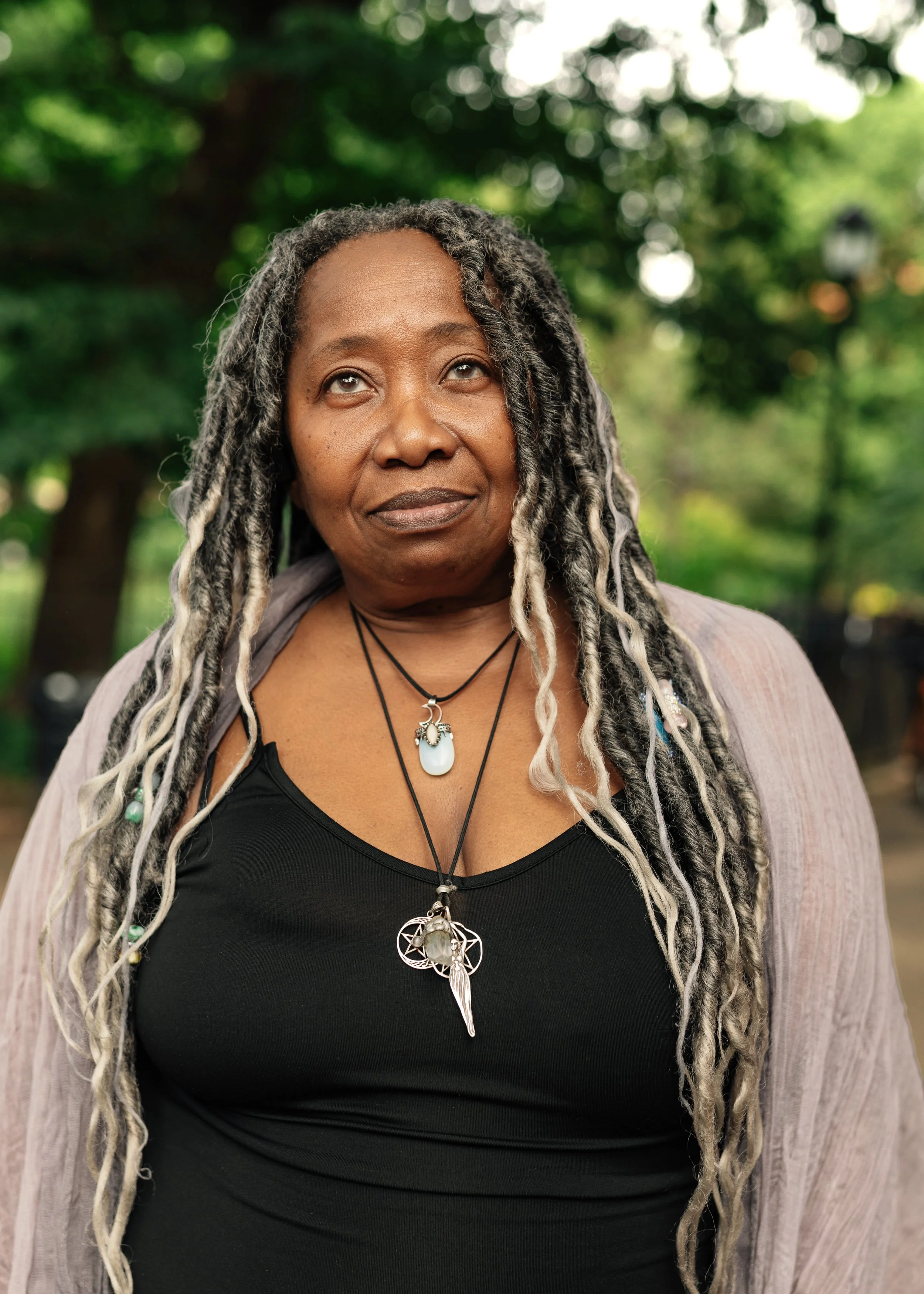
I grew up Catholic. And my mom went from Catholicism to Christianity, which people don’t realize is very different. But I grew up as a Catholic, and I used to question things too much. They didn’t like it. I think I was about eight or something like that. And I said, “Why are we asked to read this prayer book when we have the Bible?” And I forgot what else I asked her, and then she smacked me. And my mom got really upset at her. “You don’t get to hit my kid because she asked you a question.” My mom almost smacked her. So she left the Catholic Church, and she joined the Christian churches. And of course, if she goes, we go.
I think when I was about 18, I came across a book that Selena Fox wrote. And I forgot what it’s called. And it’s so funny, I know her now. She’s a friend of mine. And I just found it so interesting. So, I went into research mode to find out about it, and I fell in love with it.
I’m not a Wiccan. I’ve always been a witch. Because at least not the way they know it, you know. Or I could say I’m a witche. It just means I’m a female witch. But if I said that, people wouldn’t know what I mean, so I just don’t say it.
And what did you find in being a witch that you did not find in the religion growing up?
I like the fact that I started thinking outside of the box. People can say it’s a spirituality, but it’s a religion. Once you start working with divinity and worshipping, it’s a religion. So, with my research and the fact that when you start really investigating, it gave me this carte blanche to see things from many different facets and to question more, because I used to question anyways.
I didn’t go through this grand transition, and it wasn’t a change in religion. It was more an awareness of other things. And I think that was because when I was younger, I was not aware of it in that sense. When I saw Selena Fox’s book in a library in Toronto, I was like, “This is me. This is fascinating.” And then to know that years later, she and I are friends, and she’s invited me to her gatherings, and I presented at her gatherings and things like that.
-
I would love to hear about your journey, your spiritual and religious journey. How did you grow up, and how did you come in touch with the faith that you practice now?
It’s a funny thing because I grew up Catholic, and my mom then went from Catholicism to Christianity, which people don’t realize is very different. But I grew up as a Catholic, and I used to question things too much. So they didn’t like it.
One of the nuns, I believe, is the one who slapped me when I asked a question. You know how Catholics have a prayer book, right? I don’t know if they still have that. So I asked, if there’s a Bible, what’s with the prayer book? I think I was about eight or something like that.
I said, “Why are we asked to read this prayer book when we have the Bible?” And I forgot what else I asked her, and then she smacked me. My mom got really upset with her. “You don’t get to hit my kid because she asked you a question.” My mom almost smacked her.
So she left the Catholic Church and joined the Christian churches. And of course, if she goes, we go.
But I’m, I don’t know. I think when I was about 17 or 18, I came across a book that Selena Fox wrote. I forgot what it’s called. And it’s so funny, I know her now. She’s a friend of mine. I went from reading a book of hers years ago to knowing her now.
I just found it so interesting. I’m like, this is something that I would like to find out about and research. I went into research mode because, as a university student, everything I did, I researched before I did it.
So I went into research mode, finding out about it, and I’m like, how could I never have heard of these things? How come it was always the big religions? I had never heard of this. And I fell in love with it from then on.
I used to go to Gold’s Gym and train for bodybuilding. At first, I just wanted to train, and I met Lou Ferrigno and a few others. I didn’t know who he was. I didn’t know he was the Incredible Hulk from the movies and stuff.
He helped train me, and he was also interested in certain things. He has a speech impediment, but I didn’t really think anything about it. I just used to talk to him, and he asked me about things on my necklace and everything, and he started talking.
He would train me, and at the same time, we’d be at the gym talking about religion. At the time, we were just talking about witches and the different things they had. We never heard of Wicca until the ’80s.
The word Wicca itself didn’t come about until the ‘80s with Scott Cunningham’s book, The Solitary Wicca. Until then, I was like, what is this Wicca that they’re all talking about?
The word wicca with an A meant a male witch. The word wicce, with an E at the end, is a female witch. And the word Wiccan, that’s they’re calling it now, just means more than one male witch. But Americans don’t know that.
They all think of it as this whole new modern religion from the ‘80s, but they also think it’s ancient. I’m like, no, this is from the ’80s, when Scott Cunningham wrote that book. Before that, everybody was a witch.
So I find it puzzling, but whatever.
When we named ourselves the New York City Wiccan Family Temple, we were thinking of more than one witch. People would say, “Well, you guys are Wiccans.” And we’re like, “Not the way you mean it. You mean a witch, right? More than one witch?”
And they’re like, “What do you mean?”
I said, “That’s what the word means.” So they’re calling themselves Wiccans, and they don’t realize that all it means is more than one witch.
It’s just a plural version of a male witch, basically. A male witch, because if it’s a female witch, it’s with an E, not an A. And having to explain that to people, I stopped explaining it. I just said they need to start doing their own research. They can’t be that stupid all the time, not knowing or being illiterate.
To me, they’re illiterate when it comes to the word witchcraft and the word witch. Americans are very illiterate with a lot of things. I’m sorry, but they are.
They don’t research. They just follow what someone tells them, and they don’t tend to question or investigate it. When I meet adults who do that, I just walk away. I can’t. I’m not here to teach them that. They need to do that research themselves.
So, by the time you moved to New York City, you identified as a..
As a witch. Not a Wiccan. I was never Wiccan. I’ve always been a witch, at least not the way they know it. Or I could say I’m a wicce, meaning a female witch. But if I said that, they wouldn’t know what I mean, so I just don’t say it.
It’s kind of like if you say something in Swedish, and you say, “I am this” in Swedish, I would not know what it is, and they would not know unless they spoke the language. They should know what it means, but when they don’t, I don’t bother.
And what did you find in being a witch that you did not find in the religion you grew up with?
I like the fact that it made me think outside of the box. It’s not someone telling you what religion is supposed to be all about. Because no matter what we say, it’s a religion. People can say it’s a spirituality, but it’s a religion. Once you start working with divinity and worshipping or doing different things, it’s a religion.
With my research, and the fact that when you start really investigating it, it gave me this carte blanche to see things from many different facets and to question more, because I used to question things anyway.
And the fact that it recognizes the goddess for what she is, and not just the god. They always thought there was only the patriarchal one, the god. I like the fact that, no matter what anybody says, I’m not negating the god, because the world and everything that procreates involves male and female. So, no matter what we say, unless it’s an asexual being, to procreate, it’s male and female.
I’m not going to be like some people who say that they’re witches but only worship the goddess and not the god. I can’t have that imbalance. For me, it’s an imbalance. It’s a representation of both.
Is that a dualism, or is it the same divinity?
No. To me, it’s not the same. That’s like a witch adopting the concept of the Christian world, saying God the Father, God the Son, and God the Holy Spirit. But they’re saying it’s one being. I’m not going to think in that way.
Every god and goddess around the world, that’s why there are millions of them, because different parts of the world have their own gods and goddesses that represent love, money, and all different things. Every culture has them.
That’s like saying you and I are one being, but you’re a female and I’m a male. It doesn’t make sense, because you’re your own individual being, and I’m my own individual being. So I think we negate that factor, or thought pattern, when we do that to divinity.
We do that to the gods and goddesses and say they’re one. We’re taking the Christian concept and applying it to witchcraft, which it’s not.
They are all individuals, and you have to think of it like that, or at least that’s my perspective. That’s how I teach it, because I want people to question what I’m saying. Even at the school, I have them question what I’m saying.
Tell me if you don’t agree with it. Prove it. Do your own research as to why you think differently. And if that’s your belief, then you hold on to that. Don’t take my belief as your own. That’s my belief because, to me, it’s logical.
It’s kind of like taking a plant and saying oregano and dittany are the same thing when they’re not. They look alike, but they’re two different plants altogether. People have literally done that and thought, “We’ll sell you oregano,” saying it’s dittany. And it’s not.
To me, you can’t negate one thing and then say it’s another. You shouldn’t, rather.
How did your family and friends back in Toronto react when you started identifying as a witch?
My mom, at first, thought it was devil worship. She said, “That’s got to be devil worship.”
I said, “Actually, Mom, the devil is a Christian thing, or a non-pagan thing. In paganism, there’s no devil. We don’t believe in it, so we’re not giving it power. The reason the devil has got so much power is because the Christians and other religions give it all that power. You guys believe in it so much. So hold on to your devil, because that’s not our thing.”
She was highly upset. And I said, “It’s your thing. You guys created that being. We didn’t. It’s not part of our religion, so you can’t make it something that we’re not.”
My friends, I’m not, I was always like this. I don’t know why I was always like this, but my attitude has always been, and I’ve gotten worse as I’ve gotten older, if you don’t like it, too bad. Either you accept me or you don’t. And if you don’t like it, que sera, sera. You don’t have to be my friend.
And that included my family members. I didn’t care. I was always me. I never hid it.
When people said they came out of the closet, I understood their circumstances because I have friends who are schoolteachers, lawyers, and judges who are witches, and they can’t come out. So I understand, because of their jobs and their livelihoods. I never had that problem because I did real estate. I could do whatever I wanted, within reason.
Once I knew that’s what I was, I haven’t stopped since then. I’m 66 now, and I still haven’t stopped. And my mom is still waiting to have me convert.
I’m like, “Mom, I’ve been at this longer than you’ve been coming at me, and it hasn’t changed. I’m not going to change.”
So I didn’t go through this grand transition. It wasn’t a change in religion. It was more an awareness of other things. I think that was because, when I was younger, I wasn’t aware of it in that sense.
I saw her book in a library in Toronto. I read it, and I was like, “This is me. This is fascinating.”
And then to know that years later, she and I are friends, and she’s invited me to her gatherings, and I’ve presented at her gatherings and things like that. It’s just amazing.
How old were you when you read Selena Fox’s book?
I was probably going on 18. I was constantly in the library, and everything I did was based on whatever research I was doing on one particular topic. And now I was just like, there’s such a thing as witches.
It was a simple book. It was a groundbreaking book, very influential. I was just like, this is really fascinating. In a way, she played a big part in who I am.
Some people I’ve spoken to describe finding a faith as finding something they knew all along, and then having it reaffirmed. Does that resonate with your experience?
I believe them when they say that, but I don’t know if they mean it truly in that sense. There’s a process, right?
When I saw it, I was like, they’re describing the things I like and the things I see in myself and it was awakening my mind to different concepts and different things.
But I’m a logical person. Everything I do has to be logical. If it’s not logical, I can’t accept it.
In my head, the goddess deserves as much recognition as the god. And then, when you research how, for so many centuries, they desecrated all the goddess sculptures and everything around different countries, they defiled them. It was almost as if they were putting down women. They didn’t want to have a goddess. They wanted only a god to dominate.
And we’re watching that happen now. You’re watching women help that situation along now. At least centuries ago, women were still trying to stand up for themselves. Women today are actually negating that.
Oh my God, I can’t even. When I heard on TikTok some women saying that women’s rights should be taken away because of all the mess that’s going on, I’m sitting there going, am I really hearing this? What era are we in? What century are we in?
I don’t even think they realize the repercussions. I don’t think they realize the damage that could be done.
I have to walk away from people like that. I can’t argue with stupidity. Honestly, I have to walk away from it because that’s a lost fight. I’m not here to fight losing battles. I’m not.
If that’s a rabbit hole they want to go down, let them do that. They’ll learn. Although, I hate to say it, we’re all going to pay the repercussions. But what are we going to do? There’s nothing we can do about it if their beliefs are like that.
Where is your family from?
Trinidad.
Were there any native faith traditions in Trinidad?
Christianity, but yes, they have Obeah. It’s a religion.But it was banned. Or what’s the word? It was outlawed.
Christianity took over. That’s what I don’t like about Christianity. It’s like a ball. It goes in, absorbs things, and takes over. It tells you those things are bad, even though they were your religion. Your belief is bad, and this is better.
Did you look into Obeah? Was that something you were interested in?
It’s part of my practices over here. I don’t teach it because it’s a Caribbean thing. It’s in my blood, right? And it’s not something that I teach.
I think when people hear Wiccan, they think of European, pre-Christian, medieval spirituality.
And it’s not. It is, but not in the way people think.
Tell me more about that.
Until Scott Cunningham created the construct of Wicca, it did not exist in the way it exists right now. That was in 1988. It did not exist in that form.
Even Tolkien, what’s his name? He wrote about it and called it a witch, as in the Anglo-Saxon etymology of the word and what it means, the female witch and the male witch. He knew it as that, too, because he did his research.
So someone who’s not even pagan researched it and came up with the same information I did. And yet you have modern-day witches saying “Wiccan.” I’m sorry, you’re the one who chose to dumb yourself down and not educate yourself on what the words really mean.
Scott Cunningham, I think he did such a disservice to the religion by allowing it to be created that way. He created that construct, and people followed it blindly. I’m not that person. I don’t follow anything blindly. I research it before I step into it, and that’s what I did with this.
Could you define and explain the religion?
I don’t think it’s that confusing or wordy. To me, my practice, whatever I call it, is a very personal thing, and it’s personal to everybody.
I may teach you these things, but when you go home and practice privately, you bring in a lot of your culture and other things that you add to your witchcraft. It’s a very personal thing for each person.
I think witchcraft is a very individual religion in that way, whether you practice solitarily or not. I think we’re all solitaries, no matter what, at least the ones I know, because we’re supposed to be able to think as individuals. That’s what witchcraft gives you.
That’s why I’m personally against covens and things like that. They don’t think individually. They think like a group, and they don’t know how to be individuals.
Scott Cunningham was following what the Gardnerians or the Alexandrians did. He created his own construct, and when they have their covens and the Gardnerian stuff, they act as if they’re bound by those rules. “I can only do this.” They’re not thinking as individuals.
To me, covens have become small churches of Christianity in my head. They have the witchcraft part that they practice, with initiations and things.
Witches originally didn’t have initiations. They didn’t know each other that much. They were far apart. How were they doing initiations? There’s no such thing.
I mean, that was the Masonic thing. The Masons did that because they did things as a group. That wasn’t part of the tradition.
Skyclad, initiations, and all those things were introduced by people like the Gardnerians. Gerald Gardner and Alexander were into the BDSM lifestyle. They were nudists and other things, and they brought that into their form of witchcraft. Now, all of a sudden, skyclad is what’s normal.
But that’s what they wanted to bring in. Think about it. It became cold in the winter. You think a witch was out there skyclad? Come on. Think about it.
People don’t think. Just step outside that mindset for a minute. Their homes weren’t full of electricity and warmth like we have now. Their homes had breezes coming through and everything. They would be covered in furs and stuff.
So what are you talking about, skyclad and all these things, and saying they’re part of witchcraft? I’m sitting there going, no, you made that up and brought it forward, saying it’s ancient.
To me, that’s why I’m a throwback, an ancient witch. That’s what I call myself. I’m not part of modern witchcraft. I’m not modern. I’m not part of modern Wicca. I’m not going to claim any of those things.
So, witchcraft?
Yes. Witchcraft.
Or just being witches?
The witchcraft itself is when you do the spellwork and everything else. It’s the practice.
Right, the practice itself.
Yes. It is ingrained in the cycles of the seasons of the planet, and everything is part of it, symbiotic.
People say, “Well, I’m vegan because I’m honoring the planet. I’m honoring it by not eating meat.” And I’m like, we are carnivores. We are omnivores for a reason. Our teeth are meant for meat and other things.
We’re depriving the body of its natural protein, which is what it’s meant to get. That’s what it was created for, to feed us and give us life.
Raw vegetables and plants are healthier when we eat them raw than when we cook them. That’s what they’re for. That’s what makes us healthy in the body.
If you want to say the gods provided us with everything, it’s up to us to use our own minds and handle it. If you’re not eating meat, then you’re not eating enough protein, and you become deficient and get sick. Sorry, you’re not making sense. It’s not logical.
When you use the word witch, is that gender-neutral?
Technically, it’s gender-neutral. A witch could be male or female or whatever gender.
But they must have had a reason why the original words had an E at the end and an A at the end, male and female. I don’t know. It’s Latin, later etymology.
But that’s the thing about the word witch. People think a witch is only European. Again, does that make any logical sense? Why are there witch doctors in tribes around the world? Why are there witches in Obeah, in Voodoo, and in other traditions?
Yet people say it’s a European thing. Does that make any bloody sense? It has to be logical.
That’s what I was asking earlier. It’s not logical. These people were calling themselves this at that time, but they didn’t even know about each other around the world. So what they say isn’t logical.
I’m using history to define what I’m describing. If you’re going to use the word, at least know where it came from. It cannot possibly be exclusively European when another part of the world uses it, too. If anything, you could argue that Europeans took the word from witch doctors and other people around the world, not the other way around.
When people have beliefs or reasons for doing things that you consider illogical, how do you approach that?
When people say things that are logical or illogical, and they have their reasoning for whatever they believe, I say, okay, that’s your belief. I’m not going to change. I’m not here to change your mind.
The only thing I suggest is that they start doing their own research. Actually research what they’re saying before they say it. Otherwise, they just make themselves sound stupid.
Something I like to ask people is this: Having lived in New York for so long, you see that people don’t necessarily talk about spiritual things. People don’t go to church, or they’re not religious. But when you start scratching beneath the surface, you find something. Do you think having a spiritual practice or belief is better than not having one?
I can’t say, because everybody is different. People accept or don’t accept things based on their childhood, how they were raised, what was done to them, or what they were exposed to.
They’re products of their upbringing and of the people who played pivotal roles in their lives. That shapes how they think about things. So I don’t know if it’s right for everyone, because some people can become fanatical about it, just as they become fanatical about Christianity and other things.
They’re very opinionated, as if they know for sure, and yet they haven’t done the research.
When people say Wicca has been around for a long time, I’m sitting here going, okay, no, you know it was only from the ’80s, right? And they get highly upset.
I’m like, okay, I’m not here to be your professor. You need to do your own research.
Unless they come into my school, then we teach them. And I still tell them to go and research it the way I did. That way, they’re not just taking my word for it. They can know the facts for themselves.
I don’t want them to take just my word for it, either. I want them to actually use their brains.
What does your practice look like daily?
I would like to say that every day I say hi to the goddess, but I’m sorry, that would be a lie.
You know, I have so many things going on. Sometimes I go to bed thinking about one thing. This is why I don’t sleep very well. I don’t get much sleep. I survive on maybe two or three hours a night.
I go to bed late because I’m doing all these things, and I wake up with a list in my head of what I want to do.
Even my plant that’s right next to me, I have to remember to always say hi to him because he gets upset. He starts wilting until I say something nice, and then all of a sudden he’s blooming.
I’m like, “You are such a queen.” I tell him that all the time.
You communicate with the plant?
He’s a queen. If I get up and don’t say something to him, when I come back, he’s all drooped down like this. And I’m looking at him, going, are you serious right now?
I don’t know if I communicate with him. I just feel like I know what he’s doing.
If you see this plant all wilted, and you say something nice, “Come on, honey, you know you’re beautiful,” then a few seconds later he’s blooming again. Don’t you think that’s something?
He’s a queen. In the begonias. I’ve had him since 2015, when I was in the hospital. I had bilateral knee surgery at NYU Hospital, and they came around and gave us these plants.
That plant has survived since then. He’s gotten bigger and bigger. It’s such a thing.
He always has to hear that he’s beautiful or something like that, and yet he screams. So, yeah, he acts like a queen.
Tell me more about the community in New York and the temple you’re building.
We don’t have a building. I wish we did. Property is just too expensive.
We’ve been in so many places over the years. We rented from a church. The Archdiocese of New York told us we couldn’t be there anymore, so we had to leave.
At each place, we started out fine, and then they told us we had to leave because we were witches.
Even at the park on Avenue C, we were there for years. Then new people moved into the neighborhood from outside the state, and suddenly they objected to witches being there, even though we were there before them.
That’s why I kind of resent people coming from other states, moving here, and changing things. They love New York, but they want to change it. That’s like an abusive husband or wife situation. You loved her when she was a certain way, and now that you’re married to her, you want to change her. Really?
How does your spiritual practice fit into your daily life?
I would love to say I get up and spiritually do all these things, but I don’t. I just kind of play it by ear as I’m going along. Whether I’m in my car or somewhere else, I’ll say something to the divine or whomever I’m talking to. I’m in the car by myself with my son, and he’ll go, “Mom, who are you talking to?”
I say, “You know who I’m talking to.”